
Japan was not always an island. During the Ice Age it was still tied to the Korean Peninsula by a land bridge, and the main islands themselves were joined: Kyushu in the south reaching the continent, Hokkaido in the north stretching toward Siberia.
Stone Age groups crossed that bridge the same way others later crossed the Bering Strait. Flint tools from around 30,000 BC sit in that older layer — the Paleolithic period of Japan. The Jōmon and Yayoi peoples come later, and they are still the ones who explain how a lasting Japanese society began to form.
Jōmon Period (c. 13,000–300 BC)
Traces of Paleolithic culture, mainly stone tools, occur in Japan from 30,000 BC onwards. The first phase of the Jōmon period began while Japan was still connected to the Asian continent as a narrow peninsula.
The glaciers melted after the end of the glacial period. Sea level rose and cut the Japanese archipelago off from the mainland. Kyushu, about 190 kilometers from the Korean Peninsula, was close enough to pick up continental changes from time to time, and far enough for island communities to grow in their own way.
Vegetation changed with the warmer climate. Beech, chestnut, and oak produced edible nuts and acorns, a dense food store for people and animals. The Jōmon lived in small communities, mostly in pit dwellings near inland rivers or along the coast, by hunting, fishing, and gathering. Archaeologists also see signs of early plant tending toward the end of the period — chestnut groves, beans — without turning the islands into a farming country yet.
The name itself is a clay mark. Jōmon (縄文) means “cord-marked.” In 1877 the American zoologist Edward S. Morse found sherds at the Ōmori shell mound near Tokyo and used that word for the rope patterns pressed into wet clay. Some of the oldest pots, from sites such as Ōdai Yamamoto I in Aomori, reach back to around 14,500 BC. The potter’s wheel was unknown; the usual method was coiling: clay rolled into a rope and spiraled upward. Middle Jōmon flame-style vessels from the mountains are almost baroque. Late Jōmon dogū (土偶), clay figurines with goggle eyes and marked bodies, point to a ritual life that hunting camps rarely leave in writing.
As the climate cooled after about 1500 BC and food became less abundant, the population dropped. People gathered in smaller groups, and regional differences grew. Wet-rice farming, at first on a modest scale in western Kyushu, begins to appear in this late window — the hinge into Yayoi, not a sudden replacement of every hunter overnight.
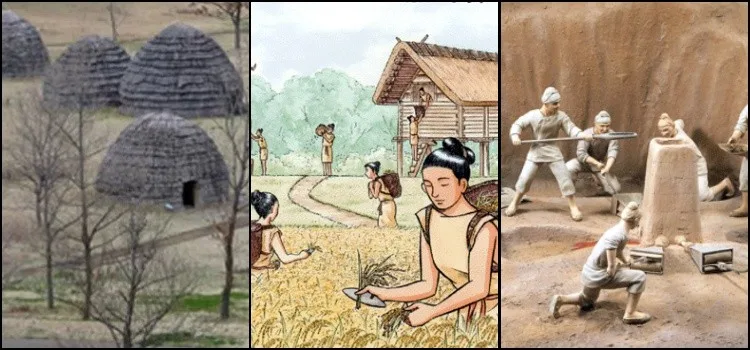
Yayoi Period (c. 300 BC–250 AD)
Schoolbooks still date Yayoi from 300 BC to about 250 AD. That range is the old classroom frame. Radiocarbon work on early paddies in northern Kyushu often pushes the start back to the 10th–8th century BC. The end is clearer: the mid-3rd century, when keyhole tombs announce the Kofun period. The name “Yayoi” is modern archaeology, from a Tokyo district where the pottery was identified in 1884.
Metalworking arrived at the close of Jōmon, but Yayoi communities at first still used stone. Stone blades on hoes and spades gave way to bronze and iron. Irrigation for rice paddies became a village skill. Diet and settlement changed together: people stayed put, grew most of their food, and hunting stopped being the main supply. Pottery was still coiled, then smoothed and fired — yet Yayoi ware is more functional, less porous, and far less decorated than the cord-marked jars of the previous age.
Bronze dōtaku (銅鐸) bells, mirrors, and weapons turn up as ritual and prestige objects, not only as tools. Villages could be moated. Clans formed. Chinese records of Wa describe many small polities, and in the 3rd century they name Queen Himiko (卑弥呼) of Yamatai (邪馬台国), a shaman-ruler whose location — northern Kyushu or the Nara basin — is still argued. That is political Japan taking a first written shape. It is not yet medieval Japan.
The leap from Yayoi clans to daimyō and samurai skips several centuries. Rice and metal made denser populations and sharper status possible. The next archaeological chapter is Kofun, with its mounds and the Yamato court — long before the Heian period or the later shogunate.
| Jōmon | Yayoi | |
|---|---|---|
| Name | Cord-marked pottery (縄文) | Tokyo district, 1884 find |
| Dates (conventional) | c. 13,000–300 BC | c. 300 BC–250 AD |
| Economy | Hunting, fishing, gathering | Wet-rice villages |
| Craft | Ornate coiled pottery, dogū | Plainer pottery, bronze and iron |
| Society | Small riverside and coastal communities | Clans, status, early kingdoms |
A timeline of Japanese eras helps keep the sequence straight: Paleolithic stone, Jōmon cord-mark, Yayoi rice, then Kofun. The two middle periods are still the hinge. One people spent millennia with clay rope and chestnut. The next planted paddies and cast bronze. Japanese society as a farming, ranked, metal-using country starts there — not with a shogun, and not in a single century.





Community
Comments
0 comments
There are no published comments in this language yet.
Send comment