

The Paleolithic period of Japan is where the human story on these islands actually starts — not with emperors, and not even with the cord-marked pots that made the Jōmon famous. For a long time that sounded simple. Then the dates kept moving.
The first people to stay here left almost no graves. Volcanic soil eats bone. Archaeologists have had to read the islands from stone blades, a nationwide layer of volcanic ash, and a few skeletons that limestone happened to save. The 50,000 BC still printed in some older summaries is not the date most specialists will defend.
Contents 5
How old is the Japanese Paleolithic?
The Japanese Paleolithic period (旧石器時代, kyūsekki jidai) is the time of human habitation before pottery. The widely accepted range now runs from about 35,000 BC to around 14,000–12,000 BC, when Jōmon ceramics begin to appear. Older charts used to open at 50,000 BC; after a dating scandal in 2000, that round number quietly left the serious literature.
The first Paleolithic site recognized in Japan was not found until after World War II. Tadahiro Aizawa picked up stone tools at Iwajuku, in Gunma, in 1946; the excavation that convinced the field followed in 1949. Digs had often stopped at the Jōmon layer because nobody expected people underneath it. Thousands of Paleolithic sites have been recorded since, from Kyushu to Hokkaido, most of them small scatters of stone because acid soils destroy almost everything else.
The First Inhabitants of the Archipelago
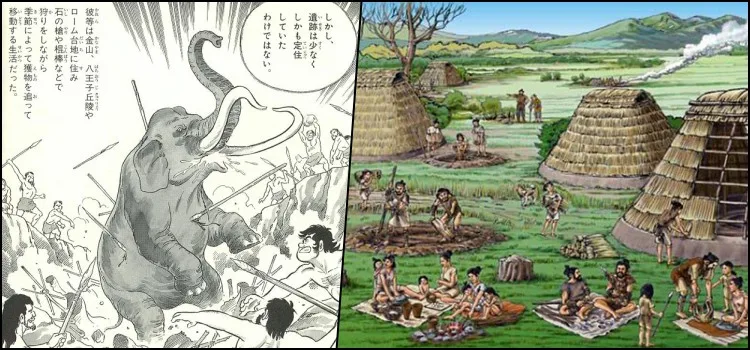
The first humans to inhabit the archipelago would be Stone Age hunters from northeast Asia. Traveling in small tribes and using weapons with stone tips, they followed herds of wild animals across land bridges to Japan, formed during the Ice Age.
While many believe they came earlier, it is known that these hunters arrived in Japan no earlier than 35,000 BC. Paleolithic artifacts include finely made blade tools, similar to those from Siberia and Eurasia.
Since no pottery has yet been discovered, the Paleolithic period in Japan is also referred to as the “pre-pottery” period (Sendoki). That name helps distinguish its inhabitants from the Jōmon and Yayoi communities that follow.
Events and Tool Development
A massive volcanic eruption in southern Japan, in Kyushu, spread a distinct ash, the Aira-Tanzawa (AT) pyroclast, across much of the country. Archaeologists still date events as “before or after AT.” Older summaries put that eruption around 24,000 to 22,000 years ago; more recent geological work places it closer to 30,000 years ago. The layer’s job is the same either way: it is a nationwide clock.
From that moment on, pebbles became less important. Small and well-made tools, especially knife-shaped ones, became more important around 16,000 years ago.
The small tools made of quartz and obsidian that predominated between about 16,000 and 13,000 years ago show considerable similarity to tools of the same age in northeast Asia and Europe. The tools from sites on Hokkaido Island are almost identical to those from the Far East and Siberia.
The development of tools made with polished stones, which emerged later in the Neolithic period for the rest of the world, makes this period of prehistoric Japan unique compared to other prehistoric periods. Edge-ground axes appear in Japan around 30,000 BC — tens of thousands of years before polishing becomes the Neolithic signature elsewhere.
Bones that the soil did not eat
Human bone from this period is scarce on the main islands. One of the few sets from Honshu was found in a limestone quarry at Hamakita, in Hamamatsu, Shizuoka. Radiocarbon dating puts those fossils around 14,000 to 18,000 years old.
Limestone caves in Okinawa have been kinder. Sites such as Minatogawa and Shiraho Saonetabaru preserved more complete Paleolithic remains, including a nearly complete skeleton at Shiraho dated around 27,000 years. Those southern bones do not automatically tell the story of Honshu hunters, but they are the clearest human bodies Japan has from the age of stone blades.
The planted stones that reset the calendar
If you still meet a chart that sends Japanese prehistory back 100,000 or even 600,000 years, you are looking at the shadow of Shinichi Fujimura. In November 2000 the newspaper Mainichi Shimbun published hidden-camera photographs of the amateur archaeologist burying artifacts at the Kamitakamori site in Miyagi, then “finding” them. He had been nicknamed the divine hand. He later admitted planting finds at dozens of Lower and Middle Paleolithic sites.
The Japanese Archaeological Association spent years reviewing the damage. After that, the widely accepted floor for people on the archipelago sat back around 35,000 BC. Claims of a much older Japan did not vanish from the internet; they just stopped being something a careful excavation can carry.
Pottery is the next chapter. When cord-marked vessels appear, the Paleolithic label gives way to Jōmon, and the islands start to look settled in a way stone scatters never quite do. For the longer walk through later eras, see the history of Japan told in ages.





Community
Comments
0 comments
There are no published comments in this language yet.
Send comment