
![How to say "I" in Japanese? [私;僕;俺]](https://cdn.skdesu.com/uploads/2023/01/japanese-girl.webp)
Do you already know the pronouns in Japanese? Do you know how to say "I" in Japanese? Maybe you have seen the words watashi, boku, ore? Which ones to use? In this article, we will see thousands of different ways to refer to yourself (say I) in Japanese.
In the Japanese language, there are several ways to say I, and these forms are also used to refer to "me", "us", and to "the person themselves", unlike Portuguese where we have specific words for that. Not to mention keigo, the formality in the Japanese language.
Contents 6
Watashi and watakushi [私]
The most common and formal way to say I in Japanese is watashi [私]. Many women also use it in informal speeches, which can sound feminine, but the word can be used by both sexes in formal conversations.
It can occasionally be written in hiragana [わたし] to give a softer tone. The ideogram [私] also has the reading of watakushi, another way to refer to I, but in a much more formal manner to be used with bosses or important people.
Women can say "atashi" [あたし] a more delicate and feminine form mainly used by girls between 20 and 40 years old. Other ways to say Atashi are: Atai, Ashi, Asshi, Atai, Ataki, Ate, Atakushi, and others.
See the forms of saying I, derived from the ideogram [私]:
- Watakushi [わたくし] - very formal;
- Atashi [あたし] - informal feminine;
- Washi [わし] - very informal used by old men;
- Wate [わて] - Popular in the Kansai dialect;
Boku [ぼく] and Ore [俺] - Masculine pronouns
Young boys and children often use "boku" [僕]. This word presents a sense of casual consideration, being quite humble, since its ideogram also means servant (shimobe). That is why children tend to use it.
If you are already an adult, avoid using it, as it may sound a bit childish or delicate.
The word boku [僕] is also used to refer to you. This happens when the person being referred to has used the term to refer to themselves, or to refer to someone who probably uses this pronoun, like a young boy, being equivalent to Boy.
Another quite popular first-person pronoun is ore [俺] which sounds quite informal and rude. Usually used among friends by men and boys. When used with others, it can sound authoritative, as if commanding someone.
Anime characters that use the first-person pronoun are delinquents, bad people, yakuza, and others who give off a bossy air. The pronoun ore establishes a sense of masculinity.
Used mainly with colleagues or with younger or lower-status people, indicating the status of the speaker themselves. Among close friends or family, its use is seen as a sign of familiarity rather than masculinity or superiority.
Some derived and similar words to Boku and Ore are:
- Oira [おいら] - Similar to [俺], but more casual. Can give the sense of a country bumpkin;
- Ora [おら] - Dialect in Kanto and further north. Gives the sense of a country bumpkin;
Bokukko - Women who use Boku
Although the word boku is preferable for men, some rare girls are called bokukko for using the first-person pronoun boku. Generally, a girl disconnected from society, from the countryside, or quite masculine.
Even with Japanese speech patterns becoming more gender-neutral over the years, this would be considered unusual in real life; however, it is a common character quirk in Japanese anime and video games.
This speech pattern can also be used to keep a character's gender obscured - is she a boyish girl or a girlish boy? The same can happen with another masculine pronoun ore, where they are called orekko.
Other ways to say I
There are other ways to say I in Japanese, although some are very uncommon or have fallen out of use.
- Waga [我が] - Means "my" or "our". Used in speeches and formalities;
- Ware [我] - Alternative to waga.
- Uchi [家] - Means I, or the person themselves. Commonly used in the dialects of some regions of Japan;
- Warawa [童] -Used by princesses, an old form of watakushi;
- Gusou [ぐそう] - Used by Buddhist priests;
- Jibun [自分] - Means oneself, yourself, or the person themselves.
In Japan, it is also common to use one's own name to refer to oneself. It is mainly used by small children and young women, and can be considered something cute, but sometimes annoying, full of oneself.
Each region of Japan may have some different way of saying "I" in Japanese. This happens because of dialects and the multiple readings that can be allowed for a single ideogram. The image below has more ways to say I in Japanese:
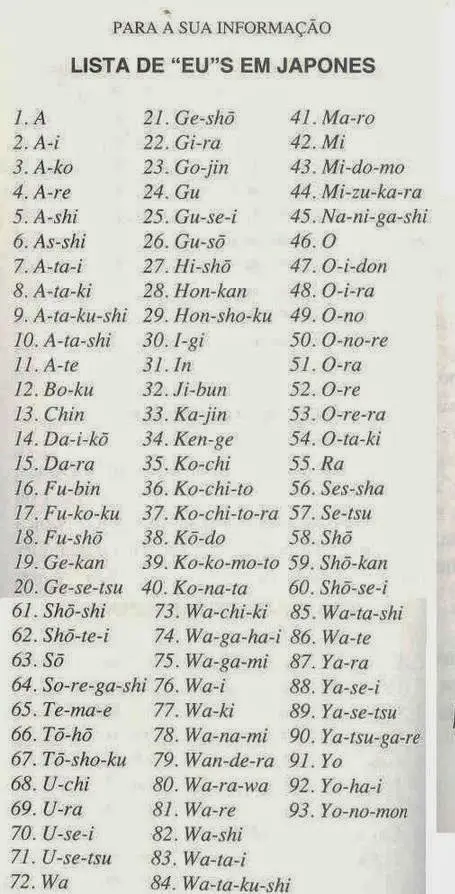
Archaic ways to say I in Japanese
Below we will share a list of archaic Japanese first-person pronouns. Most archaic pronouns are masculine, only those derived from watakushi and waga are commonly used by both sexes.
Responsive Table: Scroll the table sideways with your finger >>
| Form | Kanji | Notes |
| adakado | 仇家人 | Used as a humble term, literally for a person's house. |
| asshi | あっし | From the Feudal era. |
| chin | 朕 | Used only by the emperor, mainly before World War II. |
| onore | 己 | Means "yourself". |
| sessha | 拙者 | Used by ninjas and samurais during the feudal era. |
| soregashi | 某 | Old form of "watakushi". |
| waga-hai | 我が輩,吾輩 | Literally "my group", but used in a pompous way like I, my; |
| warawa | 妾 | Old form of "watakushi". |
| yo | 余, 予 | Archaic singular first-person pronoun. |
Transforming pronouns into Plural
First-person pronouns can be transformed into plural by adding a suffix. Thus, you will be able to say we with the words you learned in this article. The plural of pronouns in Japanese is called fukusuukei [複数形].
Tachi [達] - One of the suffixes used to make a pronoun plural. It can be written in hiragana, and can also be added to names to indicate a person's group of friends. Examples: [俺たち, 僕たち, 私たち].
Domo [共] - Denotes some sprinkling in the mentioned group, therefore it can be rude. The word is quite humble and can be used, for example, in watakushi. Example: [私ども].
Ra [等] - Used mainly with informal pronouns. Its use and mode are more didactic. Examples: [お前ら, 俺ら, あいつら].
Gata [方] - Normally used in second and third-person pronouns, it is more formal than -tachi and -ra. Examples: [あなた方].
We also have the word wagasha [我が社] and hei-sha [弊社] which means we. These words are formal and humble, used when representing one's own company. With hei-sha being more humble than wagasha.
Also read our basic article talking about other pronouns by clicking here. I hope you enjoyed this article, if you liked it, share and leave your comments. Did you expect the existence of so many first-person pronouns?



Community
Comments
0 comments
There are no published comments in this language yet.
Send comment