
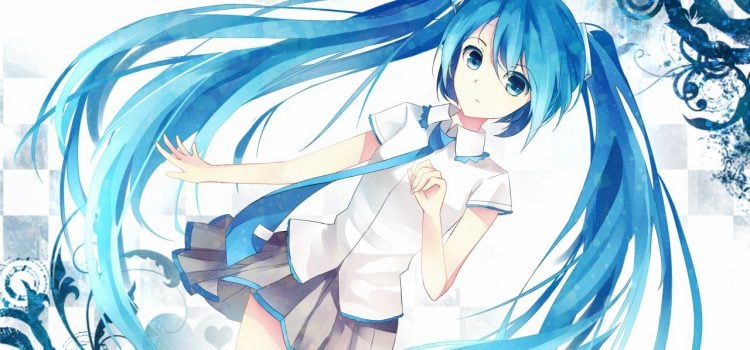
Do you know Hatsune Miku? A quite different pop star who marked the music industry in Japan and around the world. How was this virtual girl able to create over 150,000 songs and have millions of fans spread across the globe? In this article, we will be uncovering her origin and success.
For those who are unaware, Hatsune Miku (初音ミク) is a Vocaloid. A voice package developed for a voice synthesizer program, used to create music through a computer program. She was created in 2007 by the Japanese company Crypton Future Media.

The Vocaloid program was launched in 2004, where you write the syllables and choose the pitch of the voice to create your songs. It was meant to be a simple voice program, but thanks to marketing, the program created a phenomenon quite popular among young people and adults all over the world.
Japan is famous for creating stylized illustrations of anime/manga characters. The same was done, illustrations were created to represent the voices used in the program. Hatsune Miku became the most popular voice/character, becoming a standout character worthy of giant shows.

How did Hatsune Miku’s success arise?
It was on August 17, 2007, that version 2 of the Vocaloid program was launched in Japan. Hatsune Miku was released as the first voice of the future on the 31st! This is the meaning of her name, where Hatsu (初) means first, Ne (音) means sound, and Miku (未来) means future, although it is usually written in katakana (ミク).
It was thanks to the Japanese YouTube site Nico Nico Douga that Miku became a sensation. Already in September 2007, a user named Otomania published a remix of Hatsune Miku swaying a leek while singing the song Ievan Polkka. It was because of this first song that Hatsune Miku became a web sensation:
The original video gained over 3 million views by August 2011. Not to mention the over 200 million views (or more) from re-ups and different versions of the music video.
Soon, other very popular songs were created using the singer. Songs like Melt, Po-pi-po, and thousands of remixes and versions of already known songs. Soon, other voice packs of Vocaloid illustrated by different characters appeared, allowing the creation of songs with various voices and Vocaloid characters.
In addition to songs with synthesized and somewhat robotic voices, another thing that was responsible for Hatsune Miku’s success was the dance videos featuring the character in both 2D and 3D. Soon, various 3D animation editing programs were created for dance creation to accompany the songs.
The Japanese even created a version using Miku and other Vocaloids of the song Paranaue:
The Impact of Hatsune Miku on Japanese Culture
Hatsune Miku became popular in all areas involving music, videos, 3D animations, and especially memes. YouTubers began to do crossovers, and a flood of videos was uploaded to the platform. The popularity of Vocaloid videos reached the Japanese mainstream, receiving media coverage and endorsed by various J-pop celebrities.
Her popularity was so great that in August 2009, a promotional concert sponsored by SEGA took place. A real show, with Miku projected on glass screens, drove fans wild. In addition, a famous rhythm game was released called Project Diva. This was just the beginning of a series of shows and games.
Hatsune Miku made her first holographic debut in the USA through the David Letterman show. Even games like No More Heroes 2 featured songs by Hatsune Miku in their soundtrack. Fans began to create Mods and Skins for other games and created numerous modifications to Hatsune Miku, bringing the singer to life.
Various action figures and products related to the singer were created and spread around the world. At anime events, someone always appears cosplaying as Hatsune Miku or another famous Vocaloid. Clothes, toys, towels, and even jeans were created using the highlight of Hatsune Miku.
Curiosities about Hatsune Miku
Who is the voice behind Hatsune Miku? The name of the voice actress who provides the voices used in the Vocaloid of Hatsune Miku is Sakiko Fujita (咲子藤田), nicknamed Saki.

Hatsune Miku went to space! In 2009, Miku fans made a petition to convince JAXA to send aluminum plates of the character on a probe to Venus. The petition surpassed 10,000 signatures and gained the support of a professor from JAEA. On May 21, 2010, the first Venus probe was launched containing 3 plates of Hatsune Miku.
The opening of the OVA of Black Rock Shooter was sung by Hatsune Miku along with Supercell. The original artist of the character also created an unofficial manga with several short stories about the character. The name of the manga is Hatsune Mix!
The first version of viral nyancat was made using the Vocaloid with Hatsune’s voice.
In 2012, a wave of people began reporting Hatsune Miku’s videos due to copyright issues on YouTube. A campaign was launched to combat this problem. Indeed, Hatsune became popular for creating covers, remixes, and parodies of well-known songs, but that was not the reason for the reports; it was merely envy of her success.
The universe created around Miku and the other Vocaloids is truly gigantic. There are several new songs every day, videos, and 2D, 3D animations, and even fan games, doujinshi, and others. I hope you enjoyed this short article; if you want to delve deeper, we will leave some related articles about Hatsune Miku below. We appreciate the comments and shares:
Leave a Reply