

One of the most popular words in the Japanese language is daijoubu, which is written using the ideograms [大丈夫]. Learners often meet it as “don’t worry” or “it’s all right,” then hear the same word used to accept something, refuse an offer, or check if a person is hurt.
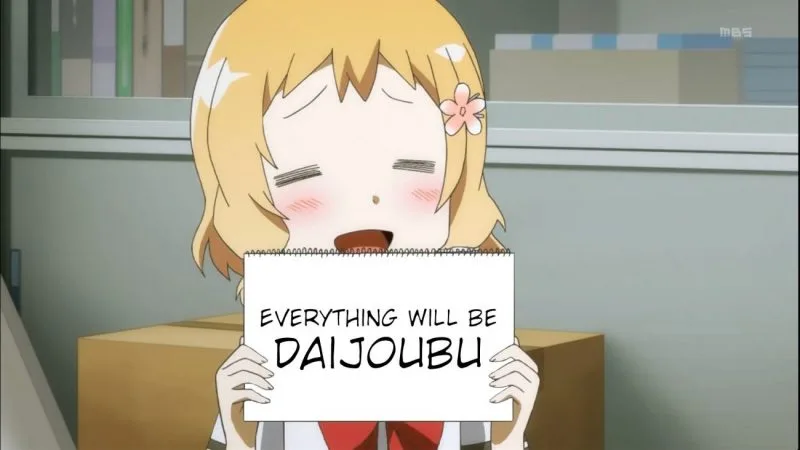
The word daijoubu can be an adjective, an adverb, and a noun used in questions and answers in different situations in the Japanese language. This expression has also become popular in the West due to otaku and anime. It is commonly used as a response when people ask if they can do something.

Contents 6
What is the meaning of Daijoubu?
As a [な] type adjective, the word daijoubu [大丈夫] can mean that something is safe, free of problems, that one can perform the action without any fear, that everything is fine, or okay.
When daijoubu is used as an adverb, it conveys the idea that everything is all right, without doubts or problems.
The word daijōbu (another romanization) can also decline an offer, in a tone close to “no thank you.”
It can convey the idea of “no thank you,” “it’s all right,” “everything is fine,” “don’t mind me.” The most common interpretation of the word is a simple “I’m fine,” especially if accompanied by desu [です] or da [だ].
When used as a question, we can translate it as “are you okay?” or “everything all right?”. If someone trips, looks sad, appears scared, or does anything that involves concern, the expression “daijoubu” may be the most polite to use.
The meaning of the word will depend on the context used!

What is the origin of Daijoubu?
In the past, the word referred to a great man of full stature, which is why the ideograms 大 (great), 丈, and 夫 (man) are used. What do these ideograms have to do with the meaning of the word?
丈 is an old unit of length. In Zhou-dynasty measures, one 丈 was about 180 cm, the height taken as a grown man. 夫 here means a man, not specifically a husband. In classical Chinese, 丈夫 named a fully grown man, and 大丈夫 named an outstanding one.
In Japan the sense shifted toward someone reliable and steady, then toward “no cause for worry.” Dictionaries still record an older reading daijōfu for the “great man,” while everyday conversation uses daijōbu for safety, permission, and reassurance.
“Dai” [大] means big, strong, and much. The rest of the word “joubu” [丈夫] means healthy, robust, strong, solid, and durable. That older picture of a solid person is the bridge to the modern “it’s all right.”
The same flexibility shows up in other Japanese answers; this article on vague Japanese that can mean yes or no helps place daijoubu in that habit of speech.
It is interesting to remember that the name Masurao can be written with the ideograms [丈夫]. There is also the expression “daijō bukkyō” [大乗仏教], Mahayana Buddhism, a different word that only sounds close: it uses 乗, “vehicle,” not 丈.

When to use Daijoubu for Questions?
There are numerous situations involving questions where you can use the expression daijoubu. One of the most common is after someone looks hurt, unwell, or worried.
If you were sick last week, a friend might ask you:
- 大丈夫ですか
- daijoubu desu ka?
In this case, you can respond:
- 大丈夫です
- daijoubu desu
The same polite answer also works when someone offers you something and you want to decline. If a clerk asks whether you need a bag, 大丈夫です is often heard as “I’m fine, no thank you.” The previous question tells you which reading is intended.
Alternatives to Daijoubu
What other words can be used instead of daijoubu? What are the differences between them? First, we will make a list and then explain a little about each of them.
- Genki [元気] - Are you okay?
- Kekkou desu [結構です] - I’m fine;
- Ii desu [良いです] - It’s okay;
The phrase “kekkou desu” [結構です] means splendid, good, wonderful, sufficient, and quite. It is usually used to politely refuse something.
On the other hand, “ii desu” [良いです] literally means it’s good. This word is often used beyond just good; it is commonly used to accept or reject something.
What is the difference between daijoubu and genki?
Another word with a similar meaning is genki [元気], which is often used to ask about a person's health or if they are okay. If you want the greeting in more detail, see this guide to genki as “how are you” in Japanese.
Although both words mean “to be well,” the word “daijoubu” is used to inquire about a situation at the moment. In contrast, “genki” is used for a continuous “to be well,” as if you had a good day.
“Daijoubu” is especially used when something is wrong or someone is hurt. Meanwhile, “genki” is often used when greeting and starting a casual conversation.
Sentences and expressions that use daijōbu
To conclude, here are example sentences that use daijoubu in Japanese, English, and romaji, so you can hear the same word shift with the situation.
| English | Japanese | Romaji |
|---|---|---|
| My mother said she was fine. | 母は大丈夫だと言った | Haha wa daijōbu da to itta |
| Everything is probably fine. | 多分大丈夫です | Tabun daijōbu desu |
| Are you feeling okay? | 気分は大丈夫ですか | Kibun wa daijōbu desu ka |
| Is everything all right? | 全て大丈夫ですか | Subete daijōbu desu ka |
| This water is fine to drink. | その水は飲んでも大丈夫です。 | Sono mizu wa nonde mo daijōbu desu. |
| Everything will be fine if you hurry. | 急げば大丈夫です | Isogeba daijōbu desu |
| I am not okay (formal). | 大丈夫じゃありません | Daijōbu ja arimasen |
| I am not okay. | 大丈夫じゃない | Daijōbu ja nai |
| Everything will be fine. | きっと大丈夫だよ | Kitto daijōbu da yo |
| Is everything alright for tomorrow? | 明日は大丈夫ですか | Ashita wa daijōbu desu ka? |
| Is it okay to ask? | お願いしても大丈夫ですか | Onegai shite mo daijōbu desu ka? |
| Are you okay? | 大丈夫なのか | Daijōbu na no ka |



Community
Comments
0 comments
There are no published comments in this language yet.
Send comment