

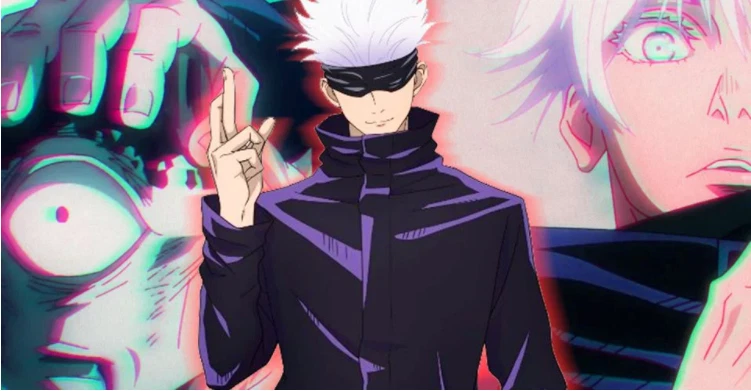
«Daijoubu desho, datte kimi yowai mon» is a line from Jujutsu Kaisen, spoken by Gojo Satoru while fighting the curse Jogo. It sounds friendly and it is an insult: he tells his opponent not to worry, because the opponent is weak anyway. Here is the scene, the meaning of each word and the grammar behind it.
Contents 6
The scene
The line appears in volume 2, chapter 15, and in episode 7 of the first anime season. Jogo, a special-grade curse, attacks Gojo and mocks him for bringing his student Itadori along: «Bringing a burden with you yourself is foolish.» Gojo answers calmly: 大丈夫でしょ、だって君弱いもん. Right afterwards he shows Itadori a domain expansion, the highest form of jujutsu, in front of Jogo, and the line turns into an announcement that the fight is already decided.
Word by word
大丈夫 (daijoubu) means «it's fine» or «no problem». でしょう (desho) is a polite guess, like «right?» or «surely». だって (datte) introduces a reason: «after all», «because». 君 (kimi) is «you», used towards equals or people below you and deliberately condescending here. 弱い (yowai) means «weak». もん (mon) closes the sentence with a tone of «that's just how it is», like the stubborn explanation a child gives.
What the grammar tells you
Four pieces make the sentence rude. First the guess with でしょう, which takes away the opponent's worry before he can voice it. Second だって, which adds a reason as if it were obvious. Third もん at the end, which makes the sentence childish and argumentative. Fourth 君: addressing a special-grade curse as «you» puts him below the speaker in the same breath. Polite Japanese would use あなた or a name with さん, and both would be absurd in that moment.
How to translate it
Literally it reads: «It's no problem, right? After all, you're weak, that's how it is.» In English the tone comes across best with something like «It's fine, you're weak anyway» or «No worries, you're just weak». What matters is the register: not anger, not triumph, but the bored politeness of someone who already knows he wins.
Pronunciation matters for the joke to land. でしょう rises slightly, だって is said fast and casually, and もん drops at the end with a stubborn little fall. Without that melody the English version reads as plain meanness instead of teasing.
The series context explains the effect too. Gojo is treated as the strongest jujutsu sorcerer of his generation, and Jogo shows up to test exactly that. The line takes the seriousness out of the attack before it lands, and the domain expansion that follows shows how far apart the two really are.
For learners, the sentence is also a compact grammar lesson: a guess with でしょう, a reason with だって, and a sentence-final もん that carries most of the attitude. Strip any of the three and the line stops being funny.
Variations
In the anime you also hear the more polite form 大丈夫です、だって君弱いもん (daijoubu desu, datte kimi yowai mon). It sounds more formal because です replaces でしょう, but the statement stays the same: the speaker takes the time to be well mannered while putting the other down. That mix is why the line is quoted so much.
Where the series comes from
Jujutsu Kaisen is by Gege Akutami and has run in Shueisha's Weekly Shōnen Jump since 2018. Studio MAPPA adapted it from October 2020, with a second season in 2023. The characters' lines are one reason the series is quoted so widely outside Japan.
Anyone who wants more lines like this can keep reading: Dattebayo from Naruto, doko and Japanese particles, Japanese i-adjectives and 50 reasons to study Japanese. Sources: Jujutsu Kaisen and 呪術廻戦 (Japanese).





Community
Comments
0 comments
There are no published comments in this language yet.
Send comment