
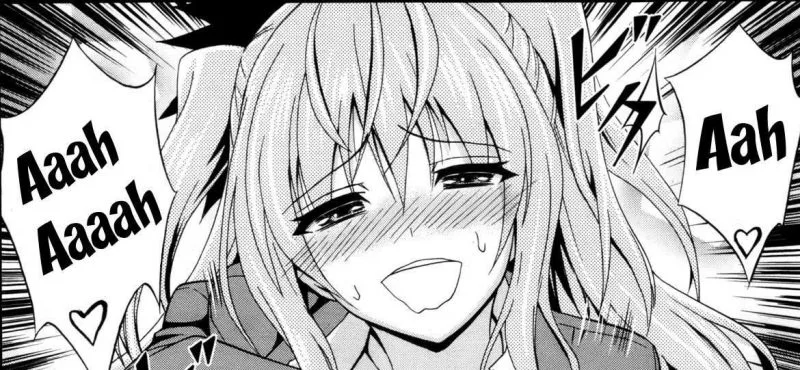
Have you ever wondered what ahegao actually means, and why it so often appears next to words like gesugao and torogao? These are Japanese terms for exaggerated facial expressions from manga and anime. They began in adult art and now circulate as internet memes. This article explains the meaning, the origin and the differences between them, without going into explicit detail.

Contents 8
The word gao means face
All of these words end in gao, the combined form of kao [顔], the Japanese word for face or expression. The element ahe [アヘ] has no kanji: it is short for aheahe [アヘアヘ], an onomatopoeia that imitates heavy breathing and panting. Literally, then, ahegao means «panting face».
The full word, ahegao [アヘ顔], describes an exaggerated expression that shows intense arousal or pleasure. It comes from Japanese erotic art, so it is worth treating the term carefully: outside adult works, it usually appears as parody or visual quotation.
What ahegao means
Ahegao is an exaggerated facial expression that makes a character look as if they have lost control of their face. Typical features are wide or rolled-back eyes, a protruding tongue, flushed cheeks and sweat. Most often it is drawn on female characters, but it also appears on male characters and in comic versions.
The exaggerated style connects to a wider visual tradition in manga, where large eyes and intense emotions are a language of their own. If that interests you, we have an article on why manga and anime characters have big eyes.
How the term originated
Many accounts place the origin of the word in the 1990s, when Japanese adult magazines used it to describe the expression of a performer at the climax. In the early 2000s the term appeared on forums such as 2channel and BBSPink and on adult video platforms.
Between 2003 and 2005, erotic manga artists and anime producers began to stylize the expression. The manga artist Suehiro Maruo had used similar faces in the early 1980s. By 2008 the term was common enough for the first dōjin anthology titled A-H-E to appear; major publishers followed in the 2010s.
A frequent explanation for its popularity is Japanese censorship: because genitals must be covered in pornographic publications, the face became a way to show pleasure without breaking the rule. The researcher Thomas Baudinette supports this reading, though it is not the only possible one.
Why faces carry so much meaning
Japanese visual storytelling leans on faces because they can carry emotion without dialogue. A single panel can show surprise, contempt or exhaustion through the eyes and mouth, and readers learn to decode those signals quickly. The gao words name that visual shorthand, which is why they spread so easily among fans.
The same logic explains why the terms travel across media: a face drawn for a manga panel works as an avatar, a reaction image or a thumbnail. Once a face becomes a recognizable code, it stops belonging to one work and starts belonging to the internet.
Gesugao, torogao and kuzugao
Gesugao [ゲス顔] combines gesu, a derogatory word for a low-class person, with gao: it is a look of contempt or superiority, with half-closed eyes and a mocking smile. It is common in memes and in characters who act superior.
Torogao [とろ顔] comes from toro, the idea of something melted or dazed: it describes a relaxed face with glazed eyes and a slightly open mouth. Kuzugao [クズ顔] literally means «trash face» and is used for characters showing a pathetic or defeated expression. In every case, the tone can be erotic or comic depending on the context.
From manga panels to social media
With the internet, these expressions left the manga page and became memes. The model Belle Delphine popularized the gesture on Instagram and TikTok in the late 2010s, and her account was suspended in 2019 for violating the platform rules. The episode shows how a term from Japanese adult art can become a global meme and, at the same time, clash with social media guidelines.
In otaku culture, ahegao is also used as an ironic reference: it appears in parodies, collectible figures and T-shirts. It is important to distinguish the humorous quotation from explicit content, and to remember that many platforms limit how it can be shared.
What it reveals about language and memes
The case of gao is interesting because it shows how Japanese builds words by combining a suffix with other roots: gao works almost like a mold that produces new terms depending on the nuance. It also shows how a word born in a subgenre can move into popular culture and change tone along the way.
More Japanese gestures and expressions in the article on akanbe, and for context on the fandom, the guide to otaku culture.
Conclusion
Ahegao, gesugao and torogao are Japanese words for exaggerated facial expressions. Ahegao began in adult art and is now used as a quotation or meme; gesugao and torogao have broader uses. Knowing their origin helps you understand the references without confusing them, and without forgetting that the original context of ahegao is adult.





Community
Comments
0 comments
There are no published comments in this language yet.
Send comment