
You look at a kanji, recognize the shape, remember that you've seen it somewhere else... but get stuck when it comes to reading it. The correct reading of a kanji is not always intuitive, and yes, there are several ways to read it. In Japanese, the same character can have different readings depending on the context, the word, and even the combination with other kanjis. This happens because of the on and kun readings, among other nuances.
But hold on. There is logic behind this apparent confusion. Understanding this logic is the first step to mastering the readings and stopping the guessing. Let's explore each of the factors that influence the correct reading of a kanji, with practical examples, cultural insights, and tips to facilitate your learning.
The question that begs to be asked: can you tell when to use kun-yomi or on-yomi just by looking? The answer is: almost. With practice, patterns, and observation, you'll get there.
Contents 7
Kun and on readings: what they are and when to use them
First of all, you need to understand that kanjis came from China, but the Japanese language already existed. This means that each character was adapted, gaining at least two forms of reading: a native one (kun-yomi) and one of Chinese origin (on-yomi).
The kun-yomi is the original Japanese reading, usually used when the kanji appears alone or in more "Japanese" words. The on-yomi is the adapted Chinese reading, and it mainly appears in compounds of two or more kanjis.
We already have a complete article discussing the reading kun yomi and on yomi. But let's make a brief summary in this article. See the example with the kanji 山 (mountain):
- Kun-yomi: やま (yama) → 山に登る (climb the mountain)
- On-yomi: サン (san) → 富士山 (Fuji-san, Mount Fuji)
Did you notice that the reading changes depending on the usage? This is the general rule, but as always, Japanese likes exceptions. There are words with mixed readings, and some forms that only appear in proper names or fixed expressions.
When to use which?
- Kanji alone → usually uses kun-yomi
- Two kanjis together → usually uses on-yomi
- With okurigana (kana that accompany the kanji) → kun-yomi
- Technical or Sino-Japanese words → on-yomi
But that's not all. Some words have more than one valid reading, depending on the context. Therefore, it's no use memorizing in isolation. You need to see the kanji in action.

Radicals: the key to understanding and memorizing
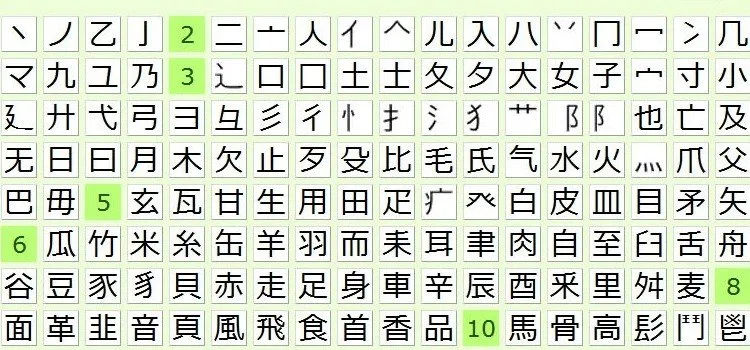
The radicals (bushu) are the building blocks of kanjis. They provide clues about the meaning, and sometimes even about the reading. Knowing how to identify the radicals can save you a lot of time when trying to guess what a kanji means.
Think of radicals as LEGO pieces. Together, they form a more complex character, but each piece still carries its meaning. A clear example is the radical 氵(sanzui), which appears in kanjis related to water:
- 海 (うみ, umi, sea)
- 河 (かわ, kawa, river)
- 洗 (あらう, arau, wash)
Even if the reading is not the same, the radical helps you visually associate the kanji with an idea.
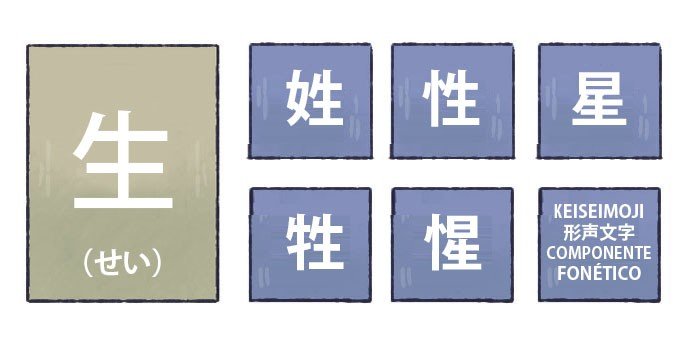
Some radicals also indicate reading
It's rare, but it exists. Some radicals or components carry phonetic clues. An example is 青 (ao, blue), which appears in:
- 清 (せい, sei) — clean
- 晴 (せい, sei) — clear weather
These kanjis share part of the reading because of the phonetic component 青. But be careful: this pattern is not guaranteed. Use it as a hint, not as a fixed rule.
Reading in proper names: the treacherous part
If you've ever tried to read Japanese names, you know what comes next. The kanjis in proper names can have readings that deviate from any pattern. This happens because names allow more freedom in choosing readings, even using nanori — readings used only in names.
For example, the kanji 一 can be read as:
- いち (ichi, on reading)
- ひと (hito, kun reading)
- かず (kazu, nanori reading)
So, if you see 一美, it could be Kazumi, Hitomi, Ichimi... without context, there's no way to know for sure. The only solution? See how the person reads their own name. Simple as that.
Practical tip: when studying names, memorize them as a unit. Don't try to decipher piece by piece — it's like trying to guess a Wi-Fi password.

Other readings and special cases
In addition to on, kun, and nanori, there are other surprises in the world of kanjis. Some gain special readings in fixed words, idiomatic expressions, or due to historical language changes.
A good example is 今日. The kanjis literally mean "this day," but the reading is きょう (kyou), which does not exactly correspond to any of the traditional readings of 今 (ima) or 日 (hi/nichi).
These cases are called 読み方特有 (tokuyuu yomikata), meaning specific reading. They are exceptions that need to be memorized, but they appear frequently.
Another trap is the ateji — kanjis used solely for their pronunciation, without any connection to the meaning. An example is 寿司 (sushi), where the kanjis have nothing to do with raw fish. They are just used for their sound.
Want a way to avoid confusion? Use reliable dictionaries and tools like jisho. They show all possible readings of a kanji, with practical examples and even the radicals used.
Tips to discover the reading of a kanji
You don't need to memorize all the readings. The secret is to learn the patterns and train your intuition. Here are some strategies that work:
- Analyze the context: what comes before and after the kanji changes everything.
- See if there is okurigana: if there is, it's probably kun-yomi.
- Look for the type of word: technical, abstract, or compound words tend to use on-yomi.
- Use the most common reading first: some kanjis have more frequent readings — start with them.
- Study by words, not by isolated kanjis: memorize complete words and their real readings in everyday life.
Additionally, listening to spoken Japanese helps to solidify. Watch anime, dramas, listen to podcasts. Try repeating sentences with the kanjis you are studying. This improves your memorization and your confidence.


Community
Comments
0 comments
There are no published comments in this language yet.
Send comment