
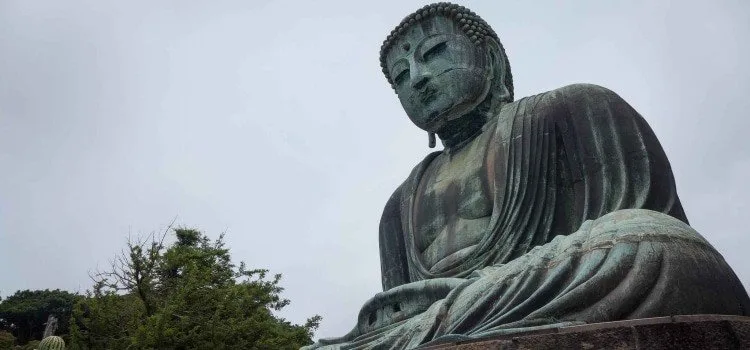
Buddhism is a religion that originated in India between the 4th and 6th centuries BC, centered on the teachings of Siddhartha Gautama, known posthumously as The Buddha, which aims to help any living being cease the cycle of suffering (samsara) and achieve the extinction of suffering (nirvana) by becoming a bodhisattva (one who attains nirvana).
The religion migrated out of India and spread throughout Asia, consequently reaching Japan in the 6th century AD.
Buddhism had a significant influence on the development of Japanese society. In modern times, the most popular schools of Buddhism in Japan are Pure Land, Nichiren, Shingon, and Zen.
As of 2008, approximately 34% of Japanese identify as Buddhists, and the number has been growing since the 1980s, in terms of association with organized religion.
However, in terms of practice, 75% practice some form of Buddhism (compared to 90% practicing Shintoism), so the majority of Japanese practice religion to some extent. About 60% of Japanese have a Butsudan (Buddhist altar) in their homes.

Table of Contents
The arrival of Buddhism in Japan
According to the Book of Liang, which was written in 635, five Buddhist monks from Gandhara traveled to Japan in 467. At the time, they referred to Japan as Fusang (Chinese: 扶桑; Japanese pronunciation: Fusō), the name of a mythical country to the far east beyond the sea.
Although there are records of Buddhist monks from China arriving in Japan before the Asuka Period, the “official” introduction of Buddhism to Japan is dated to 552 in Nihon Shoki when King Seong of Baekje (now Korea) sent a mission to Emperor Kinmei that included Buddhist monks or nuns along with an image of Buddha and a series of sutras to introduce Buddhism.

Buddhism during the Meiji period
With the Meiji Restoration in 1868, the new government adopted a strong anti-Buddhist stance and a movement to eradicate Buddhism and elevate Shintoism emerged throughout the country. This was due to the strong connections of Buddhism with the shoguns.
Shintoism became the state religion. Within the Buddhist establishment, the Western world was seen as a threat and a challenge to face.
Buddhist institutions had a simple choice: adapt or perish. Rinzai and Soto Zen chose to adapt, trying to modernize Zen while simultaneously maintaining a Japanese identity. Other schools and Buddhism in general simply saw their influence wane.

Since World War II
During World War II, almost all Buddhist temples strongly supported the militarization of Japan. In contrast, some individuals like Ichikawa Haku and Girō Seno’o were targeted. Soka Kyoiku Gakkai, an organization of Nichiren believers, was banned by the military authorities.
During the 1940s, the leaders of Honmon Hokke Shu and Soka Gakkai were imprisoned for their challenge to the government’s wartime religious policy, which required displays of reverence for the state Shintoism.

Japan saw a growth in lay Buddhist believers and a decline in traditional Buddhism in the 20th century. As of 2008, approximately 34% of Japanese identify as “Buddhists.”
I hope you enjoyed the article. We appreciate the shares and comments. We also recommend reading:
Leave a Reply