
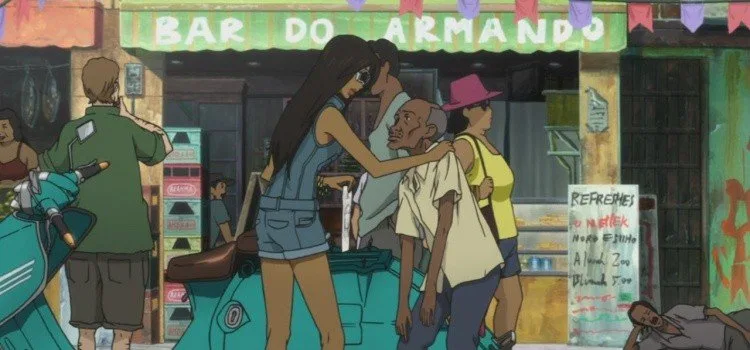
Brazil shows up in Japanese animation more often than you might expect at first glance. Most of the time it stays in the background: football, Carnival, the Amazon rainforest, a passing nod to Bossa Nova. A genuine lead role, however, is rare. One notable exception is Michiko to Hatchin (ミチコとハッチン), a 2008 anime whose entire story takes place in a world that resembles Brazil closely - just under a different name.
This article introduces the anime, places it inside its Brazilian setting, and then looks at further references to Brazil that pop up across the genre.
Contents 13
About Michiko to Hatchin
Michiko to Hatchin is an anime series written by Takashi Ujita, produced by the studio Manglobe and directed by Sayo Yamamoto. Sayo Yamamoto is also the director of Cowboy Bebop, which gives the series a similarly cinematic, jazz-inflected, and genre-crossing hand. The anime aired in Japan in 2008 and runs for 22 episodes.
The story is set in a fictional country called Diamandra, which, according to Wikipedia, has not only a culture and landscapes quite similar to those of Brazil, but also the same geographical division and the same currency. In the anime, the currency is called Austral, a direct nod to the Brazilian real. That makes Michiko to Hatchin one of the few anime in which an entire setting is built around a single South American country.
References to Brazil in the anime
Once you start looking at locations and props, it becomes clear that the creators spent real time with everyday Brazilian culture.
The first thing that stands out is how much of the background is written in Portuguese rather than Japanese: posters, graffiti on house walls, letters, and even road signs. Look closely and you can spot signs and texts in Brazilian Portuguese, including fragments like Largo da Memória or Saída. These details anchor the fictional Diamandra convincingly in the Portuguese-speaking world.

The background music reinforces the impression: several tracks on the soundtrack are sung in Portuguese with a Brazilian accent. Genres like Bossa Nova, Samba, and Bachata show up, giving the series a warm, Latin American color that stands out from the typical J-Pop sound of many anime.
The character names themselves are Portuguese. Michiko Malandro carries a surname that, in Brazilian Portuguese, means something close to "trickster" or "cheeky." Hana "Hatchin" Morenos sits comfortably in the Spanish-Portuguese naming world. Even supporting characters carry Brazilian-sounding first names, which keeps the South American feel of the series consistent.
Everyday cultural details add further weight: tropical colors, sun-bleached streets, run-down favela-style neighborhoods, motorcycles, and tropical vegetation. The camera picks up motifs that also appear in Brazilian Cinema Novo and in Latin American cinema more broadly - family bonds, social inequality, and life on the margins of society.
The story of the anime
The story begins when the prisoner Michiko Malandro escapes from a high-security prison. On the run, she runs into Hatchin Morenos, a girl who lives with the Blenbauza Yamada family. Hatchin, whose given name is Hana, is systematically mistreated there by her foster parents - Father Pedro and his wife Joana - and by her foster siblings Gabriel and Maria.
One day, when Hatchin turns against the family, Michiko steps in and rescues her. Both carry a snake tattoo - a motif that nods to Brazilian prison culture - and slowly begin to trust each other. Together, they set out in search of Hatchin's biological father, Hiroshi Morenos, a man who shaped both women in different ways.
What follows is a road-movie plot across Diamandra: the two protagonists cross tropical coasts, grimy big cities, and remote villages, run into corrupt police officers, local gang leaders, and shady fixers. Between action sequences, humorous everyday moments, and quiet family scenes, the series builds a dense picture of a country that resembles Brazil without ever naming it outright.
More references to Brazil in anime
Michiko to Hatchin is the most obvious adaptation of a Brazilian setting, but it is far from the only reference. A short selection:
Golden Time and the Carnival
In the romantic comedy Golden Time (2013), one episode features women dancing Samba and wearing Carnival costumes. The scene points to the Brazilian Carnival as the country's best-known cultural export and works as a recurring shorthand for "Brazil" across the anime genre.
Captain Tsubasa and football
Almost no sports anime can avoid Brazilian football. In Captain Tsubasa (by Yōichi Takahashi), Brazil has been the unrivalled reference for technical brilliance, ball control, and tactical creativity for decades. Several of the series' key matches send the Japanese protagonists to São Paulo, Rio de Janeiro, or the Amazon rainforest.
Aldebaran of Taurus
In the classic anime Saint Seiya (known in some regions as Knights of the Zodiac), the Gold Saint Aldebaran of the Taurus constellation is an obvious homage to Brazil: dark skin, traditional dress, South American folklore, and a background rooted in the Brazilian backlands. He is one of the most recognizable Brazilian characters in the anime genre.
Hayate no Gotoku
The comedy series Hayate no Gotoku (2004) plays with Brazilian references across several episodes. It mentions a fictional train line between Rio de Janeiro and Tokyo, coffee plantations, and the Amazon rainforest. Within the show's internal logic, Brazil is one of those places the characters are assumed to have been to at some point.
Pokémon and the Amazon
In the first Pokémon movie (Mewtwo Strikes Back, 1998), Mewtwo is cloned from the original Pokémon Mew in the Amazon rainforest. The tropical vegetation serves as the backdrop for the decisive confrontation and has cemented the rainforest in the imagination of many anime fans.
Rozen Maiden and Ayrton Senna
In the background of the doll anime Rozen Maiden, a poster of Ayrton Senna - the Brazilian Formula 1 world champion - hangs in the protagonist Jun's room. The detail is small, but it shows how deeply Brazilian pop icons are embedded in the everyday aesthetics of Japanese series.
Gundam 00 and the arms industry
In the mecha anime Gundam 00 (2007), one of the most powerful Mobile Suits is developed in a Brazilian research facility. That frames Brazil in the series as an emerging high-tech region - an unusual but consistent extension of how South America is portrayed in the genre.
Cowboy Bebop and Bossa Nova
Since Cowboy Bebop was made under the same director as Michiko to Hatchin, the Brazilian tone is also present there. Across several episodes, the series nods to the Brazilian composer and poet Tom Jobim, and includes characters with Brazilian-sounding first names like Antônio and Carlos. That fits Bebop's taste for Latin American music, especially Bossa Nova and Latin Jazz.
Brazil in anime: a short takeaway
Brazil remains, in mainstream anime, a kind of cultural shorthand: football, Carnival, Samba, the Amazon, the occasional nod to coffee, and the occasional hint at colonial history. Michiko to Hatchin is the rare series that runs that setting consistently all the way through - with Portuguese language on the posters, Brazilian-sounding surnames, a soundtrack sung with a Brazilian accent, and a street aesthetic that recalls the periphery of São Paulo. If you like anime in which Latin American culture appears not just as a folkloric aside but as a working world of its own, this 2008 series is hard to skip.




Community
Comments
0 comments
There are no published comments in this language yet.
Send comment