

For those planning to go to Japan for more than a short trip, the authorizations start well before the flight. One of those papers is the Certificate of Eligibility. But what is this certificate, and what is necessary to obtain it?
Contents 4
What is the Certificate of Eligibility?
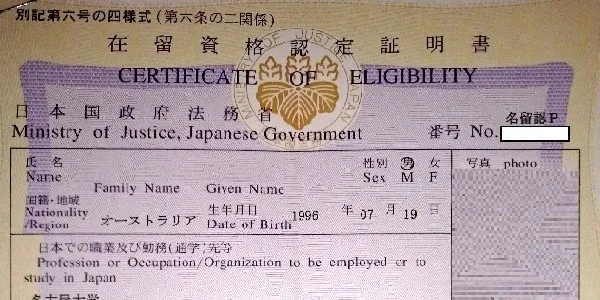
The Certificate of Eligibility (在留資格認定証明書, zairyū shikaku nintei shōmeisho) is issued by a regional immigration office of the Immigration Services Agency, under the Ministry of Justice. Article 7-2 of the Immigration Control and Refugee Recognition Act is the basis. The certificate shows, before travel, that the activity planned in Japan fits a status of residence.
The Immigration Services Agency limits this procedure to a status of residence other than Temporary Visitor and Permanent Resident. Spouse of a permanent resident is a separate status, and that one uses the certificate. Those statuses are separated on the procedure page for the Certificate of Eligibility.
You present the certificate when you apply for the visa, and you can present it again at landing. Since 17 March 2023 the office can send the certificate by email, and that message can be forwarded to the person waiting abroad. A copy of both sides of a paper certificate is also accepted for the visa and for landing.
The deadline for the foreigner to land in Japan is three months after the issuance of the Certificate of Eligibility. The Consulate-General of Japan in San Francisco gives its long-stay applicants the same instruction: enter within three months of the issue date. It is worth remembering that this documentation does not guarantee the automatic issuance of the visa.
The embassy checks identity and the passport. The Foreign Ministry explains that a certificate issued on mistaken or false information can be refused. A visa in the passport remains only one condition for the officer at the airport.
What is necessary to obtain the document?
The request is filed in Japan, at the regional immigration office for the place the person plans to live, or for the organization that will receive them. Weekday hours are 9:00 to 12:00 and 13:00 to 16:00. Some procedures use a narrower slot, so the person submitting the papers should ask that office before going to the counter. The office does not take the form by post, whether the envelope is addressed to the Immigration Services Agency or to a regional office. From inside Japan the information center number published on the procedure page is 0570-013904.
If the applicant is already in Japan, they can file in person. From abroad, a sponsor in Japan files. An employer does this for work, and a school does it for study. A relative who lives in Japan does it for a family status. The Japanese spouse is the usual choice, and another close relative living in Japan can take the filing on. The couple does not have to travel on the same ticket. The Japanese resident can go ahead, and the other spouse can follow once the certificate and the visa are ready. A lawyer, or an administrative scrivener (行政書士) who has notified the bureau, can hand in the file when the applicant or that sponsor is in Japan.
The status decides whose papers matter. For a spouse, the file centers on the marriage and on the life in Japan of the relative who files. Each status has its own form on the immigration page, and that form is the list for the certificate. A foreign-registration card belongs to a document Japan replaced with the residence card in 2012, and that old card is the wrong document for this application.
Once the certificate arrives, by email or from the sponsor, the foreigner applies for the visa at the Japanese embassy or consulate that covers their home. The Ministry of Foreign Affairs is clear that this visa cannot be requested inside Japan, and that the sponsor sends the papers to the applicant rather than to the ministry. With the certificate in hand, bring a valid passport, the visa application form, a photo, and the certificate. The mission adds its own items, and it can ask for more while it examines the case. Read that mission's page before the flights are booked. A trip of up to 90 days, with no paid work, follows the tourist visa route instead.
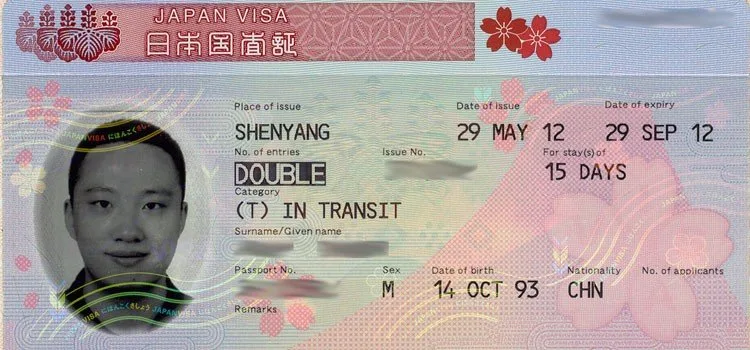
The sticker in this photo is the visa itself, issued in Shenyang as a transit visa for 15 days. It is a different document from the certificate above, and a short transit like this one does not go through that certificate.
Work visa through the Certificate of Eligibility
A work status and a family status are separate filings. Descendants of Japanese nationals usually rely on spouse or child of a Japanese national, or on long-term resident when the tie is Japanese ancestry. The status comes from that family tie, and a relative in Japan files that certificate.
A work visa needs a specific kind of work, and the company in Japan files the certificate. The long-stay list includes professor, artist, journalist, business manager, instructor, engineer or specialist in humanities and international services, intra-company transferee, nursing care, entertainer, skilled labor, and specified skilled worker, among others. The company files the status that matches the job. The types of Japanese visas sit side by side on another page.
After landing, a longer period of stay is a different application from this certificate. That later step is the one in extending a stay in Japan.
Time and costs
To spend a season in Japan, it is necessary to plan the documents well in advance. No last-minute decisions, okay! It can end up causing a headache.
The standard processing period published by immigration is one to three months. The category, the family tie, and how complete the file is all change the wait, so one month is only the short end of the published range. Leave time for the visa examination after the certificate arrives. When the file is in order, the Foreign Ministry's standard is five working days from the day after the mission accepts it. A case that needs extra documents takes longer. A long stay filed with no certificate at all is the situation the ministry flags as slow.
Applying for the Certificate of Eligibility is free. You will not pay a revenue stamp for this request. If you prefer to pay a professional to handle the procedures, there is an additional cost that varies with the office, the status, and the number of people. Any visa fee comes later, at the embassy, and it depends on your nationality and on that mission.
The extra validity granted during the pandemic, for certificates issued from 2020 into 2021, has ended. The period printed on the certificate you receive now is the one that counts.
Have the sponsor in Japan file only after the status is clear, and treat the mission's own list as the last check before you book. Once the visa is in the passport, set the flight against that three-month landing deadline.



Community
Comments
0 comments
There are no published comments in this language yet.
Send comment