
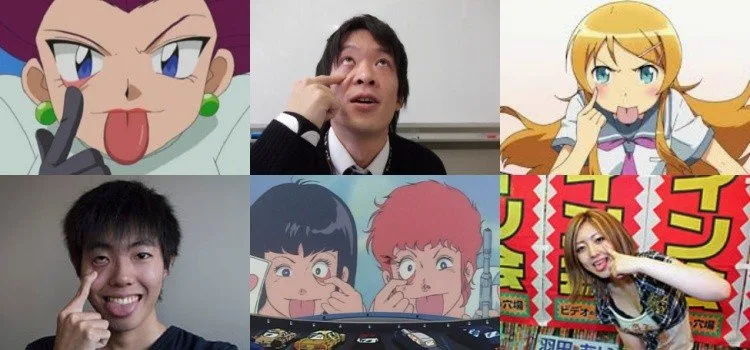
You’ve seen it a hundred times in Japanese animation: a finger yanks the lower eyelid down, the red shows, the tongue follows. It looks like a cartoon gag until you notice kids in Japan still do it in the schoolyard. That face has a name: akanbe.
The joke is smaller than it looks. Akanbe is not a Western-style insult. It is a childish poke — sarcasm, refusal, a “nyah” aimed at someone standing right there — and the word has been in print since at least 1909.
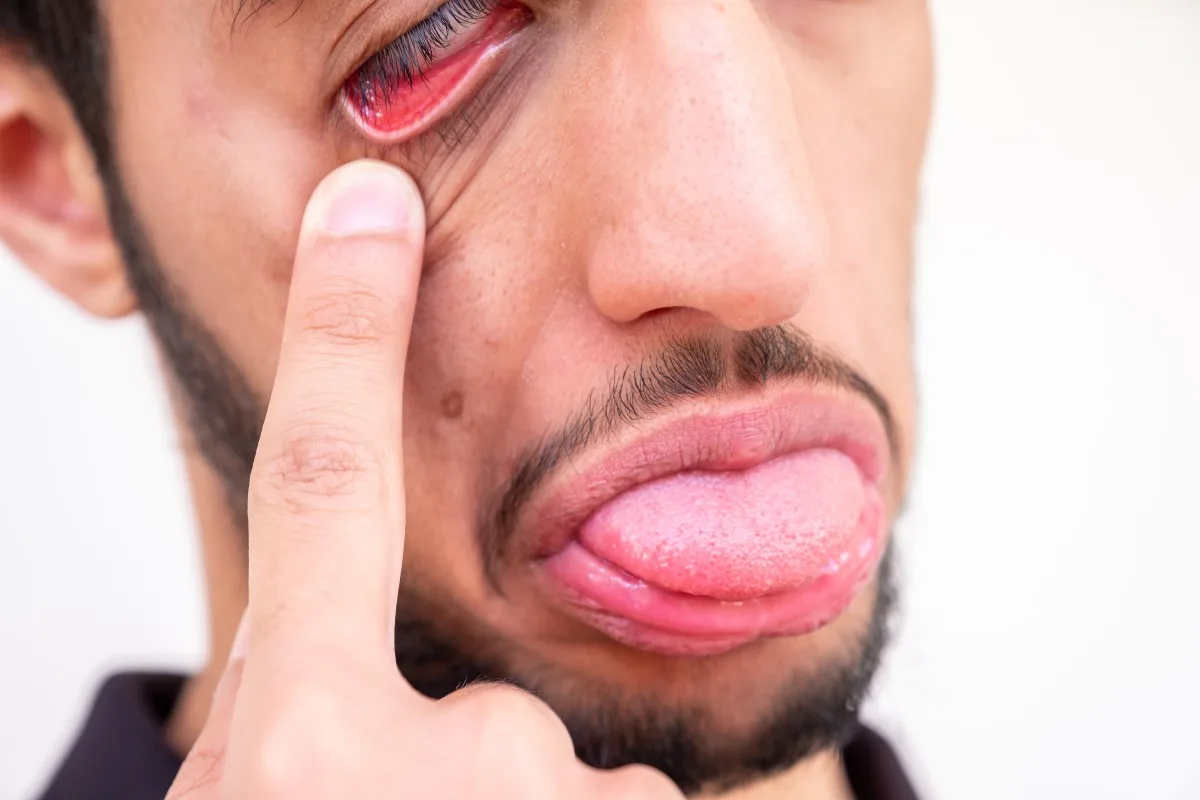
Akanbe or akkanbee [あかんべえ, あっかんべー, アッカンベー] is a Japanese facial gesture of teasing sarcasm. It is performed by pulling down the lower eyelid, exposing the red underside toward someone, and it is often done with the tongue sticking out. It reads as immature provocation, not a serious fight-starter.
In France the same eyelid tug often rides with mon œil — “my eye,” said the way English speakers say “yeah, right.” In Korea the playground cousin is merong [메롱]. The faces look alike; the shade of mockery is not identical.
Origin of Akanbe
The term first appeared in a story from 1909 written by Katai Tayama titled Inaka Kyōshi (田舎教師, “Country Teacher”). The gesture is used by male students in the story. The author gives the etymology of the word as a slip from akai me [赤い目], “red eyes” — the color you expose when the lower lid is pulled down. In the novel it is written 赤目 and glossed アカンベイ. The m in me sliding toward a b is the kind of sound change Japanese folk etymology loves.
There is an older cousin in the language. Natsume Sōseki’s Botchan has a character do a bekkankō [べっかんこう] with the index finger — same family of eyelid tease, different nickname. How far back the motion goes is unclear; Edo-period rakugo already uses an akanbe as a punchline, so the face is older than the Meiji spelling.
Although the word Akanbe originally referred to sticking the inner part of the eye out, it is now even used when someone just sticks their tongue out. A lot of people hear the bee as a cousin of bero, baby-talk for tongue. Both readings circulate. Either way, the move still feels a bit childish. In Japanese you do an akanbe: akanbe o suru [あかんべえをする]. Adults can still flash it as a joke among friends, but in a shop, at work, or toward a stranger it just looks rude and a little sad.
You will also see it next to other Japanese signs and gestures that look playful until you know what they are asking of the other person.
Akanbe in anime and manga
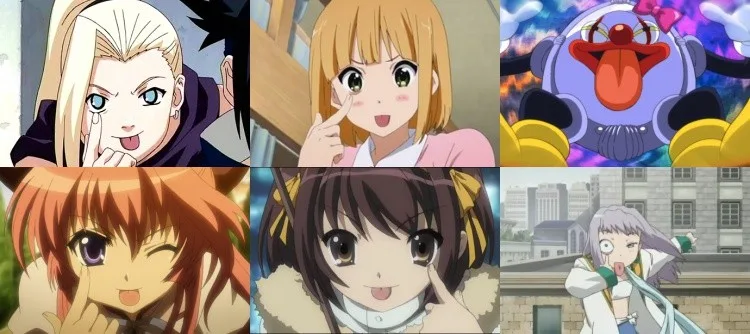
Currently this face turns up in all kinds of anime and manga, not only on female tsundere characters. Once you know the name, you start seeing it as a tease after a prank, a refusal, or a bratty send-off. Haruhi Suzumiya does it. So do kids in Naruto and Bleach, and a long list of school comedies. The point is the attitude, not a single character type.
In Smile Pretty Cure! the weekly monsters are literally called Akanbe (Buffoons in the Glitter Force dub). They get the name from the gesture: clownish eyes, a red streak, a tongue hanging out. They are not doing akanbe at the heroes so much as wearing the face as a design joke.
Doraemon and Crayon Shin-chan even borrowed the word for a Darth Vader gag, Akanbēdā. If you have watched any amount of Japanese pop, you have already been on the receiving end of an akanbe — you just may not have had the vocabulary.
If faces in Japanese media are your thing, the sanpaku eye is a different superstition entirely, and ahegao is another drawn expression with a completely different job.


Community
Comments
0 comments
There are no published comments in this language yet.
Send comment