

A single postcard can dump a hundred million yen into a shy girl's hands. A desperate man can walk onto a floating casino because a friend left him holding the debt. That is the mood of gambling manga: not lucky spin wheels for decoration, but tension, bluffing, and choices that leave a mark.
Whether the board is a lie, a ball, a mahjong tile, or a high-school dare, these stories turn risk into drama. Below are five titles that keep that pressure high without needing a real casino floor.
Contents 5
Liar Game
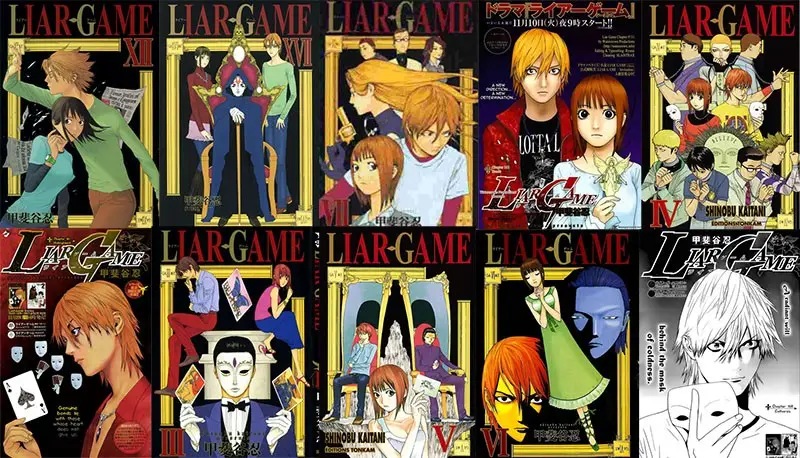
Liar Game is a super famous manga in Japan. Created by Shinobu Kaitani, this gambling-themed work was so successful that it even spawned a TV drama.
“Congratulations, you just won 100,000,000 yen by registering for Liar Game!” It was through this message, written on an innocuous card, that Nao Kanzaki saw her life change drastically. The young and still naive girl ends up getting involved in a game of lies and deception.
As the name suggests, the Liar Game is an individual competition where players are called to show their talent for lying to win. Each match ends when a player manages to obtain their opponent's money within a set period. Suspense, pressure, and tension blend together while intelligence and deceit carry the table—and Nao keeps finding ways to make people walk away better than the rules intended.
Kaiji
Better known as Tobaku Mokushiroku Kaiji (Gambling Apocalypse: Kaiji), this series is about gambling and life or death. One of its strengths is a synopsis that feels uncomfortably close to real money trouble: debts, bad friends, and one night that might erase everything. That grounded dread helped carry the manga far beyond a simple card-game fantasy.
When he finishes his studies, Itō Kaiji moves to Tokyo to find a stable job. After some events, he ends up owing money in the name of a friend.
In order to repay a large sum to a stranger named Endō, Kaiji boards the floating casino ship Espoir—French for “hope”—which offers the chance to win a huge amount in a single night. That is how he dives into a brutal adventure of rigged rules, alliances, and panic that still defines the genre for many readers. The series also sits among the most discussed modern best-selling mangas when people talk about long-running gambling epics.

Gamble Fish
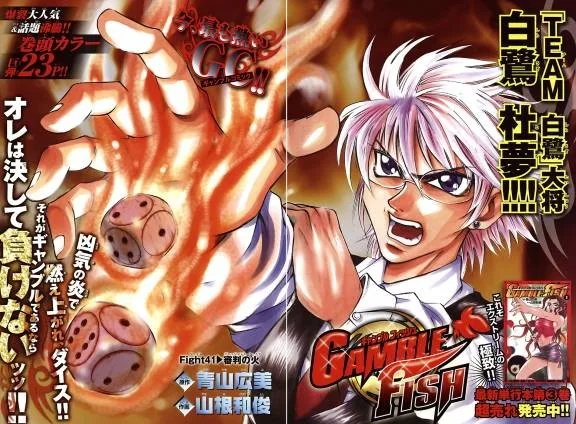
Serialized from 2007, Gamble Fish still gets recommended whenever someone wants a school setting that is louder and weirder than a pure casino story.
Its setup differs from debt ships and underground rooms. A young student arrives at a very famous wealthy school. Disinterested in the goals of that establishment, Tomu throws a crazy challenge: turn a 100-yen coin into several billion yen through betting over a few months.
The game must meet only one condition: the value of each bet must double the previous one. The students of the school then pile in, determined to silence Tomu. The result is less “elegant poker room” and more escalating dares, status wars, and absurd tables that still run on the same reader itch—what happens if the next wager cannot be walked back?
The Legend of the Gambler: Tetsuya
Shinjuku is drawn as a place where money for basic needs is tight, so some people turn to gambling in the hope of multiplying what little they have.
Tetsuya, the hero of the manga, visits mahjong parlors where he crushes opponent after opponent. His run is interrupted when he meets Boushu-san, an extremely talented player who forces him into a different level of the game. Here the thrill is quieter than Kaiji’s death games, but no less sharp: tiles, tables, pride, and a city that does not forgive soft hands.
One Outs
One Outs is a manga (and later a 25-episode anime) about baseball—one of the most popular sports in Japan. If you think that is the only theme, you are mistaken.
Hiromichi Kojima, a star batter, travels to Okinawa and meets Toua Tokuchi, the undisputed champion of a betting game derived from baseball called “One Outs.” After some attempts, Tokuchi is convinced Kojima could be useful and ends up linked to a team under a brutal contract: he receives 5 million yen for each opponent eliminated, but loses 50 million yen for each point he concedes.
Created by the same author as Liar Game, Shinobu Kaitani, the series uses the diamond as a table and pitching as the bluff. Fans who come for “smart gambling manga” often land here when they want strategy without leaving the sports frame. If you are mapping how creators jump between formats, it also sits near the wider conversation about anime and manga live-action adaptations—another path high-stakes titles sometimes take after print success.

If manga and high-stakes games are your corner of the bookshelf, start with any of these five. Each one bets on a different table—lies, debt ships, school doubles, mahjong parlors, or the pitcher’s mound—and still delivers the same rush: the next move might save you, or cost everything.







Community
Comments
0 comments
There are no published comments in this language yet.
Send comment