

Many end up confused and lost with the number of meanings of a word when browsing Japanese dictionaries like jisho.org or our Portuguese dictionary at japones.skdesu.com? Perhaps one might wonder, why do Japanese words have so many meanings? In this article, we will answer that question!
Sometimes a Japanese word has so many meanings that we become confused about which one is correct. Sometimes the same word has meanings that are completely unrelated to each other, and sometimes even opposite meanings.
There are many reasons for us to understand why Japanese words have many meanings. The 4 main reasons can be summarized in the article summary below:
Contents 5
Japanese Grammar Generates Many Meanings
The main reason the Japanese language has various meanings for a single expression is due to Japanese grammar. It uses many particles and complements that completely change the meaning of the word.
Generally, when searching for a word in the dictionary, it will not present it with different particles and complements. For this reason, a word in the dictionary can present opposite and different meanings.
The context can also change the meaning and the intention with which the word is spoken. For this reason, it is not good to cling to the meanings of a Japanese dictionary. Sometimes the dictionary even presents a negative version of the word.
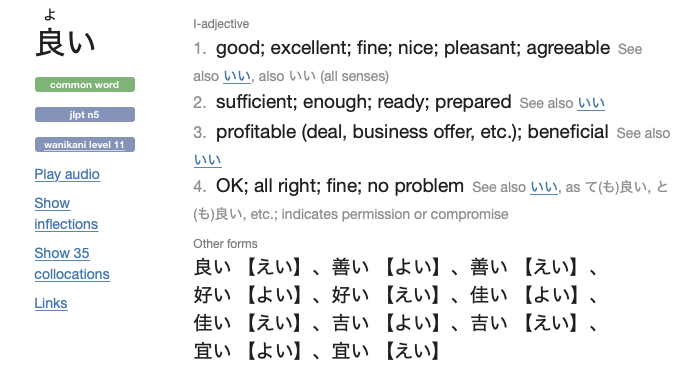
The same word followed by combinations like desu [です] can present a different meaning in the sentence. So most of the time when you find many meanings of a single word in the dictionary, it all relates to Japanese grammar.
Another thing that adds many meanings in the Japanese language is its transformation of words. A single word that is a noun can be transformed into a verb, adjective, and vice versa.
The sense that a word conveys varies according to the word that is combined with the context and the general category it belongs to. This is one of the peculiarities of the Japanese language, which we can find in any language.
Ideograms and Origin Created Many Meanings
The Japanese language has its alphabet based on ideograms that express ideas. A word can be composed of several ideograms that present different ideas. A single ideogram can also have multiple meanings.
Not to mention that the ideograms are of Chinese origin. Many Japanese words end up inheriting not only the Japanese meaning but also the Chinese meaning of the ideograms and words.
A single ideogram can present an isolated meaning or several meanings that are only correct when composed in a word. The dictionary hardly explains this and presents various meanings in a single ideogram.
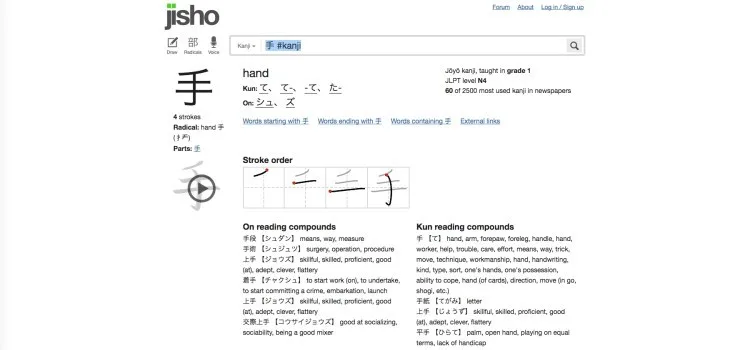
Generally, there are Japanese words composed of just one ideogram, sometimes with more than one pronunciation and with various meanings. The word itself with the meaning of the ideograms are different things.
This is not to mention the countless other Japanese words of foreign origin. This causes not only words with many meanings but also various words with the same meaning and the same use.
As an example, let's take the word maru [丸] which is just one ideogram. See below the list of meanings that this simple Japanese word can have:
- Circle;
- Wholeness, all, full, complete;
- Money, mass, spring;
- Cabinet within the walls of a castle;
- Suffix for names of ships, people, instruments, dogs, etc.;
If you search only for the ideogram, it will give you the meaning of round, circular, circle, return, full, perfection, pills, round, to roll up, to wrap, to seduce, and to explain;
See how confusing it gets? Don't worry too much about it, it may seem complex, but in reality, there's nothing to worry about. Most of the time, the particles, complements, and words from the context will help you understand what maru [丸] really means.
History and Evolution Changed Many Meanings
Throughout Japan's millennia-long history, words have changed their meaning and use. This happens in various languages, where we have words that we stop using, or they simply change their sense.
Japan has a tumultuous history with many abrupt changes both in the population and in the language. It is no wonder that Japan is divided into 47 states each with its own dialect and different accent.
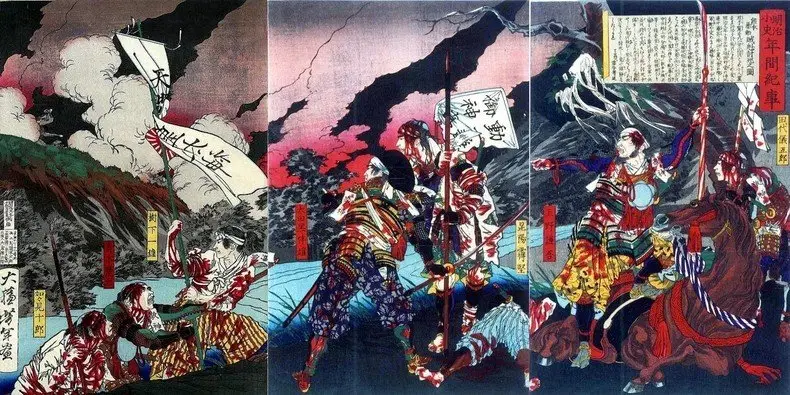
Japan spent a long time in civil wars where the population lived isolated, separated, and divided. This caused each part to use the Japanese language in a different way. Another reason why Japanese words have multiple meanings.
Nowadays, there are many words that have lost their original use, but dictionaries still maintain the present meaning. This is not exclusive to Japanese; just browse any dictionary and you will get lost.
Language Change Confuses Your Mind
In fact, as I have mentioned several times, you can take an English dictionary and check the meaning of a certain word; it will also present many different meanings.
Sometimes the meanings presented do not make sense, but they do for the Japanese. You are undergoing a language change, so it is understandable to feel completely lost with the way the Japanese think.
Another thing you need to keep in mind is that dictionary definitions may not be correct and may not correspond with live conversation or in different situations.
Without wanting to swear, Brazilians use the word caralho which in the dictionary refers to a part of a ship, but in informal language refers to the male genital organ, and at the same time refers to something surprising, admiration, or enthusiasm.
The Japanese language can have a lot of these incomprehensible things. For this reason, you need to adapt to the situation and real life and not get stuck to a dictionary.
How Not to Get Lost in Japanese
First, avoid trying to memorize the meanings of a word or ideogram within a Japanese dictionary. No one picks up a Portuguese dictionary and starts memorizing the meaning of each word.
Most Brazilians speak Portuguese without having spent time in the dictionary researching each word they wanted to learn. Try to learn things naturally without any worry.
To avoid problems when learning new words, try to focus only on the commonly used meaning of a Japanese word. But be flexible to understand new meanings depending on the context of a sentence.

It's like you want to hit a target. In target shooting, there are various points depending on where you hit. A Japanese word is like a target, where the most commonly used meaning is worth 100 points, while the secondary meaning is worth fewer points.
When you play target shooting, you always try to hit the center. So keep this in mind, if you don't hit the center, you will still score points, just don't try to hit outside. Remember that the position and strength of the wind can also affect the trajectory of your arrow.
The strength of the wind and your position is exactly the particles, context, and complements of the Japanese language. You need to adapt to the situation to hit the target right in the center.





Community
Comments
0 comments
There are no published comments in this language yet.
Send comment