
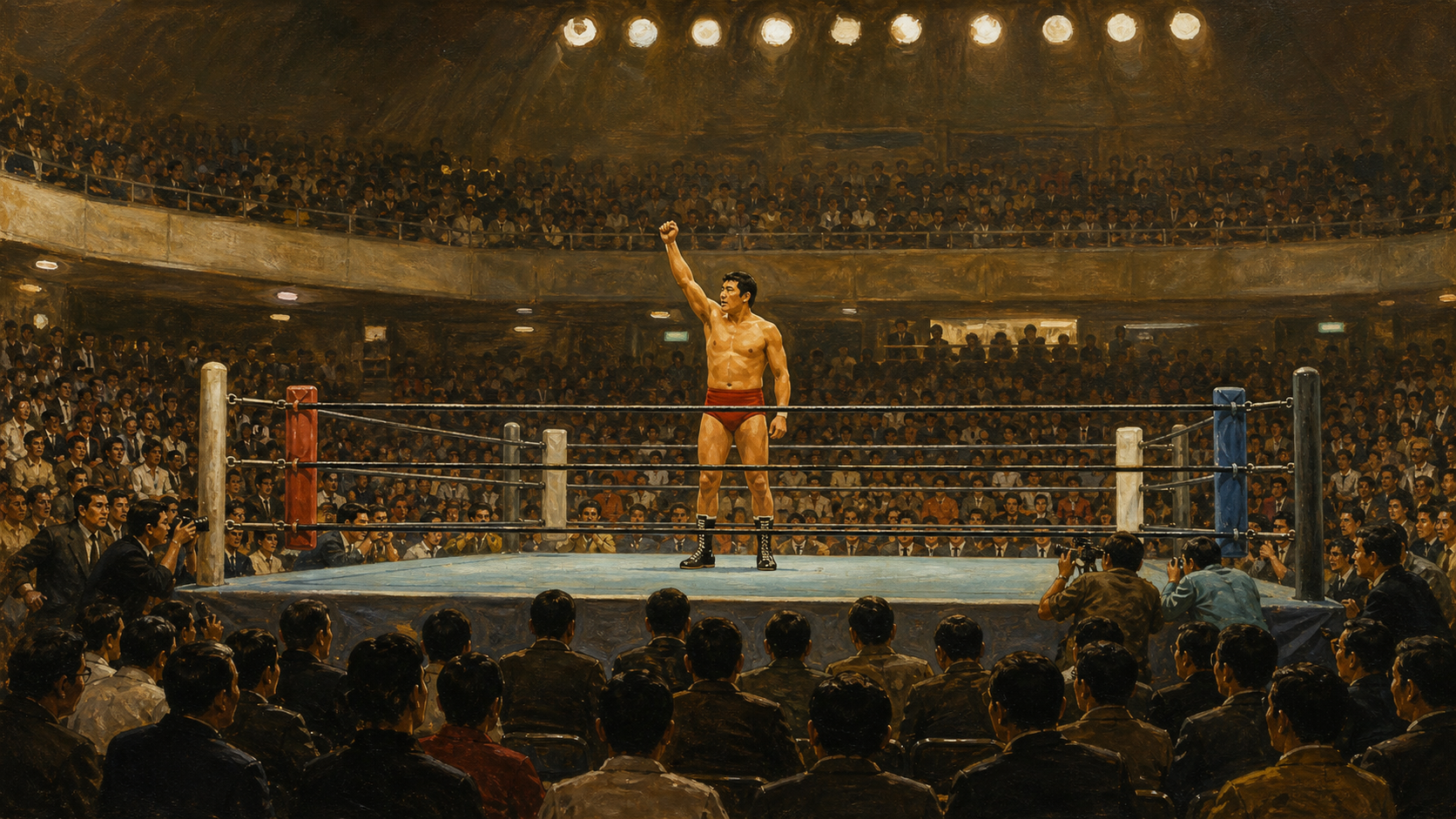
Giant Baba was the ring name of Shōhei Baba, a Japanese professional wrestler and promoter who founded All Japan Pro Wrestling in 1972. For many fans, he is the clearest starting point for understanding why puroresu became such a distinct part of Japan’s sporting culture: Baba was a headline attraction, a calm on-screen presence and the person responsible for giving a major promotion its direction.
His importance is not limited to a famous name or a signature move. Baba spent decades moving between the ring, the business side of wrestling and relationships with visiting talent. All Japan Pro Wrestling gave those roles a single stage, and its influence remained visible long after his death in 1999.

Contents 11
Who was Giant Baba?
Baba was born in Sanjō, Niigata, on January 23, 1938. Before professional wrestling, he played professional baseball; the International Professional Wrestling Hall of Fame describes him as a pitcher with strong prospects in Japan. That athletic background matters because it placed him in an era when broadcast sport was rapidly becoming part of everyday entertainment.
He entered wrestling in 1960 under the guidance of Rikidōzan, one of the foundational names in Japanese wrestling. The early years were demanding, but Baba soon had an advantage few wrestlers possessed: his height made him instantly recognisable, while his steady manner made him easy for a broad audience to follow.
From baseball player to international wrestler
Like many Japanese wrestlers of his generation, Baba gained experience abroad before returning home as a larger name. Sanjō’s historical museum records his 1961 trip to the United States, where he appeared as Shōhei Big Baba and Baba the Giant. After returning to Japan with Rikidōzan in 1963, he adopted the name Giant Baba.
Those tours were more than a detour in a biography. They gave him direct experience with overseas opponents, arenas and wrestling traditions. When foreign wrestlers later appeared in Japan, Baba could present them as meaningful challenges instead of disconnected guests. That exchange became one of the strengths of the promotion he would build.
Why did Giant Baba found All Japan Pro Wrestling?
In 1972, Baba left Japan Pro Wrestling and launched All Japan Pro Wrestling, usually shortened to AJPW. The timing placed him at the centre of a new chapter for the business. Rather than relying on one famous name, the promotion needed a dependable schedule, strong main events and opponents who felt important whenever they arrived.
Baba remained the face of All Japan for more than a decade while also running it. The International Professional Wrestling Hall of Fame notes that the company’s major programs later featured names such as Stan Hansen, Jumbo Tsuruta, Mitsuharu Misawa, Toshiaki Kawada, Kenta Kobashi and Steve Williams. That list is not a substitute for Baba’s own career; it shows the scale of the environment he helped maintain.
What made All Japan’s style stand out?
All Japan is often remembered for patient cards that built toward a major contest. The best way to describe that approach is not as a rulebook but as a sense of proportion: entrances, holds, counters and crowd reactions had time to matter. A match could become more intense without losing the feeling that both wrestlers were testing each other.
Baba’s promotion also made room for long-running rivalries and international matchups. Fans saw Japanese wrestlers measured against visitors including Bruno Sammartino, Fritz Von Erich and Gene Kiniski during Baba’s own career, while later All Japan cards continued the habit of presenting overseas talent as part of the story.
The 16 Mon Kick and Baba’s in-ring presence
The 16 Mon Kick was Baba’s best-known signature move: a high boot delivered with enough space and timing for the crowd to recognise it before it landed. Its appeal was not technical complexity. It worked because a simple move carried anticipation, and because opponents knew how to make that anticipation visible.
That economy suited Baba’s public image. He did not need to move at the pace of every younger wrestler to hold attention. His calm delivery, dry humour and unmistakable silhouette made him feel reliable in an industry built on larger-than-life personalities.
How should a new fan start watching Giant Baba?
Start with more than one period of his career. An early bout can show why Baba became a national attraction; a later All Japan main event can show how he used pace, distance and audience expectation. Watch the moments before the 16 Mon Kick, the pauses after a big exchange and the way the crowd responds before the finish.
Then watch an All Japan match from a later generation. The connection becomes easier to see: the promotion’s strongest contests did not appear from nowhere. Baba created a place where a major match could be treated as the reason for the whole card, not merely its last item.
Why Giant Baba still matters in puroresu
Giant Baba’s legacy has two sides. As a wrestler, he became one of the faces through which Japanese audiences encountered professional wrestling at home and abroad. As a promoter, he established All Japan Pro Wrestling and helped give it continuity through changing wrestlers, opponents and audiences.
For a newcomer, that is why he remains essential. Learning about Baba is not only learning the biography of a tall wrestler with a famous kick. It is learning how a promotion, a touring tradition and a shared language of main-event wrestling took shape in Japan.
Quick answers about Giant Baba
Was Giant Baba the founder of All Japan Pro Wrestling?
Yes. Giant Baba founded All Japan Pro Wrestling in 1972 and served as its central public figure for decades.
What was Giant Baba’s real name?
His real name was Shōhei Baba. Giant Baba became the ring name he used after returning to Japan in 1963.
Why is Giant Baba important to Japanese wrestling?
He combined a successful in-ring career with the work of building and leading All Japan Pro Wrestling. That gave him influence over both the matches fans watched and the promotion that presented them.


Community
Comments
0 comments
There are no published comments in this language yet.
Send comment