
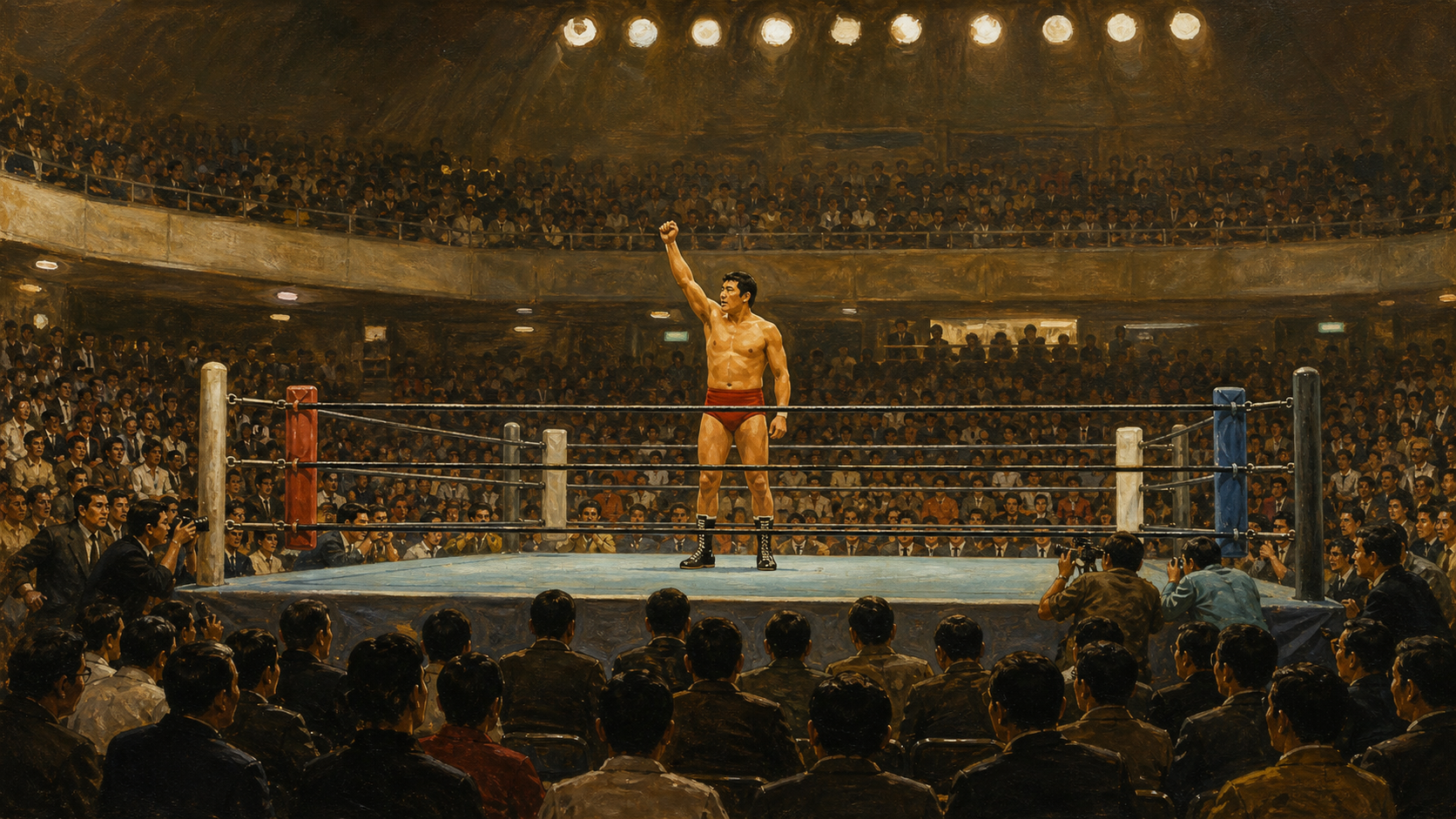
Antonio Inoki was one of the people who gave Japanese professional wrestling its modern scale and temperament. As a wrestler, promoter, and later politician, he understood that a match could carry more than a result: it could sell rivalry, test a style, and make an audience feel that something was at stake.
His name remains inseparable from New Japan Pro-Wrestling, the company he founded in 1972, and from the hard-edged idea of strong style. His 1976 draw with Muhammad Ali is still remembered because it put a wrestler and a world-famous boxer under one set of unusual rules before a global audience.
Contents 5
From the Japan Pro Wrestling Alliance to New Japan
Inoki entered professional wrestling through the Japan Pro Wrestling Alliance after being recruited by Rikidōzan. He worked in the United States, returned to Japan, and spent years building a public identity as a wrestler who looked capable of fighting outside the usual boundaries of the ring.
That identity became the foundation for New Japan Pro-Wrestling. Inoki announced the promotion in January 1972, then led its first event that March. The new company gave him a place to shape not only his own rivalries, but also the presentation of Japanese puroresu: foreign opponents, tournament stakes, and long main events could all be framed as tests of toughness rather than routine exhibition.
What strong style meant
Strong style is often treated as a single rule, but it is better understood as a way of presenting professional wrestling. New Japan placed emphasis on conditioning, hard contact, submission holds, martial-arts influence, and the sense that a wrestler needed more than charisma to survive a match.
That did not erase the theatrical side of pro wrestling. It changed the balance. A bout could still have a crowd-pleasing story, but Inoki wanted the movements, rivalries, and physical cost to suggest a real contest. The approach helped New Japan stand apart in Japan and influenced wrestlers who later carried its style into other promotions and combat-sports settings.
Muhammad Ali vs. Antonio Inoki
On June 26, 1976, Inoki faced Muhammad Ali at Nippon Budokan in Tokyo. The match ended in a draw after 15 rounds, but its reputation comes from the rules and the contrast between the athletes. Restrictions limited many of Inoki's usual options. He spent much of the contest on his back, attacking Ali's legs with kicks while Ali searched for safe opportunities to punch.
The result disappointed viewers expecting a constant exchange. It is also why the event is more interesting than a highlight reel suggests. The contest showed how much a cross-style match depends on the rules: they decide distance, permitted techniques, risk, and even what the crowd reads as an advantage. Calling it modern MMA would flatten those differences, but it was an important early example of a major event built around fighters from different traditions.
New Japan's wider influence
Inoki stayed at the center of New Japan for decades. The promotion brought together Japanese stars, international visitors, title tournaments, and major arena events. Its visual language made a wrestler's condition and fighting spirit part of the story, which gave audiences a clear reason to care before a bell rang.
His influence also reached the later meeting point between pro wrestling and mixed martial arts. Inoki promoted events that blurred those worlds and backed athletes who moved between them. That legacy is not a claim that every experiment succeeded; some of his choices divided fans. It does explain why discussions of Japanese MMA and modern puroresu keep returning to the questions he made popular: who looks credible, what rules make a contest meaningful, and how far a wrestling promotion can stretch its identity.
Beyond the ring
Inoki entered Japan's House of Councillors in 1989 and returned to national politics from 2013 to 2019. His political career drew attention partly because he carried the recognition of a wrestling star into public life. That transition was unusual, but it fits the pattern of his career: Inoki repeatedly used the visibility of the ring to enter a larger conversation.
For readers new to Japanese wrestling, his importance is easier to see through the company he left behind than through any one signature move. New Japan gave puroresu a durable home, strong style gave fans a vocabulary for its tone, and the Ali match made Inoki a reference point far beyond wrestling. He made spectacle feel like a challenge—and that idea still shapes how Japanese combat sports are discussed.



Community
Comments
0 comments
There are no published comments in this language yet.
Send comment