
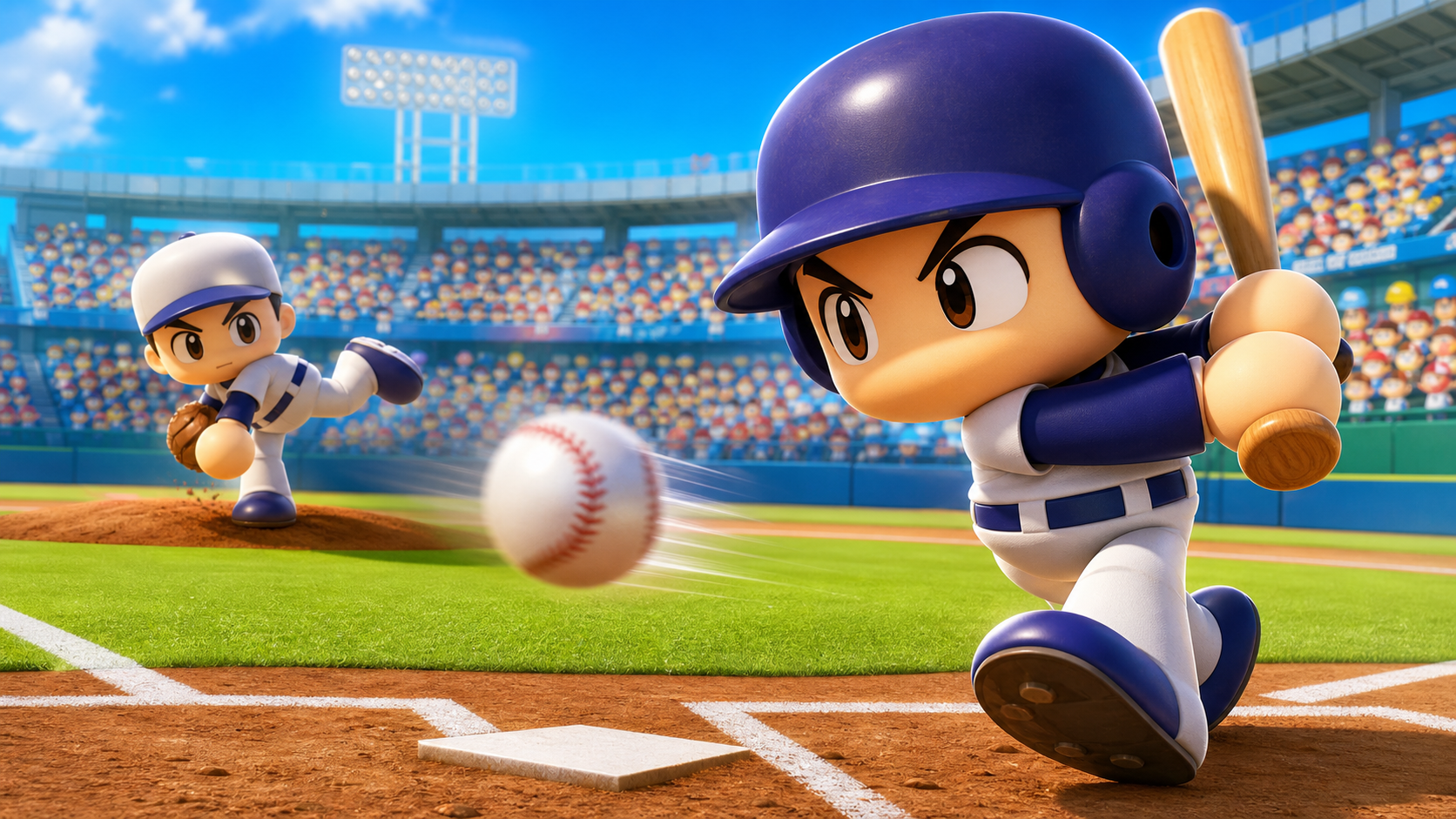
Jikkyō Powerful Pro Yakyū, usually called Pawa Puro, is one of Japan's best-known baseball game series because it makes a complicated sport feel welcoming without reducing it to a cartoon. The players have rounded, super-deformed proportions, yet a good at-bat still depends on reading the pitch, the count, the field and the risk of the next play.
That balance explains the series' long life. Pawa Puro gives a newcomer an immediate way into baseball while leaving enough decisions for someone who follows a lineup, notices pitcher fatigue or enjoys building a team. Konami marked the series' 30th anniversary with Powerful Pro Baseball 2024-2025, released in July 2024, but the appeal is older than any one edition: the game turns baseball knowledge into something you can use from the first inning.
Contents 6
Why Pawa Puro does not feel like a typical sports game
Many licensed sports games aim for broadcast-style realism. Pawa Puro takes another route. Its expressive, big-headed players make the ball easier to follow and give every hit, strikeout and diving stop a clear shape on screen. The style lowers the intimidation factor, especially for players who do not know every rule yet.
Under that friendly surface, the game still asks baseball questions. Should you wait for a pitch outside the zone? Is this the moment to steal? Does a tired pitcher need help? Those choices connect a short match to the rhythm of the sport rather than treating baseball as a backdrop for animations.

Baseball knowledge has a practical payoff
Pawa Puro is approachable because a casual game can be fun on timing alone. It becomes more satisfying once a player starts noticing why a pitch works. A fastball high in the zone, a breaking ball after two strikes, a runner on first with no outs: each situation changes the sensible choice.
Fielding works the same way. Positioning, the force play and the decision to protect an extra base all matter. The series does not require a rulebook before the first game, but it rewards the curiosity that comes after it. That makes it a useful bridge for someone learning how baseball strategy fits together.
Success mode gives the series its own rhythm
The series' Success mode is a major reason Pawa Puro feels different from a simple exhibition game. Instead of only managing a season, the player develops an original athlete through training and scenario-based choices. Attributes, opportunities and results gradually shape a player worth carrying into later games.
That player-building loop creates a personal stake that a normal roster screen cannot. Recent editions have continued to give Success several routes: the 2024-2025 release includes new and remade scenarios, while guide sites organize its scenarios by the kind of player and training path they support. The important point is not finding a single perfect build; it is seeing how practice, choices and baseball results affect one created player.
Why Japanese baseball fits the format so well
Baseball already has a shared vocabulary in Japan: batting orders, relief pitchers, bunts, stolen bases and the tension of a full count. Pawa Puro turns that vocabulary into quick decisions. A match can be a light game with friends, but it can also become a way to test how a batting order or pitching plan might work.
The link to professional baseball gives those decisions extra texture. A roster is not just a set of uniforms; it is a group of roles to arrange. Put a reliable hitter in a different spot, change the pitching sequence, or protect a narrow lead, and the game gives each small call a visible consequence.
What the 30th-anniversary edition says about Pawa Puro
Powerful Pro Baseball 2024-2025 brought together familiar parts of the series, including Success, Eikan Nine and other player-development modes. Nintendo's overview of the anniversary release highlights both new scenarios and long-running modes, which is a useful picture of what Pawa Puro has always tried to offer: a fast game when you want one, and longer projects when you do not.
That variety also keeps the series from being locked to one audience. A younger player can learn the feel of batting and pitching. A baseball fan can experiment with matchups and rosters. Someone who likes character progression can spend more time on a created athlete. The same game meets those players in different places without pretending they all want the same thing.
Who will enjoy Pawa Puro?
Pawa Puro makes sense for players who want a Japanese take on baseball rather than a strict television simulation. The visual style is easy to recognize, the matches are readable, and the deeper modes give practice a purpose beyond a single scoreline. It is also a good fit for anyone curious about baseball but unsure where to begin: play a few innings, notice the situations that repeat, then let the game make the rules familiar.
The big-headed look is memorable, but it is not the whole story. Pawa Puro lasts because a clean hit feels good immediately, while a well-planned inning feels better the more you understand the sport. That is a rare balance for a baseball game, and it is why the nickname still carries weight in Japan.




Community
Comments
0 comments
There are no published comments in this language yet.
Send comment