
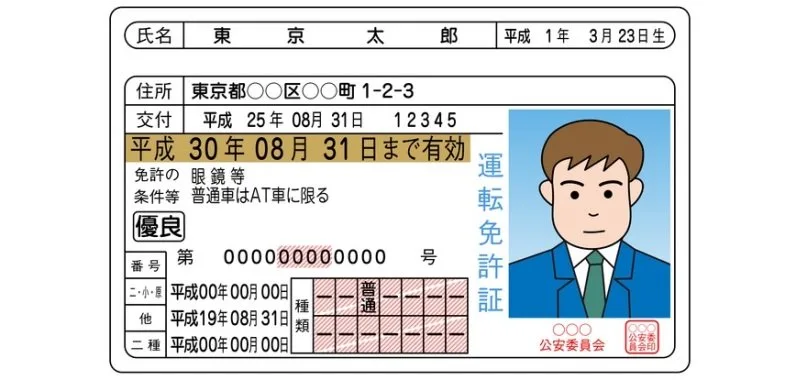
Arriving in Japan with a foreign driver's license feels like half the battle is already won. In practice, conversion is its own process: paperwork, a Japanese translation, and often a written exam plus a closed-course practical test that fails many people on the first try.
That path is still shorter than building a Japanese license from zero with a full school program. The catch is that the rules depend on the country that issued your license, your residence status, and how well you handle Japanese traffic logic — not only on how many years you drove back home.
Below is the official transfer route known as Gaimen Kirikae (外免切替), with documents, common friction points, and where a focused prep course still saves time and money — especially if you come from a country that must take both exams, such as Brazil.
Access the driver's license course for Japan
Contents 11
What Gaimen Kirikae actually is
Gaimen Kirikae is the procedure that lets you switch a valid foreign administrative driver's license into a Japanese license at the Driver's License Center (Menkyo Center) of the prefecture where you live. An International Driving Permit alone is not enough for conversion.
According to the Japan Automobile Federation (JAF), two basic conditions apply before you even open the form:
- Your foreign license must still be valid — expired cards cannot be transferred.
- You must prove that you stayed in the issuing country for at least three months in total after obtaining that license.
Conversion is for people living in Japan with a proper residence record. Short tourist stays are not the intended path. Rules and appointment systems also vary by prefecture, so always confirm the latest checklist with your local center before booking a date.
If you are still mapping the broader licensing landscape — not only transfer — see our guide to a Japanese driver's license from the ground up.
Documents you should expect to prepare
Exact lists change by prefecture and by issuing country, but the core set is fairly stable:
- Application form and application photo (commonly 3.0 cm × 2.4 cm, recent, plain background).
- Valid foreign driver's license (physical card). Bring older licenses if you still have them and the issue date is hard to prove.
- Official Japanese translation of that license — usually issued by JAF, and sometimes by the embassy/consulate of the issuing country or other recognized providers listed by local police.
- Certificate of residence (juminhyo) showing your registered address and nationality or domicile details as required locally.
- Residence card (or equivalent ID), passport, and any stamp history that proves the three-month stay after issue. Dual nationals and stamp-free travel histories often need extra originals such as employment or school certificates.
- Processing fees for the application and, when required, for the tests.
JAF translations for conversion are applied online from within Japan; the federation publishes current fees and extra country-specific uploads on its site. Getting the translation does not guarantee that the Menkyo Center will accept your conversion on the first visit.
Preferential countries versus written and practical tests
Japan does not treat every foreign license the same way.
Holders from a defined list of countries and regions (and a few U.S. states) can convert under a simplified route focused on document screening and aptitude checks, without the same written-plus-practical burden. Everyone else — including Brazilian license holders in the usual case — still goes through theoretical and practical exams after the paperwork interview.
That is why the popular phrase “I only need to retake the tests” is both true and incomplete for many nationalities. You skip the full Japanese driving-school pipeline, but you still have to pass Japanese-style theory and a circuit that rewards precision over confidence. Waiting times at the center, failed practicals, and rebooking can stretch the calendar for months.
A useful contrast for travelers (not converters): temporary driving with a Geneva Convention International Driving Permit, or with a license-plus-JAF translation for a short list of countries such as Switzerland, Germany, France, Belgium, Monaco, and Taiwan, is a different legal track. Those options do not replace a Japanese license for long-term residents.
Short-Term Visitors & Tourists: How to Get Your Mandatory JAF Translation
If you are visiting Japan as a short-term tourist with a driver's license from Germany, Switzerland, France, Monaco, Taiwan or Belgium, an International Driving Permit (IDP) is legally not recognized. You are strictly required to carry your original national license along with an official Japanese translation.
Current Friction Points & The Local Solution:
Since the Japan Automobile Federation (JAF) permanently closed all of its physical service counters across Japan, applications must be submitted strictly online. However, JAF's official portal blocks overseas IP addresses and foreign credit cards (geoblocking). Even after arriving in Japan, travel eSIMs frequently fail to access the system because they route data through overseas servers. Furthermore, there are no local motoring clubs or authorities in France, Switzerland, or Belgium that can issue this translation prior to departure.
A fast and reliable solution is provided by One Click Japan. Based directly on the ground in Ehime, Japan, their team processes official JAF translations within 24 to 48 hours. Once completed, you can easily print your official translation at any convenience store (7-Eleven, Lawson, FamilyMart) upon arrival in Japan, or have it delivered to your hotel or directly to your home address before your trip.
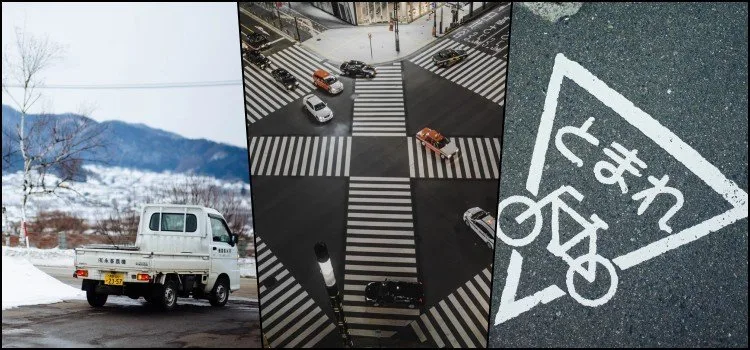
Before the practical day, it also helps to study how signs actually look on the road. Our notes on traffic signs and signals in Japan and traffic vocabulary in Japanese pair well with theory drills.
Where prep courses still make sense
People who transfer from Brazil and similar test-required countries often burn money on interpreters, last-minute lesson packages, and repeated practical attempts. A structured online prep course will not stamp the license for you, but it can compress the learning curve: which documents matter, how the interview usually goes, how Japanese sign questions are phrased, and how each circuit maneuver is judged.
That is the role of the Kirizawa course we recommend for candidates who want fewer blind spots between booking and exam day:
Access the driver's license course for Japan
Course content for driver's license transfer prep
- Find out whether your case fits an interpreter, a service provider, a Japanese-speaking friend, or a fully independent path.
- Which documents are necessary and how to obtain them.
- Interview: what it is like, how to proceed, which details you must know, and practical tips.
- Theoretical test: practice texts, signs, general signaling, and exam-style tips.
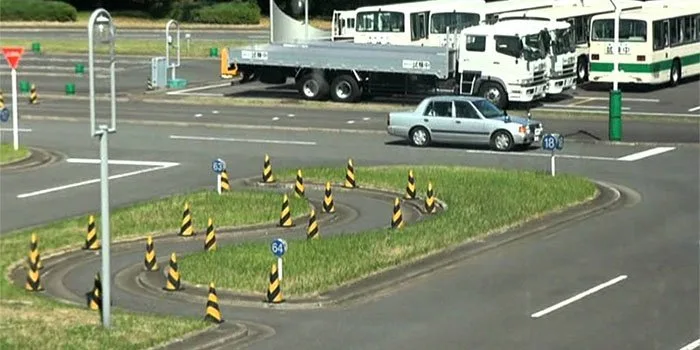
- Practical test: video lessons walking through circuit maneuvers and how examiners tend to score them.
- Psychological support: preparation before test day so nerves do not erase technical progress.
Access the driver's license course for Japan
Questions about the course
Some people worry about buying prep material online. The course is offered through the Hotmart platform; if it disappoints within the refund window, you can request a refund under Hotmart's rules for that product.
How long is the course available?
After purchase, the Japan driver's license course remains available for 180 days (about six months). During that window you can rewatch lessons and retake simulations as often as you need.
Who is this course for?
- People who will hire a helper or company for the process and want clearer detail on each step.
- People who will use an independent translator and need a full map of the transfer stages.
- People who already speak Japanese and will handle the transfer alone.
- People starting a Japanese license closer to zero who still benefit from practical-test tips.
Can I do everything on my own with the course?
Yes — if your Japanese is strong enough for appointments, counters, and day-of instructions. If not, hire an interpreter or ask a Japanese-speaking friend to help with scheduling and on-site translation for the interview, theoretical test, and practical test.
Even with solid prep, treat the Menkyo Center as the final authority: bring originals, arrive early, and recheck local rules close to your appointment date. Conversion rules and exam scoring have tightened over time for many applicants, so “what a friend did years ago” is not a safe checklist.




Community
Comments
0 comments
There are no published comments in this language yet.
Send comment