
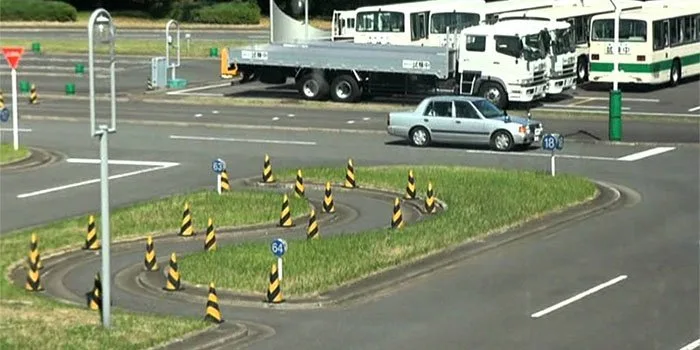
Anyone who wants to drive in Japan soon notices: it is not only about knowing how to drive. The Japanese driver's license — unten menkyoshō [運転免許証] — sits inside a system of theory, practice, vision checks, and strict rules. Reach about 15 demerit points for traffic violations and you risk losing the right to drive. And if you already hold a license from another country, your path is often different from someone starting from zero in Japan.
This guide maps the main routes: short stays with an International Driving Permit (or a special translation for a few countries), converting a foreign license as a resident, and the full Japanese school-and-exam track — plus cost ranges, the gold license, and what everyday traffic feels like.
Contents 7
What a Japanese driver's license is
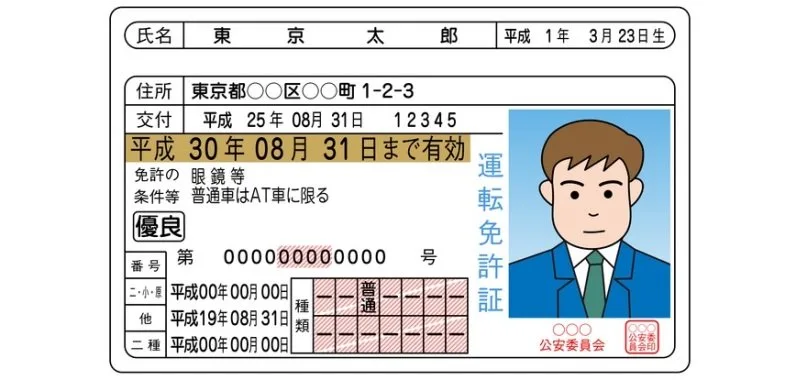
The unten menkyoshō is Japan's driver's license. Getting it means going through formal procedures; keeping it means taking traffic rules seriously. With a standard ordinary car license you can typically drive passenger cars, mopeds up to about 50 cc, and light commercial vehicles within the class limits printed on the card — always check your prefecture's license center for the exact privileges of your category.
Short stay: driving as a visitor
For many English-speaking readers, this is the first real fork. Most short-term visitors drive with a valid national license plus an International Driving Permit (IDP) issued under the 1949 Geneva Convention — obtained in the home country before travel. Japan does not treat every "international license" as valid; Vienna Convention booklets and casual online papers usually will not work.
With a recognized IDP and the original license, you can generally drive for up to one year from the date of entry into Japan (or until the IDP expires, whichever is shorter). Both documents must be carried. Holders of licenses from Switzerland, Germany, France, Belgium, Monaco, or Taiwan often use a different tourist route: the national license with an official Japanese translation (for example from JAF), also typically limited to one year from entry.
An IDP is not a long-term residency solution. Once you live in Japan, plan the switch to a Japanese license in time — do not assume you can keep renewing the visitor path indefinitely.
Converting a foreign license (gaimen kirikae) as a resident
Residents who already hold a valid foreign license usually apply for gaimen kirikae (foreign license conversion) at the Driver's License Center of the prefecture where they are registered. An IDP alone is not enough to convert; you need the real foreign license.
Typical requirements and documents (details vary by prefecture):
- a currently valid foreign driver's license (expired cards cannot be switched);
- proof that you stayed at least about three months in total in the issuing country after you obtained the license;
- a Japanese translation of that license (often through JAF or another designated body);
- residence certificate (jūminhyō), residence card or equivalent ID, passport, application photos, and further identity papers as asked;
- vision screening on site; knowledge and/or practical tests depending on the country or U.S. state that issued your license — some places are exempt from both exams when conditions are met, but the local center has the final say.
Rules tightened for short-term visitors: as a rule, tourists without residency registration are no longer expected to convert a license using a hotel address. Written and practical standards have also been described as stricter in several prefectures. If you are unsure, call the center that covers your address — not only forum posts.
For a closer look at the transfer path, see also transferring your foreign driver's license in Japan.
Getting a Japanese license from scratch
Anyone earning a first Japanese license in Japan takes the long road: lessons, theory, and several practical stages. In the classic track you will usually meet:
- a theoretical exam (often 50 questions in the first phase);
- a practical exam at a traffic center or designated school course;
- then a provisional license called karimenkyo [仮免許];
- more practice, a larger theory paper (often 100 questions), and final practical checks;
- vision and hearing screening plus knowledge of Japanese traffic habits.
Roughly, the path splits into two blocks: Karimen (toward the provisional license) and Honmen (final phase until the full license). Standards are high; many people need more than one try at the practical test because the course rewards precision and rule-following more than "just driving somehow."
A popular intensive option among locals is gasshuku: a concentrated course, often with lodging, that removes daily distractions and compresses the timeline. It costs more, but for some people it is the more realistic way to finish without months of stop-and-start lessons.
How much does a Japanese driver's license cost?
For full training at a driving school, budgets often land in the range of tens of thousands to over 200,000 yen — depending on school, region, vehicle class, automatic vs. manual, and whether you choose a normal schedule or gasshuku. Exam and issuance fees are extra and vary by prefecture.
Converting a foreign license is usually far cheaper at the counter than starting from zero; translation, optional practice lessons, and interpreters (if needed) can still add up. Always confirm yen amounts with the local license center and school — figures move and are not identical nationwide. Passing scores on theory are often strict (around 90% correct is a common bar when a written paper is required).
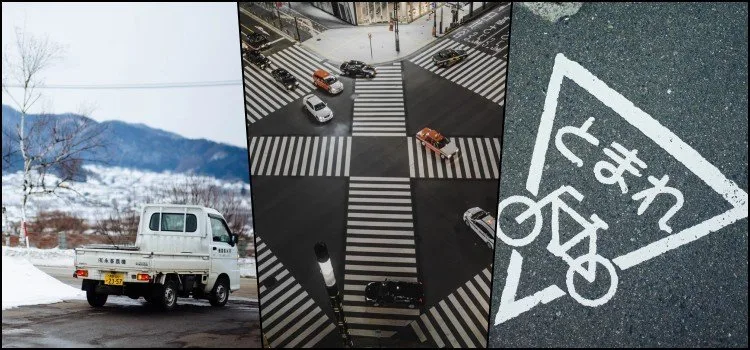
For everyday orientation, see traffic signs and signals in Japan and, once you drive, Japanese car stickers (wakaba and other marks).
The gold driver's license
Japan also has a "gold" license: drivers who stay free of relevant violations for a longer stretch (often five years) may receive a gold stripe instead of the blue one at renewal. Benefits depend on renewal rules and insurers — often a longer validity period and discounts — but gold status can disappear quickly when points and offenses return.
Minor infractions are not treated as casual "it'll be fine" moments. Demerit points, fines, and in extreme cases license suspension or cancellation are part of the system — in the same serious spirit as Japan's hard line on drinking and driving.
In short
Three paths, three logics: drive short-term with a recognized IDP (or a special license-plus-translation setup for certain countries); convert as a resident while the window and documents still fit; or complete the full Japanese training track with Karimen and Honmen. Costs and exams depend heavily on where you live and which license you started with. The expensive mistake is treating any international booklet as a permanent Japan free pass.
If you want the street beyond the passenger car: how car insurance works in Japan and why Japan drives on the left fill in more of the traffic picture.






Community
Comments
0 comments
There are no published comments in this language yet.
Send comment