
Tomoe Gozen is often called the most famous woman warrior in Japanese history. Her name comes from one of the country’s great epics, she fights in a battle against a larger army and then disappears from the record. That is exactly where the historians’ problem begins.
This article separates what the epic says, what contemporary sources noted and what arrived later. With Tomoe, the little that survives is almost entirely literature.
Contents 10
Who she is supposed to have been
Tomoe was an onna-musha, a female warrior of the late Heian period. She served Minamoto no Yoshinaka, a commander of the Minamoto clan who turned against his cousin Yoritomo during the turmoil of the Genpei War.
The name comes in two parts. Gozen is not a surname but a title given to women of rank. Tomoe is the name itself, and how she carried it is not recorded.
What the epic says about her
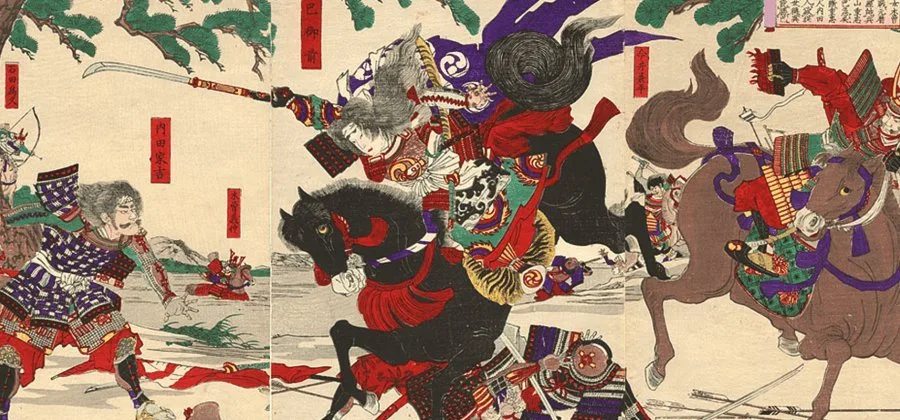
The main source is the Tale of the Heike, the epic of the fall of the Taira. It describes Tomoe as a fair, beautiful woman with long hair and one of the strongest archers of her time, who fought on horseback and with the sword.
In that account she was one of a thousand warriors fit for such a role. The formula says less about her army than about the tone of the epic, which likes round numbers.

Which text tells her story
The Tale of the Heike is not one book but a group of versions that grew for centuries, first orally and then in writing. The best known, the Kakuichi text, took shape in the early fifteenth century, more than two centuries after the battle.
Anyone quoting Tomoe is usually quoting that late version. For the question of what happened in 1184 it is therefore a second hand source, which explains the distance between narrative and evidence.
The war she fights in
The Genpei War decided who would rule Japan, the Taira or the Minamoto. In 1183 Yoshinaka drove the Taira out of Kyoto and then wanted to lead the clan himself.
Yoritomo could not allow that. He sent his brothers Yoshitsune and Noriyori against Yoshinaka, and in February 1184 the armies met at Awazu, today part of Otsu on Lake Biwa.
The battle of Awazu
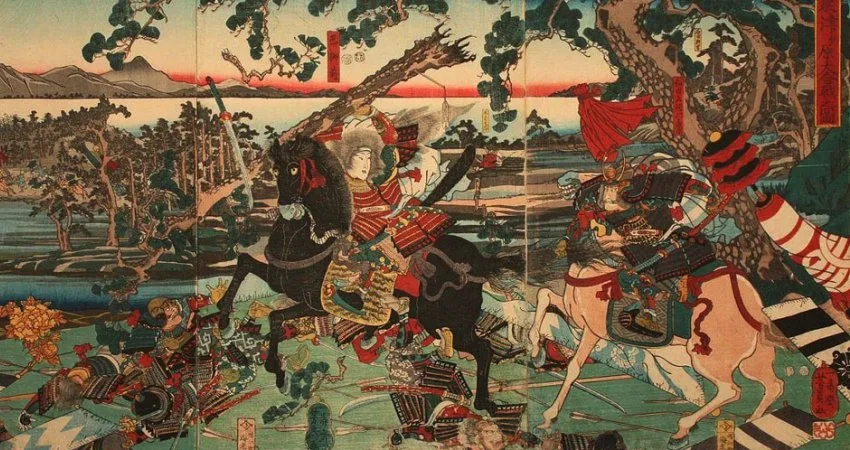
The epic has Tomoe ride with three hundred horsemen against two thousand Taira warriors. She is said to have defeated Honda no Morishige, leader of the Musashi clan, and to have brought his head to her lord.
She is also credited with the death of Uchida Ieyoshi and with escaping capture by Hatakeyama Shigetada. Even so, Yoshinaka’s army was outnumbered and overwhelmed.
The parting
When only a few men were left, Yoshinaka ordered her to flee. He wanted to die with his foster brother Imai Kanehira and gave the order on the grounds that she was a woman. She refused at first, then obeyed and rode east.
Yoshinaka died in that battle. The order is the heart of the character: the epic does not make her weak, it lets her lord decide, and it lets her leave instead of ending in the fight.
Three endings, no agreement
The tradition knows several outcomes. In one version Tomoe became a nun and lived until 1247, decades after the battle. Other texts link her to Wada Yoshimori, an ally of Yoritomo, as a concubine and make her the mother of the later warrior Asahina Yoshihide.
Others have her die at Awazu. These contradictions are not a mistake of the story, they show that several tellers kept reshaping the figure for their own purposes.
Did she really exist
In the contemporary accounts of the Genpei War Tomoe does not appear. She shows up only in later epics and their variants, which leads historians to leave her existence open.
That does not mean there were no women fighters. There were, and other sources name noblewomen who carried weapons. Only the figure as the epic draws her cannot be proven.
Why she survives
Tomoe works through contrast. She fights beside a man who loses and outshines him in memory. The epic needs her to show loss and loyalty, not to celebrate a victory.
Theatre, prints and games came later. In kabuki and noh plays she is a role where weapons and grief meet, and in modern pop culture she stands for the woman who enters a world of men.
Where to read more
On the history of women in the warrior class there is a separate piece on the onna-bugeisha. Anyone drawn to the men’s world of that era finds another way into it in the portrait of Yasuke.


Community
Comments
0 comments
There are no published comments in this language yet.
Send comment