
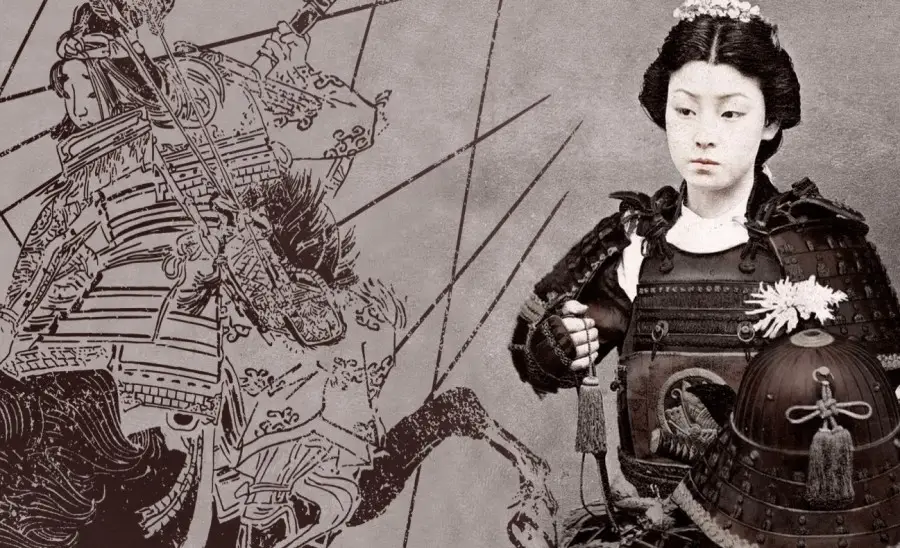
Did you know that there were female samurai? Generally, when we hear about samurai, the first thing that comes to mind is warrior men. But that wasn't always the case; there were also female samurai. They were called onna-bugeisha (女武芸者).
Because of the patriarchal Japanese society, it is not very common to talk about female samurai. After all, in terms of numbers, women were a minority, but a significant minority.
The samurai had the main function of fighting to protect castles and villages. And although it happened less frequently, they did participate in battles alongside men.
Contents 5
History of the Onna-Bugeisha
Archaeologists have found evidence of women on the battlefield. Excavations indicated the existence of these warriors. DNA tests were conducted on 105 bodies, and of those, 35 were women. In two other excavations, the results were similar.
These warriors appeared during the Sengoku period (戦国時代) between the mid-fifteenth century and the end of the sixteenth century.
They are rarely mentioned because history has always prioritized male warriors. The main function of the onna-bugeisha was to protect the lands and villages in the absence of male warriors.
Occasionally, the female warriors could participate in fights, and this is evidenced during the Heian period (平安時代, from 794 to 1185) and Kamakura (鎌倉幕府, officially recognized in 1192, although the period began in 1185).
During these periods, they also helped colonize territories.
During the Meiji Restoration around the nineteenth century, male and female samurai began to lose their place. One of the significant reforms during this period was the organized armies, so protection by samurai was no longer necessary.
Weapons, Skills, and Training
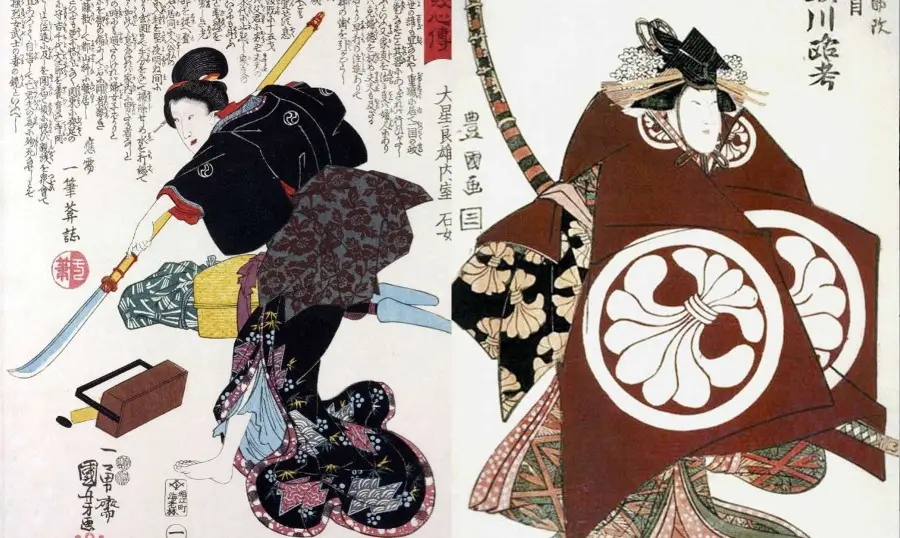
Just like the male warriors, female samurai also followed the teachings of the Bushido code. They were also experts in fighting with daggers. Most of the female warriors were educated in sciences, mathematics, and literature.
For training, they used naginatas (なぎなた, 薙刀), similar to a spear but with a curved blade at the tip. This weapon could even help the female warriors compensate for their physical disadvantage compared to men.
A warrior who stood out for her use of this weapon was Tomoe Gozen. She was a Japanese warrior who lived from around 1157 to 1247. It was during the Genpei War that Tomoe Gozen distinguished herself and gained fame as a warrior.
Tomoe Gozen was not the only warrior who stood out; let's get to know other female warriors like Hangaku Gozen, Empress Jingū Kōgō, and Nakano Takeko. But the complete story of Tomoe Gozen is already here on the site.
Empress Jingū Kōgō
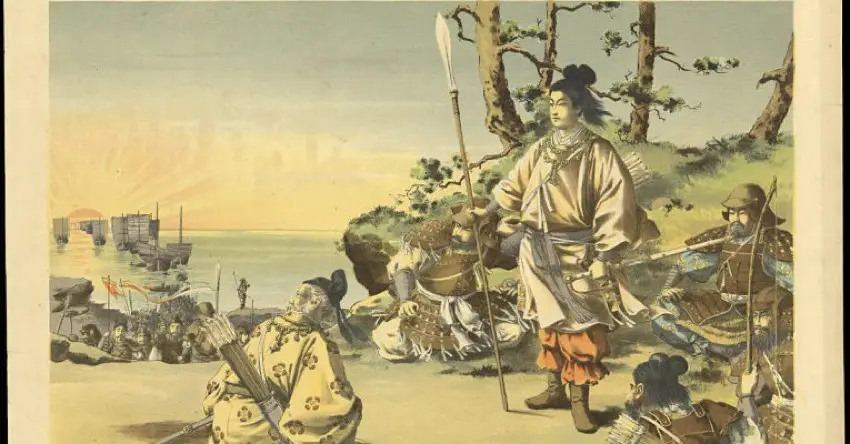
There is not much information about the life of Empress Jingū Kōgō (神功天皇); the few pieces of evidence show that she must have lived in the first century around the year 170. She is likely to have been the first onna-bugeisha.
She took possession of the Japanese throne, becoming empress because her husband, Emperor Chuai (14th Emperor of Japan), passed away, and she had to take over until her son was old enough to lead.
She surprised everyone with her sensibility in planning military strategies to invade Korea and conquer the country. And in less than a year after she took the throne, she managed to do so.
The deeds of the Empress initiated a period of a matriarchal society in the eastern region of Japan.
However, after her son Ōjin ascended to the throne, the name of Jingū Kōgō was not consolidated as the 15th Sovereign of the Japanese throne. But Jingū Kōgō reigned until the year of her death.
Hangaku Gozen
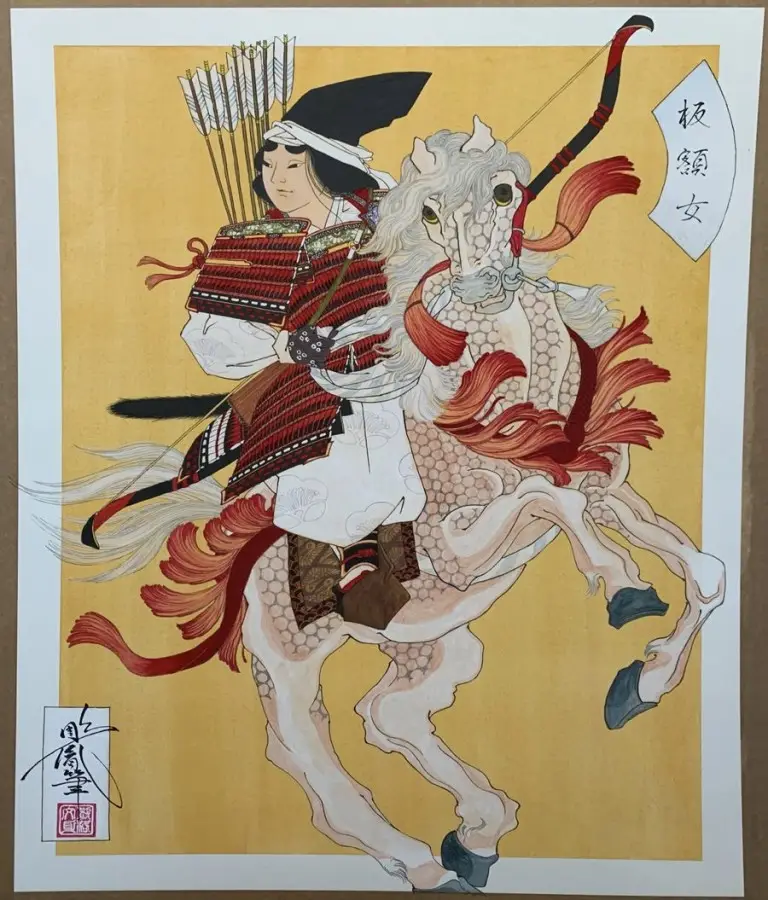
Hangaku Gozen (坂額御前), also known as Lady Hangaku, lived during the late Heian period and the early Kamakura period. She was the daughter of a warrior named Jō Sukekuni (城 資 国).
Hangaku was allied with the Taira clan, a powerful local clan from the province of Echigo. She was known for her skills as an archer.
She and her nephew Ju Sukemori, who was also a warrior, joined forces to participate in the Kennin Revolt to defeat the Kamakura shogunate as they were Taira rivals. Hangaku Gozen led and formed an army composed of three thousand soldiers.
However, the opponents had many more warriors for the battle, and she was wounded in the leg by an arrow.
She became a prisoner in the Shogun and only did not commit seppuku because a Minamoto soldier ended up falling in love with her, which led to her being released to marry.
Nakano Takeko
Nakano Takeko (中野竹子) was one of the most honored female samurai. She was the firstborn daughter of the Aizu official and samurai Nakano Heinai. Being from an important family, she began her studies at just six years old. She studied martial arts, literature, calligraphy, among others.
Nakano Takeko was adopted by the teacher Akaoka Daisuke and began teaching martial arts and naginata.
Nakano became an instructor of naginata for women and children at the Aizuwakamatsu castle in Aizu. During this same period, around 1868, she also became involved in the Boshin War with other female warriors.
This group of female warriors came to be called Jōshitai, the women's army. The opposing army, upon noticing that the front line was composed of women, decided to cease their attacks.
But the female warriors took advantage of this to attack them using their naginatas while the opponents used firearms. The Jōshitai left hundreds dead.
Despite the good strategy, Nakano Takeko ended up being shot. To be buried and not allow her enemies to violate her body to use it as a trophy, she asked her sister, Yūko, to behead her while still in battle.
Yūko took her sister's head to the Hōkai temple of the family.
What did you think of these warrior women?





Community
Comments
0 comments
There are no published comments in this language yet.
Send comment