

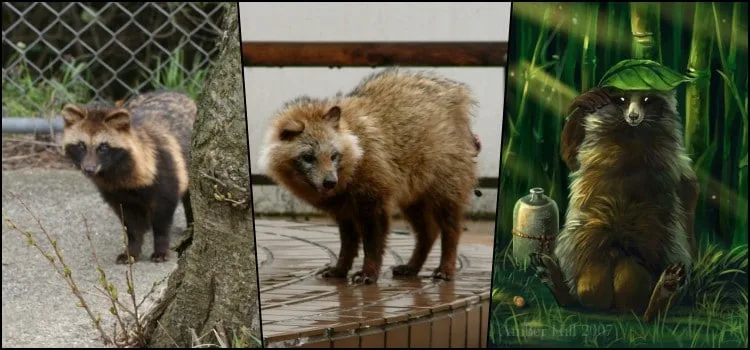
The tanuki (狸) or Japanese raccoon dog is a small canine animal from Japan, reaching up to 65 cm in length and weighing between 4 to 10 kg. One of its most recognized physical characteristics is the black markings around its eyes. They can be found in mountains and plains, but are common in forests and even seen in villages.
That mask is why so many visitors swear they just saw a raccoon. They did not. The tanuki is a canid, closer to a fox than to the American raccoon — and in some regions of Japan it may still be called mujina (貉). The same word has been used for the Japanese badger, which is why the old question never quite dies: dog, raccoon, or badger?
Contents 4
Behavior and lifestyle
They are omnivores, but can eat both seeds and frogs, lizards, and small rodents. Although they are wild animals, they are not aggressive; they prefer to flee from a fight, even pretending to be dead to avoid threats or predators.
They tend to form a pair rather than roam as a pack. Gestation lasts about nine weeks, and the male helps raise the pups by bringing food for them and the female until weaning, roughly fifty days after birth.
They are the only canids that, in the cold season, slip into a rest close to hibernation. Before that they put on a lot of fat — some accounts say they can gain as much as half their body weight. They also have other peculiar characteristics, such as curved claws that let them climb trees for fruit, and relatively small teeth.
There are reports of people raising them as pets, but they have long been hunted for meat — sometimes claimed to have medicinal qualities — and for their pelts. A mid-2000s investigation of Chinese fur farms put raccoon dogs at about 1.5 million animals. That number is not a Japanese census. In Japan, tanuki have been taken for fur and as crop pests, and one often-cited figure is that raccoon dogs once made up about 11% of animals hunted there. Traffic kills many more: estimates run into the hundreds of thousands a year on Japanese roads.
Tanuki in Japanese culture
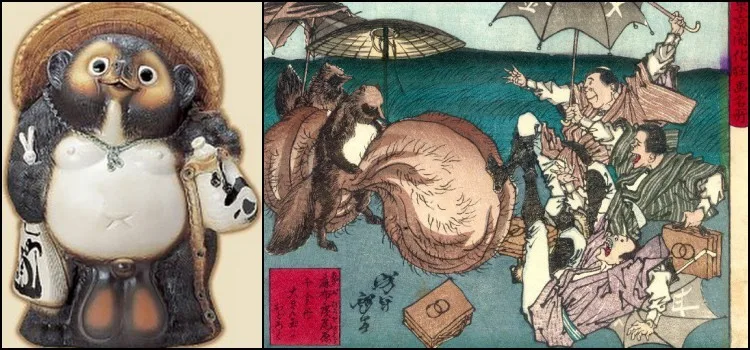
Even though it was depicted by the ancients as a scary and mysterious monster, today it has transformed into a representation of generosity, fun, and innocence, so much so that its statues are often seen in Japanese businesses and in people's homes, especially outside restaurants and bars to attract customers.
The ceramic figure most people meet is Shigaraki ware, from Shiga Prefecture. A popular reading, attributed to a Buddhist monk in 1952, gives the statue eight lucky traits:
- a hat, ready for trouble or bad weather;
- big eyes, to read the room and decide well;
- a sake bottle, for virtue and a full table;
- a large tail, for staying the course;
- an oversized scrotum, for financial luck;
- a promissory note or account book, for trust;
- a big belly, for calm, bold decisions;
- a friendly smile.
Some modern lists swap the scrotum for a money pouch. Both versions are talking about fortune at the door, not a zoology lesson. There is even a festival called Awa no Tanuki (阿波の狸まつり), held in Tokushima City in early November.
Bake-danuki and the old stories
The living animal and the yokai share a name, not a personality sheet. The supernatural version is the bake-danuki (化け狸): a shapeshifter that can look like a monk, a traveler, a tea kettle, or a stretch of road that was not there a minute ago. A saying puts it bluntly: the kitsune has seven disguises, the tanuki has eight (狐七化け、狸八化け).
The fox tends to transform in order to tempt. The tanuki, in most tales, transforms to make someone look foolish — or simply because it likes the trick. Older stories are not all cute. In Kachi-kachi Yama the tanuki is cruel. In regional legends from Sado and Shikoku, named bake-danuki become local powers with followers and rituals.
The tale most people still hear is Bunbuku Chagama (文福茶釜), the tanuki tea kettle. At Morin-ji in Tatebayashi, Gunma, the temple tradition speaks of an attendant and a kettle that would not run dry. Children's versions turn the same animal into a kettle that cannot stand the fire and later performs for a living. The kettle is the point: a tanuki that becomes an everyday object and still refuses to stay put.
From Super Mario to the ceramic crowd
The tanuki became known in the West mainly through games like Super Mario Bros. 3, where Mario acquires a costume called the Tanooki Suit, which lets him fly and turn into a statue that cannot be defeated — a leaf-and-statue gag taken straight from bake-danuki lore.
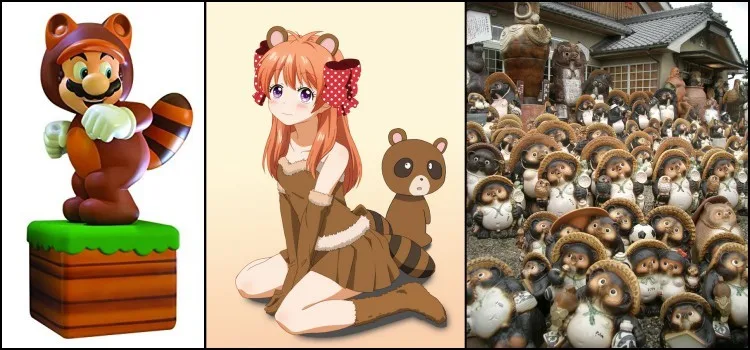
Studio Ghibli's Pom Poko puts a whole hillside of shapeshifting tanuki against suburban sprawl. In Animal Crossing, Tom Nook is an anthropomorphic tanuki running the shop. Anime and games keep borrowing the same face: half animal, half something that just borrowed your umbrella.
If you are collecting animal names in Japanese, tanuki sits next to kitsune as a word that is both a species and a story. For the broader yokai shelf, the list of Japanese monsters, myths, and legends is a good next stop.



Community
Comments
0 comments
There are no published comments in this language yet.
Send comment