
Did you know that in Japan there is a day when someone puts on an oni mask while the rest of the family pelts them with roasted soybeans? That cheerful chaos is Setsubun — the old calendar’s “seasonal division,” when winter is shown the door and spring is invited in.
When the weather flips, people long believed illness could ride in with demons. The answer was not a sword, but a handful of beans and a shout that still rings through houses and schoolyards: Oni wa soto! Out with the demons. Fuku wa uchi! In with good fortune.
Contents 5
What is Setsubun?
Setsubun [節分] literally means “to divide the seasons.” It is observed at the start of February to bid farewell to winter and welcome traditional spring — most years on February 3, though it can fall on the 2nd or 4th. The day after is Risshun [立春], the first day of spring in the old calendar. The other seasonal openings have names too: summer (rikka), autumn (risshū), and winter (rittō).
Setsubun is celebrated across Japan, yet it is not a national holiday. You will still see bean-throwing at homes, schools, shrines, and temples, because the ritual is about cleaning out the previous year’s bad luck before the season turns.
Mamemaki: throwing beans at the oni
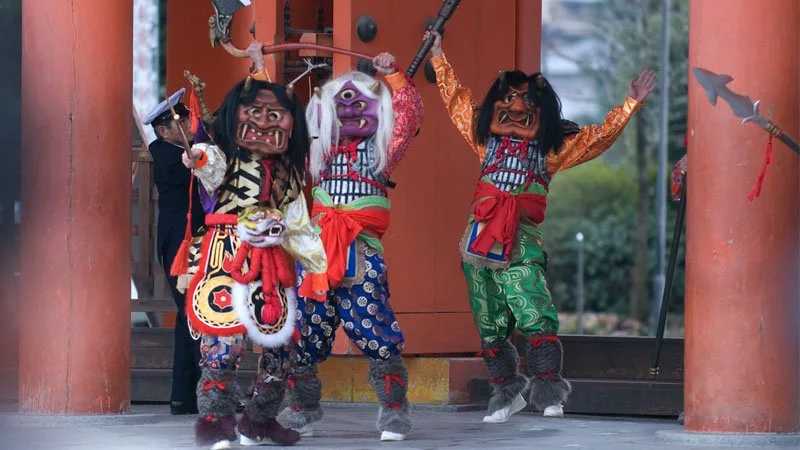
The heart of the day is mamemaki [豆撒き], the bean-scattering ritual. Roasted soybeans — fukumame [福豆], “fortune beans” — are thrown either out the front door or at a family member wearing an oni mask (ogre, demon). The person leading the throw is often the head of the household, or a man of the house born in the Chinese zodiac year of the new cycle (toshiotoko).
While the beans fly, everyone shouts: Oni wa soto! (demons out — bad luck, illness, misfortune) and Fuku wa uchi! (fortune in — happiness and good things). In Japanese: 鬼は外!福は内!
Afterwards people eat roasted soybeans — commonly one for each year of their age, and sometimes one more for the year ahead. The idea is simple: you drove the bad luck out; now you take the luck in. For more on Japanese demons and spirits, see our guide to yōkai, ghosts, and demonic creatures.
Where the custom comes from
Like many purification customs, Setsubun has roots in China. In Japan it grew out of the court ritual called tsuina (also known as onyarai), introduced by the eighth century and performed at the end of the old year to drive away spirits of disease and misfortune. Early versions used peach branches and clay charms rather than soybeans.
The bean-throwing form familiar today spread more widely from the Muromachi period (1336–1573). One famous folk explanation ties the practice to a monk on Mount Kurama who escaped misfortune by blinding an oni with roasted beans. The word for bean, mame [豆], also echoes ideas of striking the “demon’s eye” or destroying evil (mametsu [魔滅]) — a wordplay that helped beans feel like the right weapon.
Peaches remain part of the older symbolism: they were used in early purification rites and appear in the tale of Momotarō, the peach-born hero who defeated oni. The modern festival simply swapped the peach branch for a snack you can throw — and then eat.
Why soybeans — and what else people eat
Roasted soybeans stand for purification: they cleanse the house and push out spirits thought to bring bad luck and illness. Because Setsubun sits next to the old spring new year, it carried the mood of a reset — a household “new year’s eve” for fortune, not only for the calendar.
Besides the beans of mamemaki, people enjoy other soy foods such as nattō, miso soup (misoshiru), and tofu. We also have a broader look at soy-derived foods in Japan. In some regions of Hokkaidō and Tōhoku, peanuts stand in for soybeans — easier to pick up after the chaos.
Another modern favorite is ehōmaki [恵方巻], a thick sushi roll eaten whole. You face the year’s lucky direction (ehō), stay silent while you eat, and leave the roll uncut — slicing it would “cut” your luck. The custom grew strong in Kansai and later spread nationwide through shops and convenience stores. Fillings vary; the rule that matters is the intact roll, the direction, and the quiet wish.
Door charms, shrines, and a day that is still playful
Some homes still hang hiiragi iwashi — a holly sprig with a grilled sardine head — by the entrance. The sharp leaves and strong smell were meant to keep oni from crossing the threshold. At major shrines and temples, priests, performers, and sometimes celebrities throw packets of beans to huge crowds; red-and-white decorations mark the festive mood even though offices stay open.
Setsubun is serious about luck and light about the staging: a cardboard mask, a bag of roasted beans, and a family willing to shout at winter. Drive the demons out, invite fortune in, then count your beans — and maybe face east, west, or whatever direction the year calls lucky — for a bite of ehōmaki.



Community
Comments
0 comments
There are no published comments in this language yet.
Send comment