
The South Korean currency is the won, its code is KRW and the symbol is represented by ₩ (the letter W of won with 2 horizontal lines crossing the letter). The word won originates from the coins of China and Japan. Yuan (Chinese currency) and Yen (Japanese currency). All names come from China and mean ''round shape''.
It is divided into 100 jeon (전/錢), like cents. The South Korean won is not the same as that used by North Koreans. But what is the history of the Korean currency? What is the current value of the currency? And whose faces are printed on the banknotes and coins?
Contents 8
Historical Context
Initially - around 1400 - both the Korean and Japanese currency was the yen because the Koreas had not yet divided and Japan and China exerted great influence. In 1945 the countries divided and began to adopt the won, which was the same value as the yen. During this period, the value of 15 wons corresponded to 1 dollar.
Over time, the value of the won for each dollar continued to increase. In 1951 (the year the Korean War was happening), Korea became economically stagnant. In 1951, for example, 6000 wons equaled 1 dollar.
In 1962, a fixed value was established in relation to the dollar. It was set at 125 wons for 1 dollar. The fixed exchange rate lasted until 1980. Starting in 1980, a floating exchange rate policy was adopted, but it was only formalized on December 24, 1997, with the International Monetary Fund.
Shortly after, the won lost half its value due to the Asian crisis. Starting in 2006, the won was restructured to meet security and art requirements.
Another reason that contributed to the restructuring was the increasing number of counterfeits of the South Korean currency. With the new changes, counterfeiting would become more difficult. The color, size, texture, images, among other changes, were modified. With the anti-counterfeiting features, counterfeiting crimes decreased.
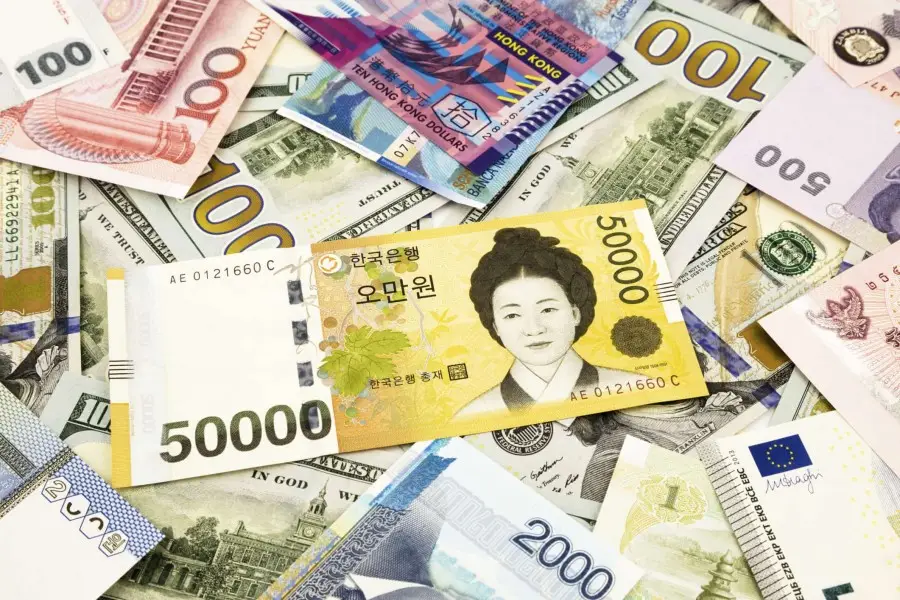
One of the most significant changes was the issuance of 50,000-won notes. This is the only note with a woman printed on it, and this was a change after 36 years.
Won in Circulation
Coins
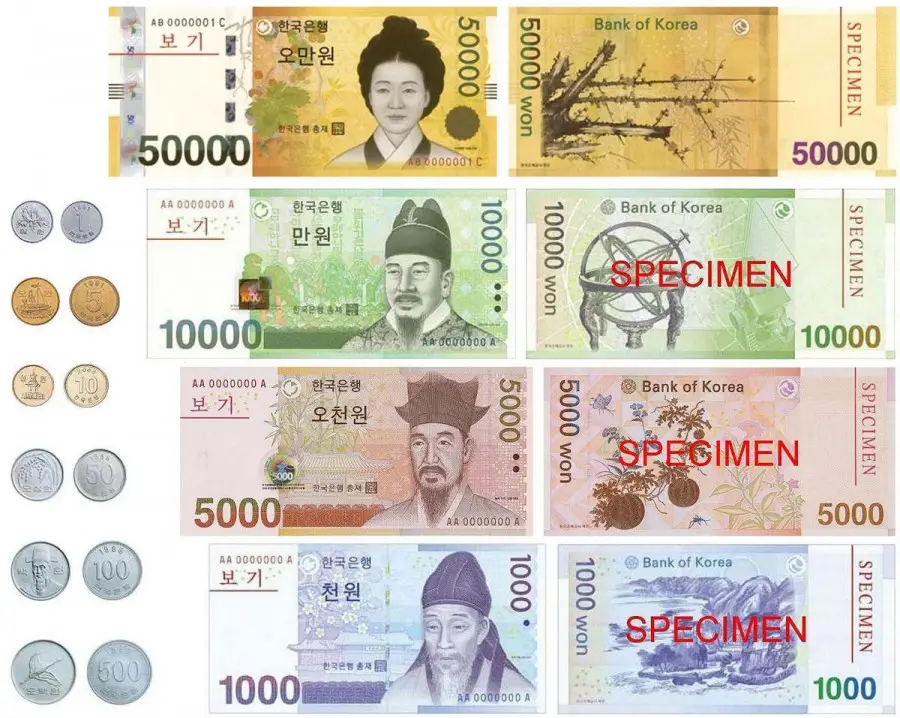
₩1 - One won
The first edition was on August 16, 1966. The symbol is the Rose of Sharon (무궁화), also known as the hibiscus of Syria, which is a symbol of South Korea. Physical characteristics of the coin: 17.20 mm, weight of 0.729g with a smooth edge. Color: silver.
₩5 - Five wons
The first edition was on August 16, 1966. The symbol is the Turtle Ship (거북선), a weapon used by Koreans in naval battles. Physical characteristics of the coin: 20.40mm, weight of 2.95g with a smooth edge. Color: gold.
₩10 - Ten wons
The first edition was on August 16, 1966. The symbol is the Bulguksa Temple in Gyeongju, where the 7 national treasures of South Korea are located. Physical characteristics of the coin: 18.0mm, weight of 1.22g with a smooth edge. Color: copper.
₩50 - Fifty wons
The first edition was on December 1, 1972. The symbol is a rice branch, a common food among Asians. Physical characteristics of the coin: 21.60mm, weight of 4.16g with a wavy edge. Color: silver.
₩100 - One hundred wons
The first edition was on November 30, 1982. The symbol is the red-crowned crane (두루미). In South Korea, this bird means ''luck''. Physical characteristics of the coin: 26.50mm, weight of 7.70g with a wavy edge. Color: silver.
Banknotes
₩1,000 - One thousand wons
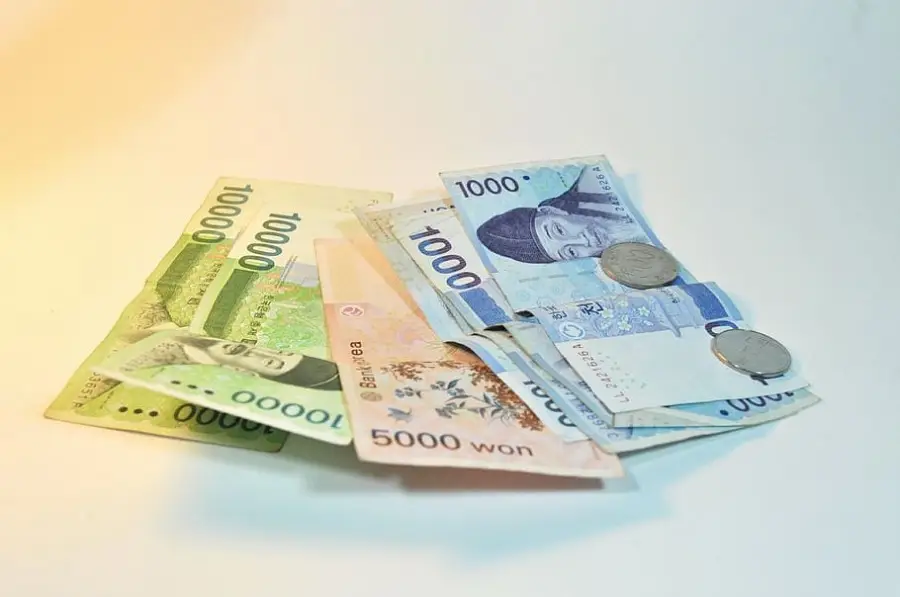
The first edition was on January 22, 2007. Color: blue. Dimensions 136X68mm. The figure represented on the banknote is Toege Yi Hwang, also known simply as Toege, who became known in South Korea as a philosopher and writer. He was a Confucianist.
₩5,000 - Five thousand wons
The first edition was on January 2, 2006. Color: red and yellow. Dimensions: 142X68mm. The figure represented on the banknote is Yulgok Yi I. Besides being a Confucian scholar, he was also a politician of the Joseon Dynasty.
₩10,000 - Ten thousand wons
The first edition was on January 22, 2007. Color: green. Dimensions: 148X68mm. The figure represented on the banknote is King Sejong the Great. He was the fourth king of the Joseon Dynasty, his reign was from 1418 to 1450. He is known for having created the Hangul (Korean alphabet).
₩50,000 - Fifty thousand wons
The first edition was on June 23, 2009. Color: yellow. Dimensions: 154X68mm. The figure represented on the banknote is Shin Saimdang. She is the only woman on Korean banknotes and was an artist, writer, calligrapher, and poet. She was the mother of Yi I, represented on the ₩5,000 note.
Cost of Living in South Korea
The estimate is that a person living alone spends 652,000 KRW, while a family of 4 members averages 2,300,000 KRW per month. Housing will depend on location and size, but the average for those renting is 300,000 wons.
Health plan fees are around 10,000 won, but it is not very comprehensive, so there are some benefits that must be paid extra as needed. And to study in South Korea in private education (remembering that it varies according to the level of education and institution) it is 15,000,000 to 42,000,000 KRW.

What is the value of the 45.6 billion won prize from the drama Round 6?
Round 6 or Squid Game is a South Korean drama that became the most watched in the world on the Netflix platform. The story revolves around people with debts that are impossible to pay, who then receive the proposal to participate in games that could cost them their lives to win the prize of 45.6 billion wons.
I’m sure that those who watched are very curious to determine how much 45 billion wons is in reais. The value is R$ 208.5 million considering the current exchange rate.
If you want to know the value of 45 billion wons in dollars, euros, and other currencies, we will leave a conversion list of 45 billion wons below:
- 45 billion wons are equivalent to 208,000,000 BRL reais;
- 45 billion wons are equivalent to 38,300,000 USD dollars;
- 45 billion wons are equivalent

What is the value of 100 thousand wons?
Just like the Japanese currency, Korean wons are not fractional. This can end up confusing some people's minds, thinking the money is super devalued.
The fact that the won currently has no equivalent to cents means that the smallest note is already a large number, but its value is extremely low. The best way to calculate this is to understand the values for each ten.
Below we will show the value of 1 won, 100 wons, 100 thousand wons up to one million wons. These values help you understand how much the won costs.
| 1 KRW | 0.004206 BRL |
| 100 KRW | 0.42061 BRL |
| 100.00 KRW | 42.0612 BRL |
| 10,000 KRW | 420.612 BRL |
| 1,000,000 KRW | 4,206.12 BRL |
A tip with non-fractional money is to always try to compare the hundred of 100 wons with the equivalent of the unit of your fractional local currency. I personally like to compare 100 yen with 1 dollar, since my currency is super devalued.
What did you find most interesting about the Korean currency?







Community
Comments
0 comments
There are no published comments in this language yet.
Send comment