
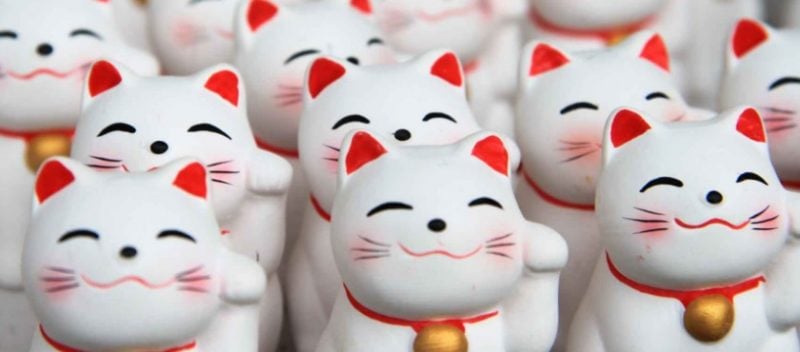
Have you noticed a small cat waving with a raised paw at the entrance of shops or restaurants? This friendly decoration is known as Maneki Neko (招き猫), the famous Japanese lucky cat. Much more than just a simple decoration, it carries centuries of tradition and symbolism, being considered a powerful amulet to attract prosperity, fortune, and protection.
Although many people associate its image with a cute or mystical figure, the Maneki Neko is not a specific breed, nor is it a living being. It is a decorative sculpture, usually made of ceramic, that represents the cat Mi-ke (Japanese Bobtail) — a three-colored feline considered auspicious in Japan. The figure often appears with one or both paws raised, a gesture that represents an invitation to luck or good business.
It is common to see these cats in stores, temples, restaurants, and even homes, always positioned near the entrance. Their presence there has a clear function: to attract good winds, customers, and wealth. And behind this striking visual tradition, there are fascinating stories, hidden symbolism, and even controversies about its origin.

What the Maneki Neko means and how to interpret it
The name Maneki Neko can be translated as “cat that invites.” But the gesture that seems like a wave to Westerners actually represents a call — as if the cat is calling people or fortune to come closer.
The raised paw has distinct meanings:
- Right paw: attracts wealth and good financial luck;
- Left paw: calls customers and visitors;
- Both paws: seeks protection and complete success (although some consider this a sign of greed).

The colors of the Maneki Neko are also rich in symbolism:
- Tricolor (mi-ke): the most traditional, represents general luck;
- Golden: fortune and financial success;
- Black: protection against evil and negative energies;
- Red: protection against diseases;
- Pink: love and romance;
- Blue: academic success and safety in traffic.
Some modern cats are electric and wave continuously, reinforcing the idea of a constant invitation. Additionally, it is common to find variations of the Maneki Neko in the form of keychains, vases, piggy banks, and air purifiers, maintaining its symbolic role even in portable versions.

The origin of the Maneki Neko: between legends and excavations
The true origin of the Maneki Neko is still a topic of debate among scholars and historians. One of the earliest representations emerged during the Edo period (19th century), and there are different birth theories of this iconic cat.
Imado-yaki Theory
One of the most accepted versions reports that a poor lady, living in the Asakusa neighborhood of Tokyo, dreamed of her cat saying that if she made a sculpture of him, she would achieve fortune. She followed the advice, created a ceramic Imado-yaki cat, and began selling it at the Asakusa shrine. The success was immediate. Over time, the model gained details until it reached what we know today.
This type of sculpture is called Marushime no Neko (丸〆猫), with the character 〆 symbolizing closure — that is, the “closing of fortune” within the home or business. These older versions have been excavated from the ruins of Edo, which reinforces the authenticity of this narrative.

Gotokuji Temple Theory
Another quite popular story involves the Gotokuji Temple, located in Setagaya, Tokyo. It is said that the feudal lord Ii Naotaka, surprised by a storm during a hunt, saw a cat waving to him near the temple gate. Following the cat, he was saved from the bad weather. In gratitude, he donated resources to the temple, which grew and began to honor the feline as a symbol of protection and gratitude.
At Gotokuji, all the statues have the right paw raised, without a purse or coin, reinforcing the spiritual focus of the figure.

Other theories about the origin
In addition to these, there are several other versions:
- At the Jiseiin Temple in Shinjuku, there is the legend of a black cat that guided Ota Dokan to a safe location during a battle.
- The Fushimi Inari Shrine in Kyoto is also cited as the birthplace of the tradition.
- Another version suggests that the waving gesture is, in fact, the cat cleaning itself — a movement that, according to ancient proverbs, would attract visitors or rain.
This multiplicity of origins only reinforces how deeply the Maneki Neko is rooted in different layers of Japanese culture.

Curiosities and modern versions of the Lucky Cat
Over time, the Maneki Neko has ceased to be just a traditional object and has become a cultural icon in Japan and beyond. Today, it can be seen in murals, festivals, giant statues, and even as city mascots.
An example is the Tokonyan, a huge ceramic cat installed in the city of Tokoname, Aichi Prefecture. With more than six meters in width, the Tokonyan watches over Maneki Neko Douri street, where shops and local craft exhibitors are concentrated.

Other interesting curiosities:
- The Japanese Bobtail, or mi-ke (三毛), is the breed of cat that inspired the Maneki Neko. With three distinct colors, it is a symbol of harmony and good luck.
- The date of September 29 is celebrated in Japan as Maneki Neko Day, with festivals in cities like Seto, Ise, and Shimabara.

The Maneki Neko beyond Japan
Although it is an essentially Japanese figure, the Maneki Neko has also become quite common in other Asian countries, especially in China and Taiwan. There, the golden version with the left paw raised is widely used in restaurants and shops. In the United States, the “lucky cat” has also gained space in pop culture, often being confused with a Chinese tradition.
One curiosity: while in Japan the waving gesture is made with the palm facing down (a calling gesture), in the West the gesture has the palm facing up — which is why many Maneki Neko sold outside Japan have their hand adjusted to match the local culture.

Leave a Reply