

How does the Korean alphabet work? What exactly is Hangul, how many letters does it have, and why do so many people describe it as one of the most logical writing systems in the world? If you are starting Korean, these are usually the first big questions.
The good part is that Hangul looks harder than it really is. Once you understand the core idea behind it, the system starts to feel much more friendly and organized than many beginners expect.
More than 70 million people speak Korean worldwide, mainly in South Korea and North Korea. On top of that, there are many learners who became interested through Korean culture, K-pop, dramas, films, or travel. If you want the broader context, our article on Hallyu and the Korean wave is a good place to continue later.
Contents 8
Where did Hangul come from?
Hangul was created in the 15th century during the reign of King Sejong. Before that, Korea relied mainly on Hanja, which means Chinese characters. That made reading and writing much harder for a large part of the population.
The idea behind Hangul was practical and ambitious at the same time: create a writing system that matched Korean better and was easier for ordinary people to learn. That remains one of its strongest qualities even today.

In the famous preface to the royal edict, King Sejong explained that many people could not properly express their thoughts because the writing system in use was too difficult. Hangul was created to reduce that barrier and make literacy more accessible.
How is the Korean alphabet structured?
Modern Hangul is usually introduced through 14 consonants and 10 vowels. What makes it look different from many alphabet systems is that the letters are not simply written one after another. Instead, they are grouped into compact syllable blocks.
That means what looks like a single symbol is often a full syllable made from multiple elements. This is one of the main reasons Hangul can seem intimidating at first glance, even though the internal structure is quite consistent.
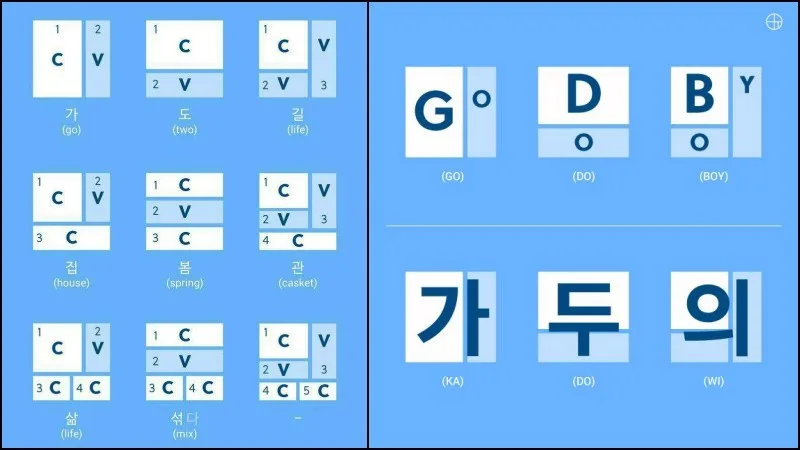
These building blocks are called jamo. A syllable block can combine two, three, or even four elements. This makes Hangul both compact and flexible, which is part of what gives it such a clean design.
If you already know something about Japanese writing, Hangul may seem halfway between an alphabet and a syllabary. That impression is understandable, but Korean follows its own logic and should be learned on its own terms. For comparison, you can later read our guide to Hiragana and Katakana.
Why is Hangul considered so logical?
One reason is that some consonant shapes were designed to reflect how the sound is produced. In other words, the writing system does not only represent sounds, it also hints at the mouth or tongue position behind them.
The vowels also carry a conceptual design. Their basic shapes are connected to ideas from Neo-Confucian thought, linking sky, earth, and human beings. So Hangul is practical, but it is also culturally rich.

A well-known quote says that a wise person can learn Hangul in one morning and even a less educated person can grasp it in ten days. It may sound dramatic, but it captures how approachable the system feels compared with many other scripts.
How many letters does Hangul have?
The basic modern system is usually taught with 24 core letters: 14 consonants and 10 vowels. From there, combinations and variants expand the sound inventory.
For beginners, though, the smartest approach is to focus first on the basics. Once those feel familiar, reading becomes much less intimidating.
The 14 consonants
| ㄱ | (g, k) |
| ㄴ | (n) |
| ㄷ | (d, t) |
| ㄹ | (r, l) |
| ㅁ | (m) |
| ㅂ | (b, p) |
| ㅅ | (s) |
| ㅇ | silent at the start, ng at the end |
| ㅈ | (j, ch) |
| ㅊ | (ch') |
| ㅋ | (k') |
| ㅌ | (t') |
| ㅍ | (p') |
| ㅎ | (h) |
The 10 basic vowels
| ㅏ | (a) |
| ㅑ | (ya) |
| ㅓ | (eo) |
| ㅕ | (yeo) |
| ㅗ | (o) |
| ㅛ | (yo) |
| ㅜ | (u) |
| ㅠ | (yu) |
| ㅡ | (eu) |
| ㅣ | (i) |
If you want to keep building from there, our guides to Korean numbers, basic greetings in Korean, and writing your name in Korean are useful next steps.
How does Hangul sound in practice?
Reading explanations is helpful, but pronunciation becomes much easier once you actually hear the sounds. That is why a good alphabet video can save beginners a lot of confusion.
Why is Hangul such a good starting point?
Because it lets you move from total confusion to real reading surprisingly fast. That does not mean Korean as a whole is easy. Grammar, vocabulary, and speech levels still take time. But the alphabet itself is often an encouraging first win.
If you want to keep going, you can also explore apps to learn Korean and some of the best books for learning Korean.

That is often the moment when Korean stops feeling distant and starts feeling personal. You are no longer just looking at symbols. You are beginning to read names, signs, menus, and small details on your own. And for many learners, that is where the real fun begins.




Community
Comments
0 comments
There are no published comments in this language yet.
Send comment