
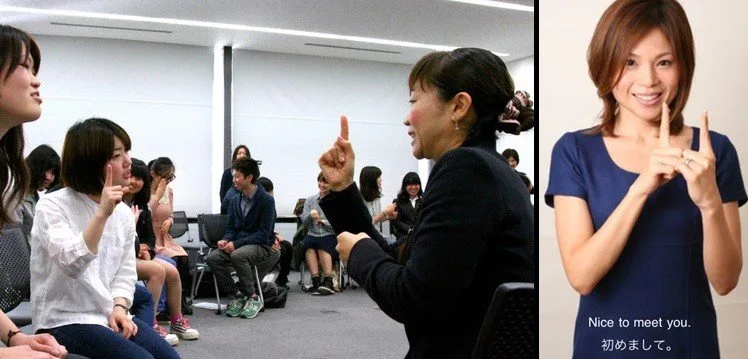
In the West, the raised middle finger is usually an insult. In Japanese Sign Language, that same finger shows up in everyday words — including the sign for “siblings.” Moments like that make the point fast: Nihon Shuwa is not silent spoken Japanese. It is its own visual language.
In daily Japanese it is often just called 手話 (shuwa, “hand talk”). Internationally it is known as JSL (Japanese Sign Language), and in Japanese as 日本手話 (nihon shuwa). If you follow anime, dorama, or Deaf life in Japan, you eventually run into this language — and into the common mix-up with “Signed Japanese.”
Contents 7
What Nihon Shuwa is — and what it is not
Japanese Sign Language has its own vocabulary, grammar, and use of space and facial expression. It relates to spoken Japanese the way neighboring languages do: there is contact and influence, but you do not simply convert syllables into hands.
Under the broad label 手話 (shuwa), people in Japan often mix several different systems:
- Nihon Shuwa (日本手話) — the natural sign language of the Deaf community, with its own structure.
- Taiō Shuwa (対応手話) — “Signed Japanese”: Japanese word order, often with speech; manual coding of Japanese rather than a full independent language.
- Chūkan Shuwa (中間手話) — contact forms in between, depending on who is signing and the situation.
For hearing people in classes or watching news with interpreters, the difference is not always obvious. For the Deaf community it is central: Nihon Shuwa is the language many deaf people live in at home and in community life — not only a set of helpful gestures for Japanese speech.
There is also relatedness with sign languages in Korea and Taiwan. Historical contact — including the period of Japanese colonial rule — helps explain partial lexical overlap, without turning JSL into “Japanese with hands.”
A short history: from Kyōto to legal recognition
Little is firmly documented about deaf communication before the Edo period. A clear early landmark is the school for the blind and deaf founded in Kyōto in 1878, linked to educator Furukawa Tashirō. Forms of signing that grew in that environment are treated as forerunners of modern Nihon Shuwa.
Through much of the twentieth century, many schools pushed an oralist line: lip-reading and speech were favored, and signing was often restricted in class. Language transmission depended heavily on student communities and deaf families — not on a public standard like spoken Japanese.
Legal and social status shifted step by step. In 2011, disability-related law in Japan explicitly recognized sign language as a language. Prefectures and municipalities then passed their own sign-language ordinances. In 2025, the World Federation of the Deaf reported a national Japanese Sign Language law after broad local support — a long-sought milestone for the Deaf movement, even if day-to-day access still varies by region and institution.
How the language works
Nihon Shuwa is not a hands-only code. Hands and arms carry signs; facial expression, eyebrows, eye gaze, and head movement carry grammar — questions, negation, emphasis. Copy only the hands and “turn off” the face, and you often lose the sentence type.
The system also includes:
- Yubimoji (指文字) — fingerspelling built around the kana, used mainly for names, loanwords, and uncommon terms.
- Mouthing (口話, kōwa) — mouth shapes that can distinguish related meanings of the same manual sign.
- Kanji strategies — air writing (空書, kūsho) and signs tied to common characters, because written Japanese is part of everyday communication.
Older names such as temane show up in historical notes; today the standard labels are nihon shuwa / JSL. Regional variation exists across prefectures, as you would expect in a living language spread through schools and communities rather than a single classroom textbook.
Rough older estimates often said that a large majority of deaf people in Japan understand JSL and that many also know the fingerspelling alphabet — numbers that appear in older community summaries rather than a single current census. Exact user counts are hard because Signed Japanese and contact signing blur the statistics.
There are well over a hundred schools for the deaf nationwide; the 1878 Kyōto foundation remains the classic origin story for modern institutional history.
The middle finger in Japanese Sign Language
One detail that went viral online is the sign for siblings (兄弟, kyōdai): both hands raise the middle finger. To Western eyes it can look comical — picture several brothers in a church trying to catch one another’s attention with that gesture.
In Japan the middle finger does not automatically carry the Western insult, even though many Japanese people now know the foreign reading. The sign for older brother (兄, ani) also uses a raised middle finger, but with one hand. The same finger can appear in other signs — money-related gestures, or “five” when other fingers join in.
You can catch this kind of signing in fiction as well: works such as Gangsta., the dorama Orange Days, and the film Babel put JSL on screen for audiences who might never have seen it elsewhere.
Yubimoji: the Japanese “alphabet” in signs
Below is a chart of Japanese fingerspelling — the yubimoji set tied to kana shapes rather than the Latin alphabet used in American Sign Language.
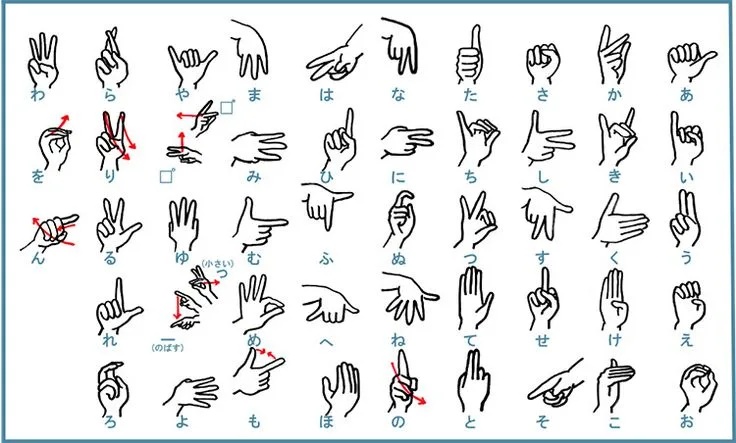
Yubimoji is useful, but it is not the whole language. Everyday conversation leans on lexical signs, facial grammar, and space. Fingerspelling fills gaps; it does not replace Nihon Shuwa the way typing every word would not replace English.
If you want media and practice material in JSL, these public resources are useful starting points:
- NewSigns — news and signed content oriented to Japanese Sign Language.
- Kyoto Board of Education JSL materials — educational pages including fingerspelling practice.
JSL on screen and on the road
Japanese TV has long had a small niche of dramas and programs that put signing at the center of the plot. Beyond Orange Days and Babel, anime and manga such as A Silent Voice (聲の形) and A Sign of Affection (ゆびさきと恋々) introduced accurate JSL to huge international audiences. Those stories do not replace community life, but they do change how many hearing viewers first notice that Japan has its own sign language.
On the street, drivers with hearing disabilities may display a special identification sticker so others know to take extra care. For the wider sticker system used on Japanese cars, see: Special stickers used on vehicles in Japan.
Public visibility of interpreters is growing — on news broadcasts, at some events, and in municipal services — while access remains uneven. Not every school for the deaf teaches consistently in Nihon Shuwa; many programs mix methods or still lean heavily on speech and literacy training.
Japanese Sign Language and ASL: a useful comparison
English-speaking readers often know American Sign Language (ASL). A short comparison resets expectations:
- Separate languages — ASL and Nihon Shuwa are not mutually intelligible. What they share is being full languages, not pantomime versions of English or Japanese.
- Fingerspelling — ASL maps to the Latin alphabet; JSL’s yubimoji maps to kana and sits alongside kanji-related strategies.
- Face and space — both languages load grammar onto face and spatial placement; the concrete markers differ.
- Status and daily life — legal recognition, interpreter supply, and media presence follow different histories in Japan and in English-speaking countries. What feels “normal” in one place does not automatically describe the other.
Knowing ASL is a strong foundation for understanding what a sign language can do — not a free pass into Nihon Shuwa. That is exactly why Japanese Sign Language matters for anyone serious about Japan’s language landscape: it is part of the country, built with hands, face, and space instead of voice and kana alone.




Community
Comments
0 comments
There are no published comments in this language yet.
Send comment