
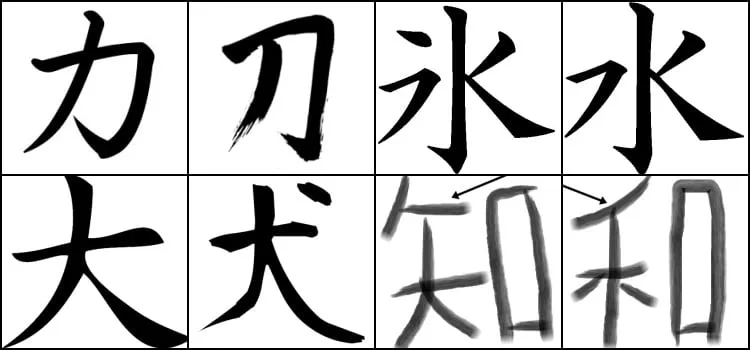
Japanese writing contains characters that even many Japanese people cannot read: they appear in no school textbook, occur in no everyday text and show up at most in old documents, place names or dictionaries. This article explains what rare kanji are, why they became so rare and presents ten examples with meaning and stroke count.
Contents 16
What rare kanji are
Japanese uses several writing systems, and kanji are grouped into categories. The Jōyō kanji consist of 2,136 characters prescribed for schools and public offices. Beyond them are the Jinmeiyō kanji for personal names and the Hyōgai kanji, characters outside these lists. Many are recorded in dictionaries but almost never used in daily life.
Some of these characters survive only in computing. The Japanese standard JIS X 0208, published in 1978, included characters whose origin could not later be traced. These Yūrei moji («ghost characters») exist in fonts and in Unicode even though nobody has ever written them.
Why some characters almost never appear
- Variants: many characters are old or alternative forms of a common kanji and were replaced by the modern form.
- Chinese forms: some characters come from Chinese and never caught on in Japanese.
- Obsolete words: the word a character stood for is no longer used.
- Loanwords: modern Japanese uses katakana words from English instead of rare kanji for many concepts.
Ten rare characters at a glance
The following examples come from dictionaries and are unusual in present-day Japanese. Stroke counts follow the usual convention. For characters that look alike, see similar-looking kanji.
1. 并
The character has 6 strokes and is the Chinese simplified form of 併 («to combine, unite»). In Japan it appears almost only as a variant in old texts; for «unite» people write 併 or 合わせる today.
2. 幷
With 8 strokes, 幷 is an older variant of 并 and therefore also a form of 併. It has practically disappeared from modern Japanese.
3. 帕
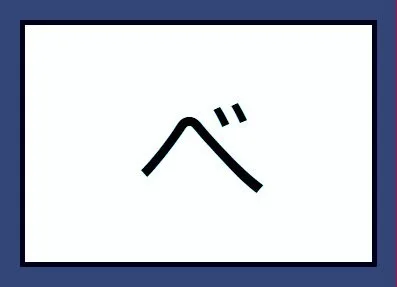
The character means «veil» or «headscarf» in Chinese and has 8 strokes. Japanese uses the loanword ベール (from English veil) instead.
4. 帇
帇 has 6 strokes; its meaning is uncertain and only fragmentarily recorded even in Japanese dictionaries. It is considered an obsolete character without a clear everyday use.
5. 帟
帟 means «tent» and has 9 strokes. Instead of this kanji, people write テント, a loanword from English tent.
6. 弙
弙 has 6 strokes and is another character without a confirmed everyday meaning. Standard dictionaries mention it only in passing.
7. 弩
弩 has 8 strokes and means «crossbow», いしゆみ in Japanese. It is not an everyday word but appears in historical texts and in compounds such as 弩兵 (crossbowman). For «arrow», Japanese uses 矢.
8. 冝
冝 is a variant of 宜 («suitable, appropriate») and has 7 strokes. Modern Japanese writes 宜 or uses words such as 適当.
9. 冢
冢 means «burial mound» and has 10 strokes. It is a variant of 塚, which is more common in everyday writing and place names. Visually it resembles the character 家 («house»).
10. 龠
龠 has 17 strokes and refers to an ancient Chinese flute. Modern Japanese writes フルート (from English flute) or 笛.
Where you meet rare characters
People living in Japan encounter rare kanji mainly in three places: in place and family names, which often fall outside the school kanji; in old documents and temple inscriptions; and in digital systems whose character sets contain characters nobody actively uses. For learners these characters are rarely exam-relevant, but they spark interest in the history of the script.
Tips for learners
- Learn the Jōyō kanji first: they cover daily life and exams.
- When you meet an unknown character, check its reading in a dictionary first; many rare characters have only an on-reading.
- Do not confuse variants with the modern standard character, for example 冝 with 宜 or 冢 with 塚.
- In your own writing, choose the common character or the katakana spelling.
Final thoughts
Rare kanji are not study material for daily life but a window into the history of Japanese writing. They show how variants, Chinese forms and loanwords shaped the vocabulary, and they remind us that the 2,136 Jōyō kanji are only part of the written culture. Once you know the common characters, you can look at the rare ones with curiosity instead of memorising them. To see how many characters Japanese students actually learn, read how many kanji the Japanese need to know.



Community
Comments
0 comments
There are no published comments in this language yet.
Send comment