
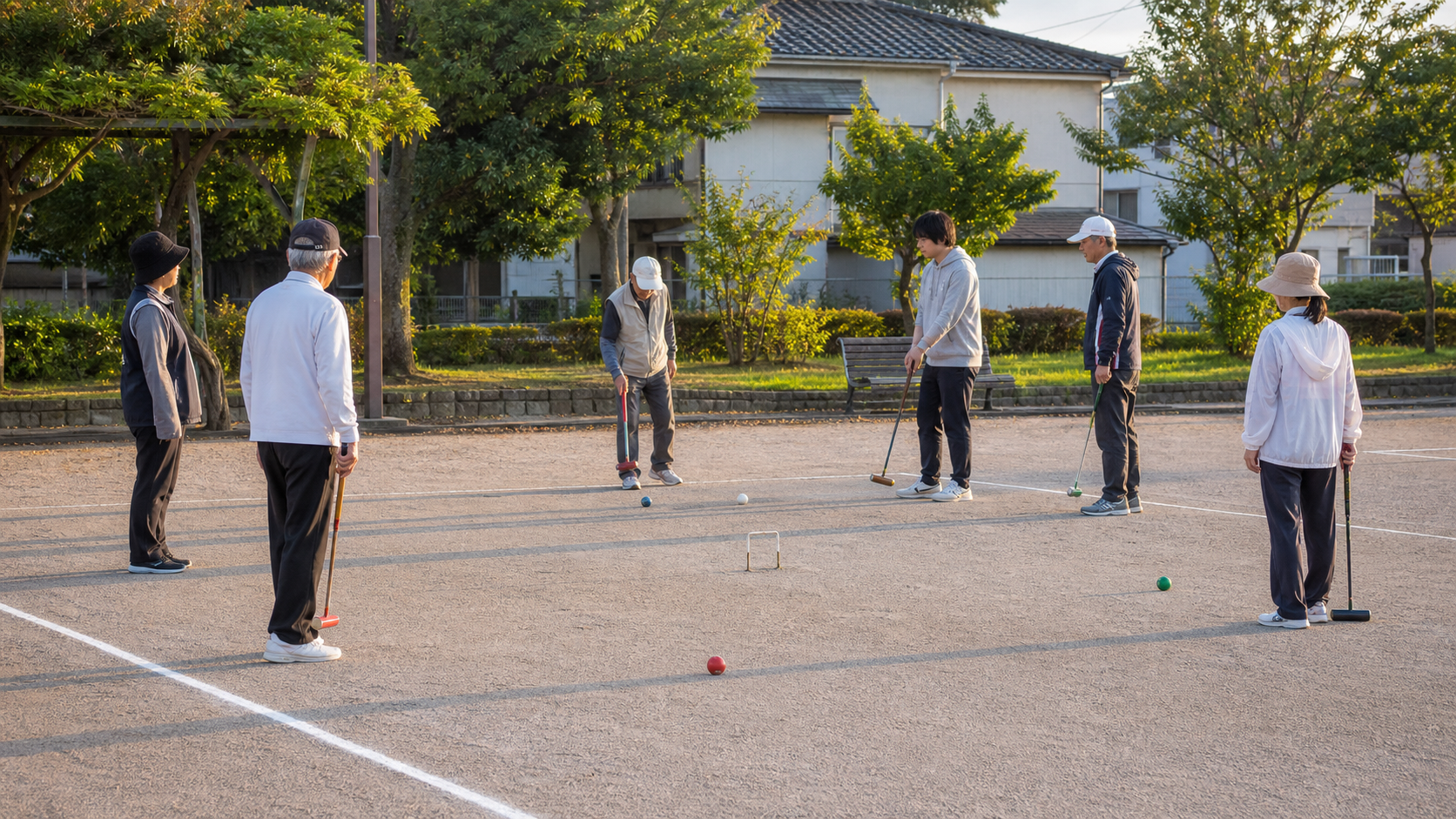
Gateball (ゲートボール, gētobōru) is a Japanese team sport played with T-shaped mallets, numbered balls, and metal gates. It is often linked with older players in Japan, but the game is not built around strength. A good stroke can open a route for a teammate, disrupt an opponent’s plan, or set up a scoring run several turns later.
Croquet is the quickest comparison, because both games use mallets, balls, and gates. It only goes so far. Gateball is played by two sides, its turn order is fixed, and every ball changes the options available to the rest of the team. On a compact court, the real contest is positioning.
Contents 6
How gateball began in Japan
Gateball began in Memuro, Hokkaidō, in 1947. Eiji Suzuki developed it in the difficult years after the Second World War as a game children could play with accessible equipment, taking inspiration from croquet. From Japan, the sport later spread to other countries and regions.
Its later association with senior clubs has a practical explanation. A match does not require constant running or a large field, yet it rewards concentration and teamwork. Local groups can set up a court in a park and make a regular afternoon of it. The World Gateball Union also presents the sport as one that people of different ages and physical conditions can enjoy together.
Gateball rules: teams, balls, gates, and the goal-pole
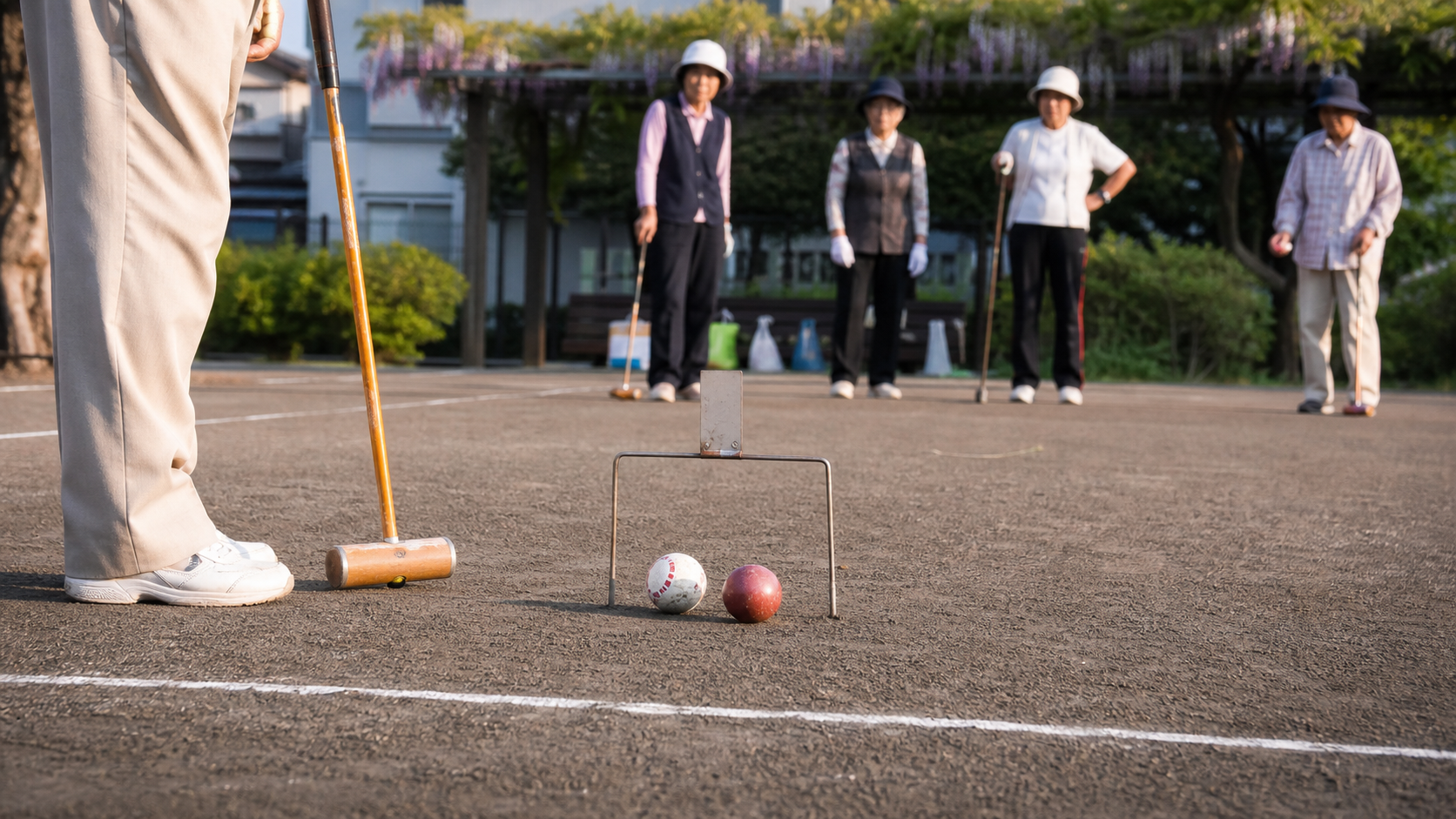
Under World Gateball Union competition rules, a match has two teams of five players. There are ten numbered balls: red balls carry the odd numbers and white balls the even numbers. Players take their turns in numerical order, alternating between the two teams.
Each ball must pass through three gates in sequence. A successful pass through the first, second, and third gates adds one point each. After the third gate, a ball can finish by hitting the central goal-pole, which adds two more points. A completed ball is therefore worth five points.
An official game lasts 30 minutes, and the team with the higher total wins. Those are the competition rules; local associations and individual tournaments may use their own formats or special rules.
Why a touch can change the whole court
The tactical feature to watch is the touch. When a player’s ball makes contact with another ball, the player may earn the right to make a spark: a controlled play that repositions the other ball and can earn another stroke. That creates choices that do not exist in ordinary croquet.
A player can use a touch to bring a teammate closer to the next gate, move an opponent away from a useful lane, or keep their own ball in a position that matters on the next round. Power helps, but reading the order of all ten balls matters more. The best shot is often the one that improves the team’s next two or three turns.
- Accuracy: clear a gate while leaving the ball in a useful place.
- Sequence: each gate must be passed in the right order before the goal-pole counts.
- Turn order: knowing which ball follows changes the value of every move.
- Team play: a safe route for a teammate can be better than a risky individual score.
Why gateball is associated with older people
The connection is more than a stereotype. For many neighborhood groups, gateball combines an outdoor routine, familiar company, and a shared task. Setting up the court, waiting for a turn, and discussing a stroke are part of the experience as much as the final score.
Still, calling it the favorite sport of Japanese seniors would turn a visible tradition into an unsupported national ranking. Gateball has a strong senior image, while its rules also make room for children, adults, and veterans on the same court. That contrast is one reason it remains interesting to watch: a quiet-looking game can demand close cooperation from every player.
Gateball, croquet, and mallet golf are different games
| Sport | What feels familiar | What is different |
|---|---|---|
| Gateball | Balls, mallets, and gates | Two teams, fixed turn order, and tactical touch-and-spark plays |
| Croquet | Gates and mallet strokes on a lawn | Its rules and formats vary; it does not reproduce gateball’s team sequence |
| Mallet golf | Mallets and outdoor play | It is closer to a golf course than a contested court |
What to notice when watching a gateball match
Follow the ball order rather than only the score. Notice which player has the next turn, whether a ball has a clear route to the next gate, and how a touch changes the layout. What first looks like a slow version of croquet becomes a short sequence of linked decisions.
For a visitor to Japan, a gateball match offers a small view of neighborhood leisure: competition without a large stadium, strategy without constant motion, and a sport that works in the space a local group already has. The mallet stroke is simple. Choosing where the next ball should stop is the difficult part.




Community
Comments
0 comments
There are no published comments in this language yet.
Send comment