
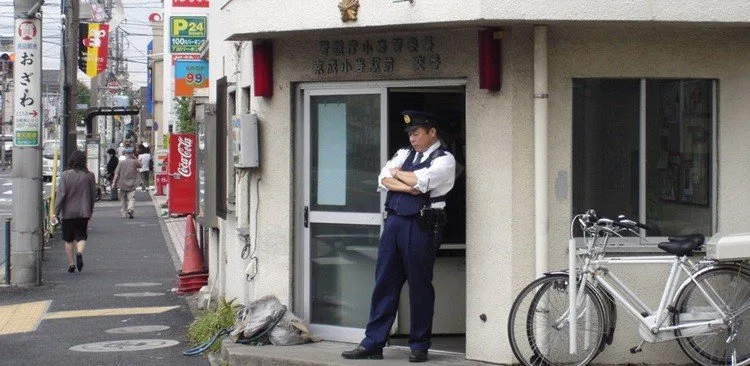
Many people picture Japanese police in one of two extremes: either they never touch a firearm, or they operate like a heavily armed force at every street corner. Real street life in Japan rarely matches either image.
Uniformed officers on duty often do carry firearms — at the koban, on mobile patrol, and in emergency response. What stands out is not the absence of weapons, but how rarely those weapons become the center of everyday policing.
Contents 8
Are Japanese police armed on a day-to-day basis?
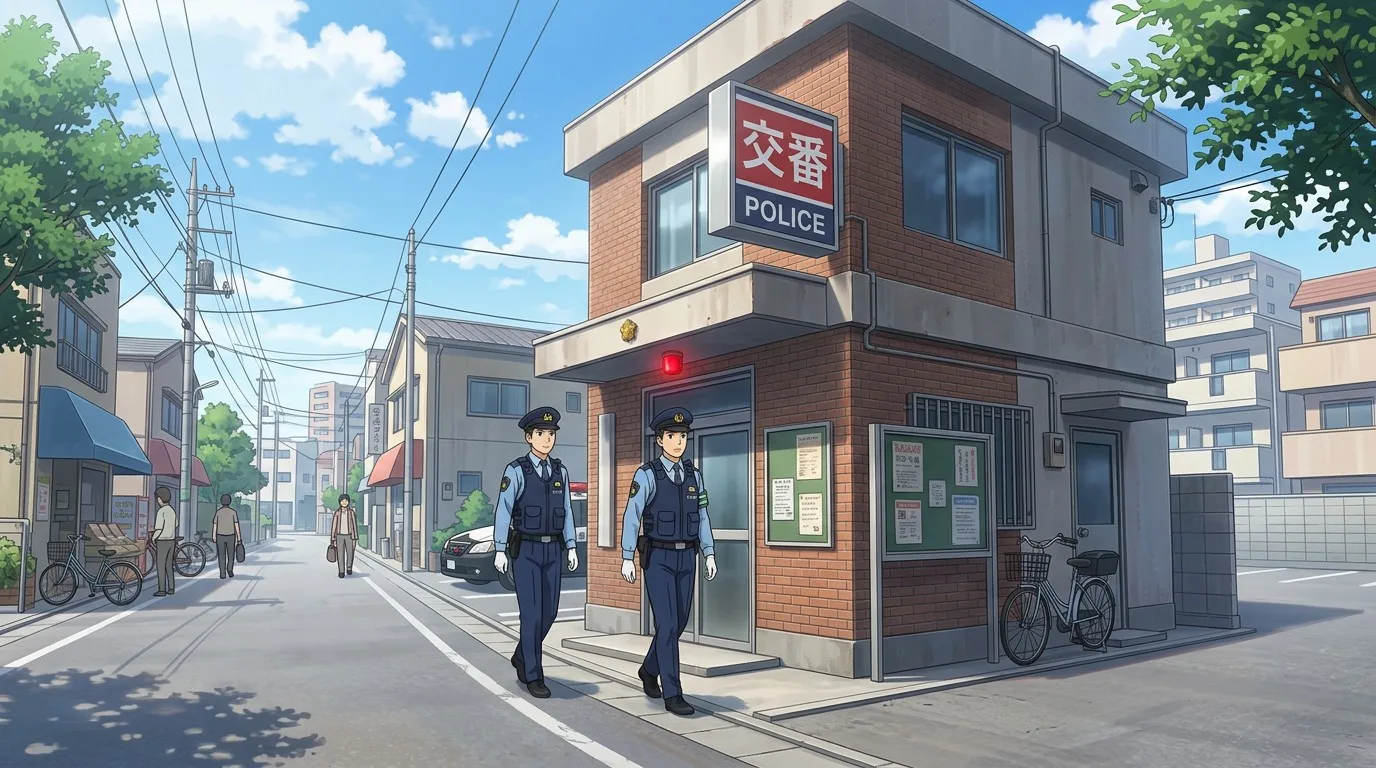
Yes. Officers responsible for urban patrols normally carry firearms while on duty. That includes mobile patrols, emergency response, and community policing from the famous koban — the small police boxes spread through Japanese cities.
Even in these neighborhood posts, which can look calm and close to daily life, officers are first responders. They handle incidents, search for missing people, deal with local conflicts, and may face unexpected criminal situations. Carrying a weapon is part of operational equipment.
The important detail is that the weapon exists as a last-resort resource. Japanese police presence tends to emphasize prevention, public guidance, and local control before any escalation of force.
Do all police officers in Japan work armed?
No. Japanese policing includes much more than street patrol. There are administrative officers, technicians, specialized investigators, and units with internal roles that do not perform daily overt policing.
So it is not correct to say that every Japanese police officer carries a weapon all the time. Arming is mainly tied to operational functions — especially direct public service and emergency response.
That distinction also helps explain why visitors sometimes see officers who appear unarmed in institutional or administrative settings. In those situations, the operational context is different from community patrol.
What sidearm do Japanese police usually carry?
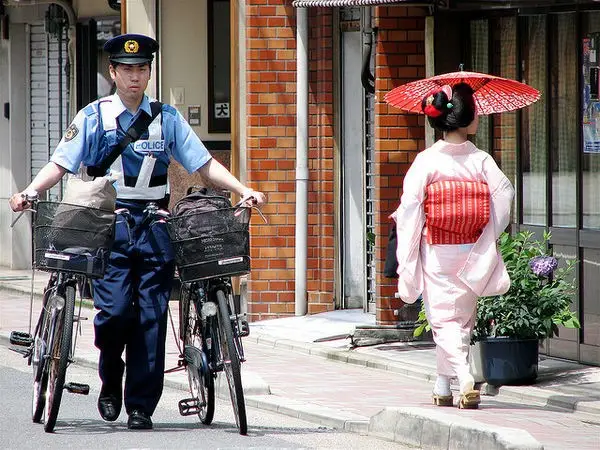
For uniformed patrol work, Japan has long relied on compact .38 Special revolvers rather than large semi-automatic service pistols as the everyday image of street equipment.
A classic standard has been the New Nambu M60, a five-round double-action revolver. Later purchases for uniformed officers have also included compact Smith & Wesson models in the same caliber family, such as the Model 37 and the M360J “Sakura.” Specialized units — security details and assault teams — can carry semi-automatic pistols and heavier weapons when the mission demands it.
Knowing the model matters less than the philosophy behind it: small, controllable sidearms for officers whose main job is neighborhood presence, not open display of firepower.
Does the weapon stay on the officer's belt?
In street policing, the weapon normally accompanies the officer as personal service equipment.
At the same time, Japan adopts a police culture less focused on visible display of the gun. In many cases it stays discreet in the holster and does not become the main element of police presence in public space. That detail feeds the common impression that Japanese police “do not carry weapons,” even when that is not true.
When can Japanese police use a firearm?
Japanese law allows an officer to use a weapon within the limits judged reasonably necessary — for example to stop a criminal, prevent escape, protect people, or overcome resistance to official duty. The legal frame is the Police Duties Execution Act, not a free hand to shoot at the first sign of trouble.
In training and street practice, officers put heavy weight on control without firing: baton work, hand techniques, and taiho-jutsu (arrest techniques) before lethal force. Firearms training exists, but discharging a gun is treated as an extreme step, not routine enforcement.
That is why news of police gunfire is rare compared with countries where armed response is a daily public spectacle. The sidearm is equipment for a worst-case scenario; most shifts never turn that scenario into a headline.
Do guards and private security in Japan also carry weapons?
Here there is an important difference that often causes confusion. Private security in Japan can almost never carry firearms. Even when they work in stations, shopping centers, or events, these professionals operate under much more restrictive rules than the police.
Seeing a uniform that looks “official” does not automatically mean a weapon is present. In many cases it is private security doing access control, public guidance, or preventive surveillance.
That clear separation between armed police and largely unarmed private security is part of Japan’s strict control over firearms — the same broader context that shapes civilian gun laws in Japan.
What does a visitor actually notice?
On a busy station platform or a quiet residential street, the first thing many visitors notice is not a drawn weapon. It is the koban light, the officer giving directions, or a private guard at a building entrance without a holstered pistol.
When a patrol officer is armed, the gun is usually low-profile. That does not make Japanese policing “unarmed.” It makes the armament secondary to presence, local knowledge, and de-escalation — until a situation forces another toolbox into play.
If you need help as a traveler, the practical move is still the nearest koban or station police, not assumptions based on Hollywood versions of Japanese cities.
Why do we hardly ever see news about police using firearms in Japan?
The main reasons sit together: strict civilian firearms control, community policing, and a culture that treats shooting as last resort. Officers can use firearms when necessary, but that use is not the center of daily operations.
For outside observers, the quiet holster can look like absence. In reality the weapon is there for many uniformed roles — it simply occupies a more discreet place in how Japan does police work.


Community
Comments
0 comments
There are no published comments in this language yet.
Send comment