
Cup Noodles (カップヌードル) sit in every Japanese konbini aisle like a quiet everyday ritual: office lunch, late train home, hotel room after a long day. Behind the foam cup is Momofuku Ando’s invention for Nissin in 1971 — boiling water, lid closed, a few minutes later, a full bowl that travels with you.
Stand in front of a Japanese shelf and the surprise is not “chicken or beef.” The lineup runs from permanent classics such as Seafood and Curry to limited editions that vanish after a season. This guide maps that landscape: history, the flavors you keep seeing, wild one-offs, how preparation usually works, and where the brand becomes a museum visit.
Contents 7
How Cup Noodles started
Ando had already created instant noodles in 1958 with Chicken Ramen. The leap into a disposable cup came in 1971: hot water, wait, eat — no pot, no kitchen. The idea was portable and practical. In the United States the product launched as “Cup O’ Noodles” and later became “Cup Noodles.” In Japan the brand is often written in the singular as Cup Noodle, while many overseas markets use the plural form.
The cup format went global, but recipes and toppings stay deeply local. That is why Japan’s selection feels so different to travelers who only know supermarket shelves back home.
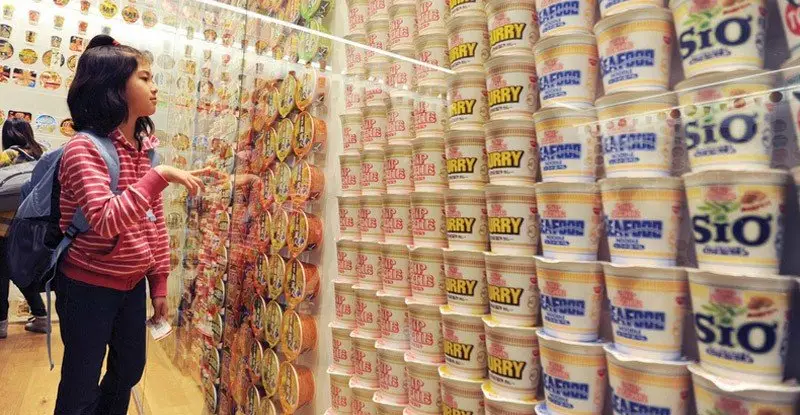
Classic flavors on Japanese shelves
Some directions show up again and again in Japan. They are the usual first encounter for both locals and visitors:
- Soy sauce / shoyu — savory, umami-forward, often the “default” cup in the aisle
- Seafood (シーフード) — marine stock and toppings; one of the most recognizable Japanese lines
- Curry — mild-spiced broth inspired by Japanese curry
- Chili tomato — fruity heat; a long-standing name in the range
- Miso — hearty, echoing everyday miso soup
- Tonkotsu — closer to rich pork-bone ramen broth
- Shio (salt) — a clearer, lighter soup body
You will also see size steps such as mini, standard, or larger Big/King cups, and occasional lighter variants. Japanese cups aim closer to a ramen-like experience than a bare emergency snack: seasoning packets, freeze-dried vegetables, and several toppings packed into the cup.
Limited editions and wild flavors
Beside the permanent classics, Japan keeps rotating seasonal cups, regional ideas, collaborations, and short campaigns. That is why lists keep mentioning odd directions — strong chili-curry experiments, yakisoba-style cups, cheese-and-garlic trials, or wasabi and mayonnaise experiments. There is almost no “complete forever list”: what sat on the shelf last month may already be gone.
Among flavors and editions that show up again and again in reports and store aisles:
- Yakisoba-style and other drier preparations
- Cheese and garlic variants
- Hot chili and pepper lines
- Seafood specials with stronger shrimp or fish profiles
- Miso, tonkotsu, and other ramen profiles in cup form
- International crossovers such as laksa-style, vongole, or risotto-leaning cups (often time-limited)
- Playful names and “mystery” or collaboration cups that come and go quickly
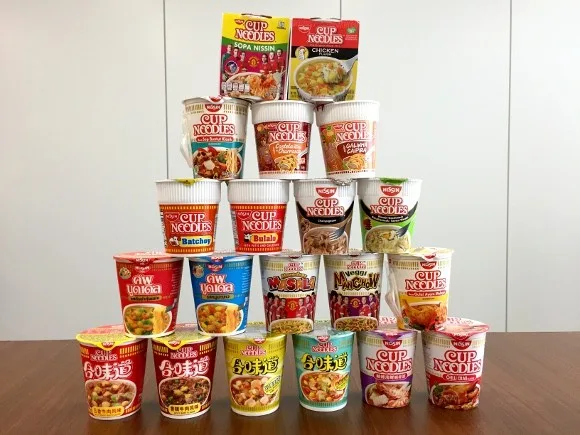
Many exotic names belong to short campaigns. If you collect or taste-test, check the packaging date — and do not expect every curiosity to stay in the konbini forever. Everyday Japan still ties Cup Noodles tightly to the konbini run after work or between trains.
To taste along with someone else exploring the range, here is a YouTube playlist of flavor trials (use the 三 icon to switch videos):
Japan vs overseas: same brand, different taste
Outside Japan, shelves often lean on chicken, beef, shrimp, or mushroom profiles tuned to local habits. In Japan, Seafood, Curry, and Chili Tomato sit much closer to the center of the aisle. Noodle length can differ too: some export recipes use shorter strands for fork eating, while Japanese cups assume chopsticks and a more open slurp culture.
The brand logic is not one world recipe in a cup — it is many local answers to the same portable format. If you want to place Cup Noodles in a wider map of Japanese noodles, see our guide to types of Japanese noodles and the everyday angle on Cup Noodles and instant noodles.
How Cup Noodles are usually prepared
- Peel the lid back to the marked line and set any separate seasoning packets nearby.
- Pour boiling water to the fill line — truly boiling, or the noodles stay firm in the center.
- Close the lid and wait the time printed on the cup (often around three minutes).
- Stir well, distribute toppings, and mix in any oil or paste packets to taste.
In Japan you also see small upgrades from the konbini itself: chili oil, chopped green onions, or a soft egg on top. The package instructions remain the safest reference, especially for special formats with more than one packet.
Cup Noodles Museum: history you can walk through
If you want the brand on the ground, visit the CUPNOODLES Museums — notably in Yokohama and in Osaka-Ikeda. Exhibits cover the invention of instant noodles, interactive displays, and often a “My CUPNOODLES Factory” experience where you design a cup and choose soup plus toppings. It works less as a pure ad space and more as a museum of modern everyday food culture in Japan.
At the Yokohama factory attraction, visitors pick from core soup bases such as original CUPNOODLES, Curry, Seafood, and Chili Tomato, then layer toppings — a hands-on reminder of how modular the cup format really is.
In short
Japanese Cup Noodles are an everyday product with surprising range: stable classics in the konbini, constant limited experiments, and a brand story that runs from Ando’s invention to museums in Yokohama and Osaka. Start with the big names — Seafood, Curry, Chili Tomato, shoyu — then chase whatever seasonal cup is only on the shelf for a few weeks.





Community
Comments
0 comments
There are no published comments in this language yet.
Send comment