
A butsudan (仏壇) is the Buddhist household altar of Japan. It is not primarily a decoration, but a place for venerating the Buddha, remembering deceased relatives, and keeping the daily practice of a family. Visitors to Japanese homes and temples often see one without understanding what it contains and why it is arranged the way it is.
This article explains what a butsudan is, which objects belong to it, how it developed, how families use it, and how its role is changing in modern apartments.
Contents 12
What is a butsudan?
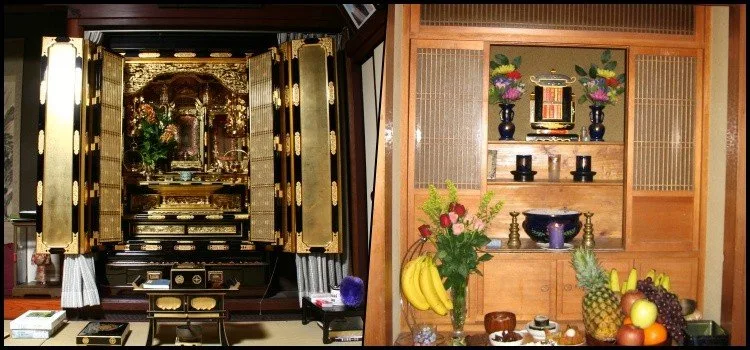
Butsudan literally means “Buddhist altar”. It is a shrine or altar-like structure found in Buddhist homes and also in Japanese temples. Most often it is a wooden cabinet with doors, or an open, often ornate platform.
Inside stands the gohonzon or another religious image: a statue or painting of a Buddha or bodhisattva, or a scroll with a mandala calligraphy. The altar has several purposes at once: venerating the Buddha, paying respects to the recently dead, and honoring the ancestors.
The parts of the altar
A butsudan contains a set of accessories called butsugu. These include candlesticks, an incense burner, a bell, and platforms for offerings such as fruit, tea, or rice. Depending on the school and the model, more objects may be added.
Most Buddhist schools, with the exception of Jōdo Shinshū, place ihai memorial tablets for deceased relatives inside or near the altar. Some families also keep a kakochō death register there, or even the urn with a relative's ashes.
The butsuma: the room for the altar
The defined space occupied by the butsudan is called butsuma. In traditional houses this is often a small dedicated room or a niche reserved for the altar. The altar is placed on a raised platform so that people can kneel or bow in front of it.
When the cabinet has doors, the family opens them for prayers and ceremonies and closes them afterwards. The doors protect the gohonzon and mark a clear boundary between the sacred area and the living space. With open altars, a cloth of brocade or white fabric is sometimes used to honor the sacred area.
History and origins
The origin of the butsudan cannot be reduced to a single event. Two explanations are discussed. One traces it to the jibutsudō, a private prayer hall in wealthy homes. The other sees its predecessor in the tamadana, a temporary altar set up during the Obon festival to welcome the spirits of the dead.
Emperor Tenmu is said to have ordered in 685 that a Buddhist shrine be built in every house and furnished with a Buddha statue and sutras. What really spread the practice was the Edo period: the terauke system required households to register with a temple, and the home altar became a visible sign of that bond. Morning and evening prayers and care for the ancestors became part of daily life.
Butsudan and the Buddhist schools
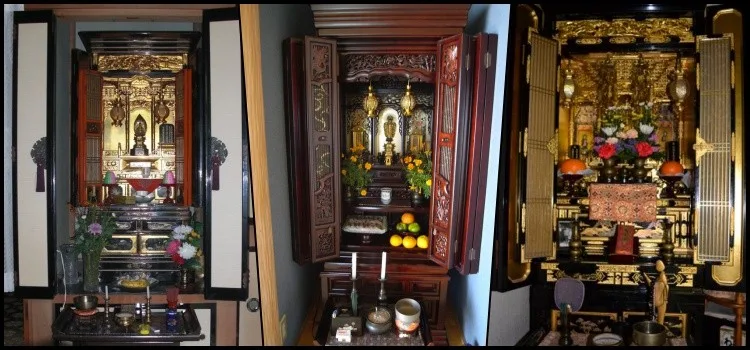
The design differs by school. In Jōdo Shinshū, the largest school of Japanese Buddhism, the altar plays a particularly important role, and its form follows the model of a temple hall. Schools differ in the shape of the roof, the colors of the pillars, and the arrangement of the interior.
In Zen Buddhism a distinct, simpler form developed, deliberately different from Jōdo Shinshū. In Nichiren schools such as Nichiren Shōshū and Sōka Gakkai the structure can look very different, with an inner shrine modeled on a temple altar. Electric doors are common in such models.
Types and styles
Specialists usually distinguish four groups: the golden kin butsudan, the karaki butsudan made of dark wood, the Kanto butsudan, and the furniture-style butsudan that looks like an ordinary cabinet. Small models for apartments are only 30 to 40 centimeters wide.
Making one is a craft with many steps, from woodworking and lacquer to gold leaf and carving. Regions such as Takaoka, Kyoto, and Nagoya developed their own traditions. Production peaked in the 1980s and has declined significantly since then.
The altar in daily life
In traditional families the butsudan is opened in the morning and evening, candles and incense are lit, and water, tea, or rice are offered. Some families ring the bell and recite a prayer or a sutra.
On death anniversaries relatives gather, and the family may invite a monk. During Obon in summer and at New Year the altar has a special meaning, because the return of the ancestors is celebrated. The home altar also plays a central role in funerals and memorial services.
Butsudan and kamidana
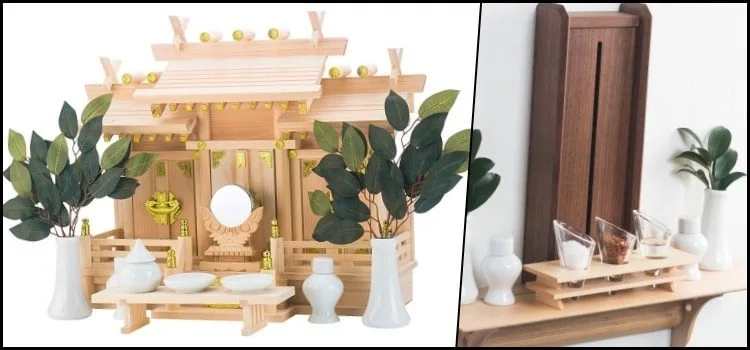
The butsudan is Buddhist, while the kamidana is the Shinto home altar. The kamidana usually stands high on a wall and holds objects for the kami, the Shinto deities. The butsudan, by contrast, is associated with the Buddha, the bodhisattvas, and deceased relatives.
In many homes the two stand side by side without being seen as a contradiction. Shinto also has the soreisha, a separate place for ancestor veneration that resembles the butsudan.
Modern apartments and the small altar
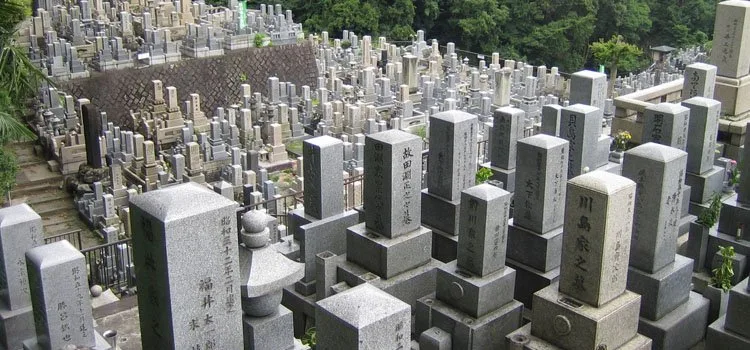
In big cities apartments are smaller, and not every family sets up a large altar. Compact models, furniture-style butsudan, and simple altars that fit on a shelf are common instead. Some households give up a fixed altar and visit the family grave or the temple instead.
The share of households with a butsudan is higher in rural areas than in cities. This has to do with living space and with the question of who takes care of it and pays for it. In some families the altar is passed down for generations; in others a new one is bought after a death.
Buying, consecrating, and passing it on
Butsudan are sold in specialist shops, department stores, and craft workshops. Prices vary widely with size, material, and workmanship; simple models are much cheaper than large altars with gold leaf and elaborate carving.
A new altar is consecrated in its own ceremony, the kaigen kuyō. When an altar is replaced or repaired, some schools hold a ceremony as well. In the past there were problems with dishonest sellers, which led to the creation of a fair trade council for the industry.
Common questions
Is a butsudan a temple at home? Not in a legal sense, but it is a small sacred area that can be designed like a temple.
Must every Japanese family have a butsudan? No. The number of households with an altar is falling, especially in cities.
May visitors touch the butsudan? Visitors should not open it or place objects on it without permission.
What is the difference from a kamidana? The butsudan is Buddhist; the kamidana is Shinto.
Conclusion
The butsudan is more than a piece of furniture. It connects a family's daily life with the Buddha, with the ancestors, and with the rites that shape Japanese household religion. Understanding it also means understanding how Buddhism in Japan is practiced not only in temples but at home.
To read more: the kamidana, the Shinto home altar, an overview of religion in Japan, Buddhism in Japan, the Obon festival and the Segaki rite for the dead.

Community
Comments
0 comments
There are no published comments in this language yet.
Send comment