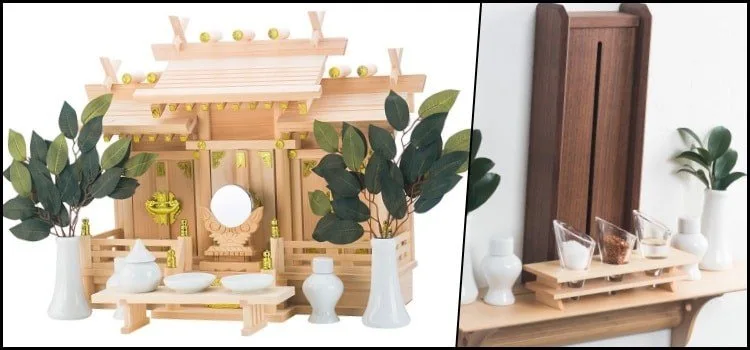
Kamidana (神棚 kami-dana, lit. "shelf of god") are miniature household altars provided to consecrate a kami of Shinto. They are most commonly found in Japan, the home of the kami worship.
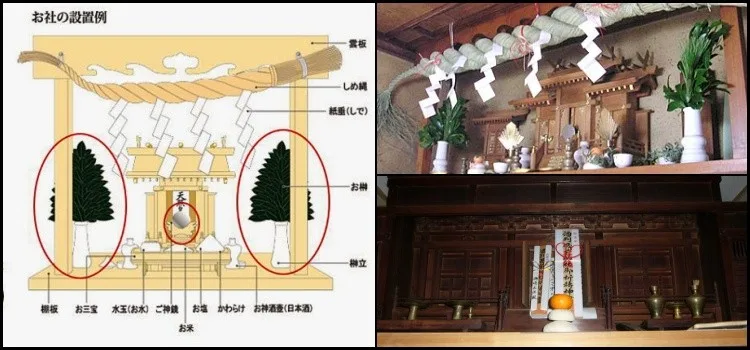
The shrine is typically placed high on a wall and contains a wide variety of items related to Shinto-style ceremonies, the most prominent of which is the shintai, an object intended to house a chosen kami, thus giving it a physical form to allow for worship.
The kami within the shintai is often the deity of the local shrine or one particular to the profession of the homeowner. A part of the kami has been specifically obtained for this purpose from a shrine through a process called kanjō. Worship generally consists of offering simple prayers, food (e.g.: rice, fruits, water), and flowers.
Before worshiping at the shrine, it is ritually important for family members to purify their hands. In Japanese homes, while maintaining a kamidana, a butsudan is also maintained.
Maintaining a Kamidana
A household kamidana is typically installed in your home to consecrate an ofuda, a type of charm. Both the kamidana and the ofuda can be purchased at any large Shinto shrine. Ofuda by themselves can be displayed on a counter or in any visible place, as long as they are kept in their protective bags.
However, when an ofuda is consecrated in a shrine, there are several rules that must be followed to ensure proper installation. First, a shrine cannot be placed on the floor or at eye level. It must be above the eye level of an average person. Second, it cannot be placed over an entrance, but must be built in a space that people will not walk under.
Finally, when an ofuda is consecrated, after removing the bag, it is customary to leave an offering of water, sake, or food in front of the shrine, which should be changed regularly. These rules apply to both homes and martial arts dojos. Ofuda are replaced before the end of each year. However, the shrine can be kept in the house until they are no longer usable.
What is kept besides the Kamidana
At the center of the shrine is the taima, an inscription from the Shinto shrine in Ise, which represents a universal kami. The shrine may also include a shimenawa, a sacred rope of twisted rice straw traditionally used to demarcate a sacred area.
Kevin Henrique has written about the Japanese language, culture, anime, games, and travel since founding Suki Desu in 2014. He first visited Japan in 2016.
Community
Comments
0 comments
There are no published comments in this language yet.

 However, when an ofuda is consecrated in a shrine, there are several rules that must be followed to ensure proper installation. First, a shrine cannot be placed on the floor or at eye level. It must be above the eye level of an average person. Second, it cannot be placed over an entrance, but must be built in a space that people will not walk under.
Finally, when an ofuda is consecrated, after removing the bag, it is customary to leave an offering of water, sake, or food in front of the shrine, which should be changed regularly. These rules apply to both homes and martial arts dojos. Ofuda are replaced before the end of each year. However, the shrine can be kept in the house until they are no longer usable.
However, when an ofuda is consecrated in a shrine, there are several rules that must be followed to ensure proper installation. First, a shrine cannot be placed on the floor or at eye level. It must be above the eye level of an average person. Second, it cannot be placed over an entrance, but must be built in a space that people will not walk under.
Finally, when an ofuda is consecrated, after removing the bag, it is customary to leave an offering of water, sake, or food in front of the shrine, which should be changed regularly. These rules apply to both homes and martial arts dojos. Ofuda are replaced before the end of each year. However, the shrine can be kept in the house until they are no longer usable.



Community
Comments
0 comments
There are no published comments in this language yet.
Send comment