
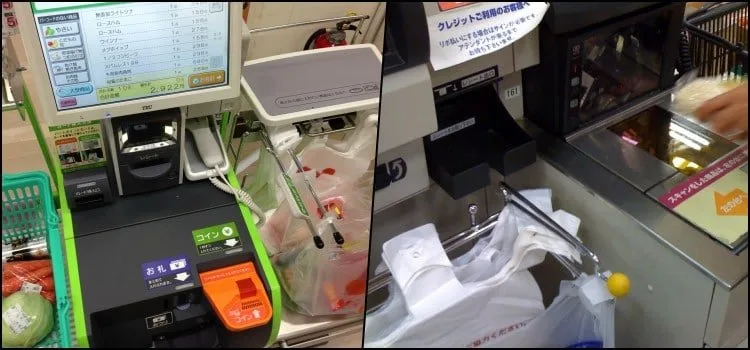
Shopping in Japan eventually brings most visitors to a checkout counter with nobody sitting at it. Self-checkout has become part of everyday life in supermarkets and convenience stores. Shoppers scan their own items, place them in the bagging area and pay at a machine. In Japanese the system is called serufureji (セルフレジ).
This guide explains the two versions of the system, how a purchase works, how shops handle age checks for alcohol and tobacco, and what travellers should know.
Contents 9
What self-checkout means in Japan
A self-checkout terminal lets customers scan their own products and pay the total. Japanese shops place these machines near the entrance or next to ordinary registers. The screen guides the customer through each step and often offers a language menu for Japanese, English, Chinese and Korean.
Two systems: semi and full self-checkout
The industry distinguishes two models. In semi-self-checkout, called semi-serufureji (セミセルフレジ), a member of staff scans the goods at the counter and the customer pays at a separate machine. Supermarkets and drugstores favour this model because staff keep talking to customers and never handle cash.
In full self-checkout, called serufureji or furu serufu (フルセルフ), customers scan and pay on their own. Convenience stores use this model most often. Staff remain in the shop to help with problems and to watch for theft, so the store is never completely unmanned.
How a purchase works
Hold the barcode of each product in front of the scanner. For fruit and vegetables without a barcode, choose the item on screen or weigh it at a separate station. Then place the goods in the marked bagging area. Sensors compare the weight with the scanned items and pause the process when something does not match.
When everything is scanned, tap the button to finish, choose a payment method and pay. The receipt comes out of the machine or can be stored digitally. Anyone who needs help presses a call button, and a member of staff comes to the terminal.
Paying by cash, card and QR code
Japanese self-checkout machines usually accept cash, credit cards, transport cards such as Suica and QR codes from services such as PayPay. The payment unit takes notes and coins and returns change automatically. With cashless services, customers show the code on their phone or hold the card against the reader.
Foreign visitors should remember that many machines do not accept foreign cash or foreign cards. Trying a purchase is still worthwhile because the process is simple and the screens usually offer an English interface.
Age checks for alcohol and tobacco
Alcohol and tobacco may only be sold to people aged 20 or over in Japan. A self-checkout terminal therefore asks for confirmation, and a member of staff normally checks the ID and approves the transaction. This is where queues slow down, especially in convenience stores.
In 2025 the Japanese Digital Agency tested a digital alternative with the franchise association. A smartphone with the My Number Card function can complete the age check directly at the terminal. A similar system reached a store in Osaka in March 2026, where customers register their ID and face in an app once and then skip the staff check.
Why stores are rebuilding their checkouts
The main reason is a shortage of workers. Japan struggles to find enough staff for registers and sales floors. Self-checkout reduces the work of taking payment and shortens waiting times at busy hours.
Commercial reasons matter too. Machines count cash accurately, record every item and produce data for stock management. With high labour costs, the equipment pays for itself for many chains within a few years.
The first machines appeared in larger supermarkets in the 2010s, followed by drugstores and convenience stores. Interest grew during the pandemic, when stores wanted less contact at the register. Today the terminals are a standard sight in many branches, even if not every chain converts every lane.
Limits and problems
The system does not run without people. Machines need maintenance, receipt paper and repairs. Customers who are unfamiliar with technology need help, and older shoppers sometimes take longer at a self-checkout than at a staffed register.
Security is another issue. Weight sensors and cameras detect irregularities, but shoplifting and fraud remain a concern. Stores therefore keep visible staff who stand between the machines and step in when needed.
A comparison with other countries shows a difference. In Japan the machines are usually seen as an addition to staffed registers, while some countries rely on self-checkout for most lanes. The mix of semi and full self-checkout lets stores adapt to the customers and the time of day.
Practical tips for shopping
Change the screen to English if needed. Bags are available at the checkout or customers bring their own. Place goods in the bagging area only after scanning, or the machine will stop the process.
Keep an ID ready for alcohol or tobacco and wait for staff approval. Press the call button if something goes wrong; help arrives without leaving the queue. Many machines also let customers store the receipt electronically.
Conclusion
Self-checkout is a fixed part of shopping in Japan. It combines technology with the local expectation that processes should run smoothly and politely. Once the steps are familiar, supermarkets and convenience stores are easy to navigate.
Read more: konbini in Japan, unmanned sales stands, vending machines in Japan, automated restaurants and shopping at a Japanese supermarket.


Community
Comments
0 comments
There are no published comments in this language yet.
Send comment