

If you have watched Japanese anime or dramas set in winter, you have almost certainly seen it: a low table, a thick blanket draped over the frame, and people who refuse to leave that warm pocket of air. That fixture is the kotatsu — not just furniture, but the winter gathering point of many Japanese homes.
It looks simple. Under the tabletop sits a heater; over the frame goes a heavy futon-style cover; legs go underneath, and the rest of the house can stay cooler. The appeal is half practical, half emotional: you stay warm without heating every room, and everyone ends up in the same place.
Contents 4
What is a kotatsu?
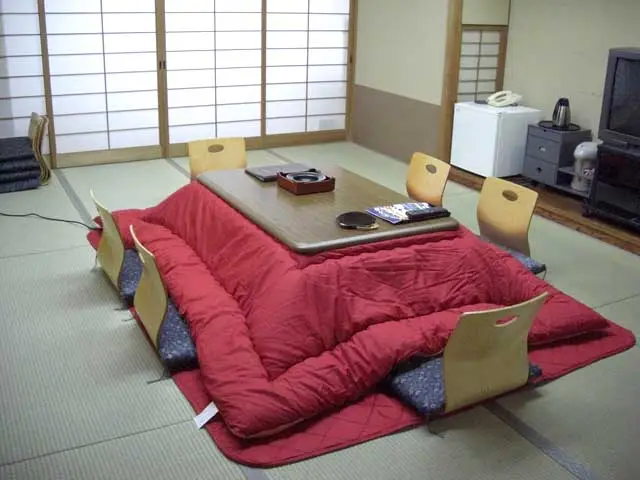
A kotatsu [炬燵 / コタツ] is a low table designed for floor seating, with a heat source under the frame and a thick cover that traps warmth around the lower body. Modern versions usually use an electric heater fixed to the underside of the table; older ones relied on charcoal.
The cover system is part of the design. A thicker outer blanket, often called a kotatsu-gake (or related kakebuton [掛け布団] style cover), sits over the frame. Under it, a lighter layer known as a shitagake helps hold heat. On the floor, a thin mat or under-futon keeps the setup comfortable. You sit on the floor or on a zabuton cushion, legs under the table, blanket over your lap and legs.
The arrangement fits traditional open clothing such as a kimono: warm air can rise from the legs toward the torso. In everyday modern life, people use it the same way in jeans and sweaters — books, snacks, remote control, and the quiet decision not to stand up just yet.
How did the kotatsu come about?
The kotatsu’s story usually starts in the 14th century, during Japan’s Muromachi period. Its ancestor is the irori, a sunken hearth used for cooking and heating the house. Over time, people added a wooden frame and a quilt to trap charcoal heat around seated bodies. That early form is remembered as the hori-gotatsu [掘り炬燵] — a “dug” kotatsu built around a pit in the floor.
Later, as tatami rooms and portable charcoal pots became common, a movable style developed: the oki-gotatsu [置き炬燵], a table you can place rather than dig into the floor. Charcoal in a pot under the table gave way, in the mid-twentieth century, to electric heaters attached to the frame. That electric version is the one most people know from homes, rental apartments, and winter scenes on screen.
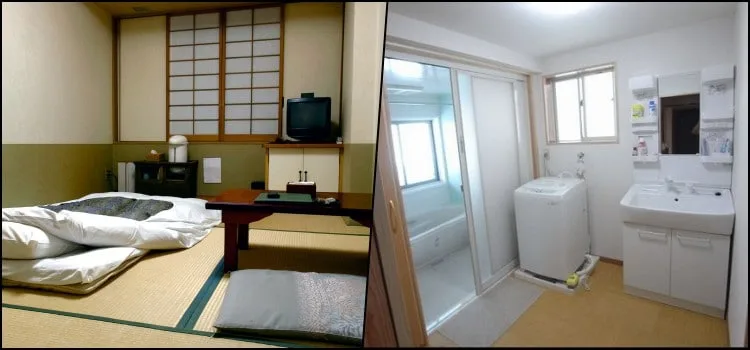
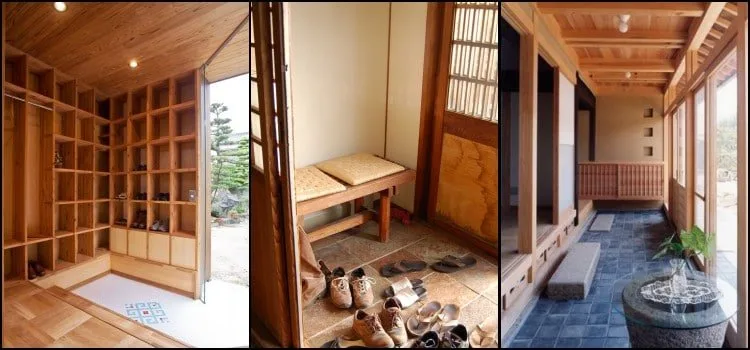
You can still encounter pit-style setups and older heating methods in traditional spaces, but the everyday kotatsu today is usually a freestanding low table with an electric unit underneath. For a wider look at the rooms these tables live in, see the features of a traditional Japanese house.
Why Japanese households still love the kotatsu
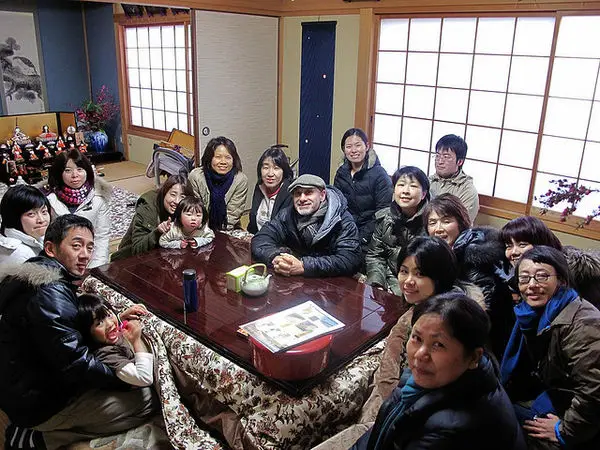
Kotatsu are especially popular in colder regions, but the cultural pull is nationwide: families and friends gather around the same table to eat, study, drink tea, watch TV, or talk. Warmth is concentrated where people actually sit, which matters in homes that historically had limited insulation and little whole-house central heating.
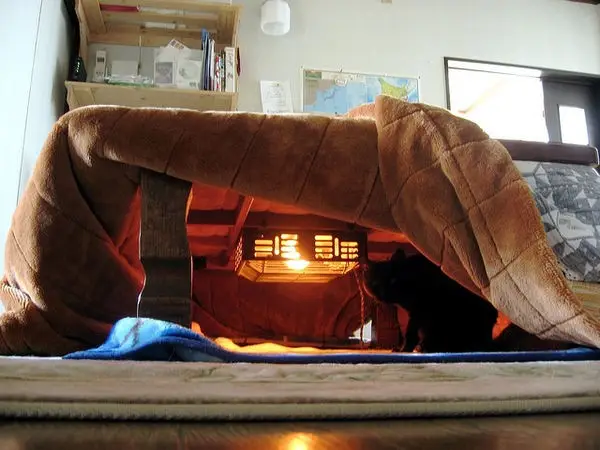
Compared with heating every room, a kotatsu is a thrifty option. The cover traps heat under the blanket so the lower body stays comfortable even if the rest of the room feels cool. In summer, many households simply remove the blankets and keep using the frame as an ordinary low table.
Napping under a kotatsu is a classic temptation — and a common warning topic. Uneven heating, the low table height, and the heater itself make overnight sleeping under one a bad idea for people. Cats and small pets, of course, often claim the warm spot without hesitation.
Similar ideas outside Japan
Japan is where the kotatsu became a household icon, but the problem it solves is universal: stay warm while sitting still, without heating the whole building. Spain and Portugal have the mesa camilla with a brazier underneath. The Netherlands historically used foot stoves. In Iran, the korsi follows a related logic of shared heat under a cover; Afghanistan and Tajikistan have the sandali. Even World War I trench notes mention improvised “Japanese foot heaters.”
Those cousins underline what makes the kotatsu distinctive in Japan: it is not only a heater, but a winter social stage — the place where the household’s attention naturally settles when the air turns cold.
Have you ever sat under a kotatsu, or only met one through anime and films? If winters where you live stay mild, the table may feel like a luxury of cold climates. If they do not, the logic is obvious the moment your legs stop freezing under a shared blanket.




Community
Comments
0 comments
There are no published comments in this language yet.
Send comment