
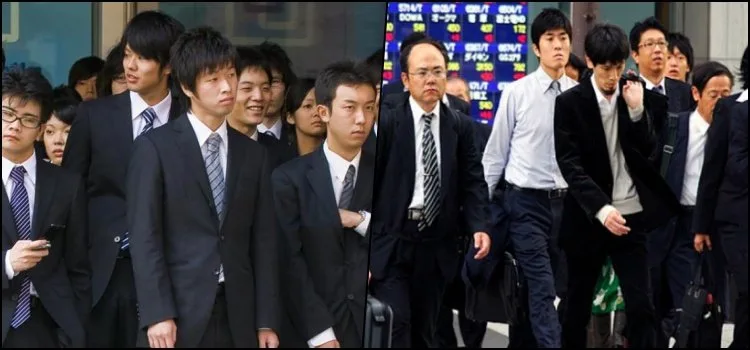
Every now and then we see stereotypes saying that Japanese people are all the same, which also happens with other East Asian countries, where people claim that everyone has the same face. Is that true?
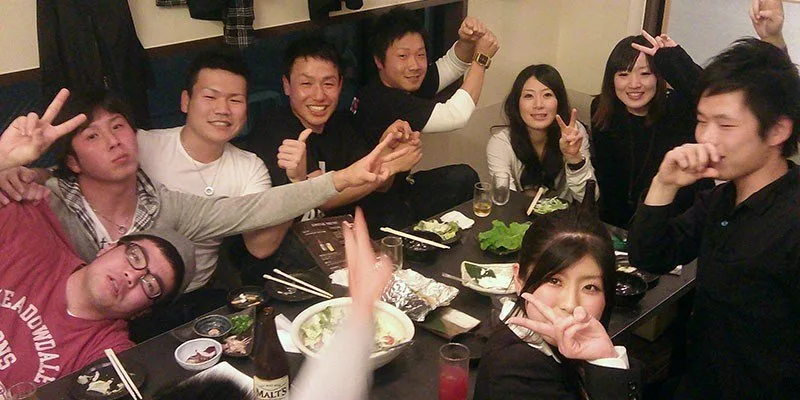
I still have a hard time telling Japanese, Korean, and Chinese people apart just by looking. That is a different problem from recognizing someone you already know. Suppose you know a Japanese person — will you find them in a crowd if they get lost? If a group of Japanese friends takes a picture together, do they mix each other up when they try to point themselves out?
Contents 3
Japanese people are not all the same
Just as a lot of Westerners imagine Japanese faces as interchangeable, Japanese people often say the same thing about Europeans and other Western nationalities: the blond hair, the pale skin, the "same" nose. All of this happens because of a simple bug in the brain.
Psychologists call it the cross-race effect — also the other-race effect or own-race bias. It is not a Japanese quirk and it is not proof that a whole country shares one face. The brain gets more practice encoding the faces it grew up seeing. Those faces get stored with the small details that tell one person from another. Unfamiliar faces get filed closer to a category: Japanese, European, Black. Category is fast. Distinguishing takes work.
A line of studies gave Europeans and Japanese photos of different ethnicities. Volunteers remembered faces from their own group more easily. The same difficulty Europeans had with East Asian photos showed up, in reverse, when Japanese volunteers tried to pick out European faces they had just seen.
People are better at telling apart faces from groups they actually practiced. Japanese faces are not a special exception — and Japanese observers have the same trouble with unfamiliar Western faces.
It was not only a recognition test. Brain recordings suggest same-group faces get a richer encoding of unique features. Other-group faces that look "typical" of the category get a shallower pass — unless a face is unusually distinctive, in which case it sticks the way a familiar face does. A century ago a psychologist already put the stereotype in both directions: to someone unused to a group, the faces collapse into a type.
Are Japanese people similar?
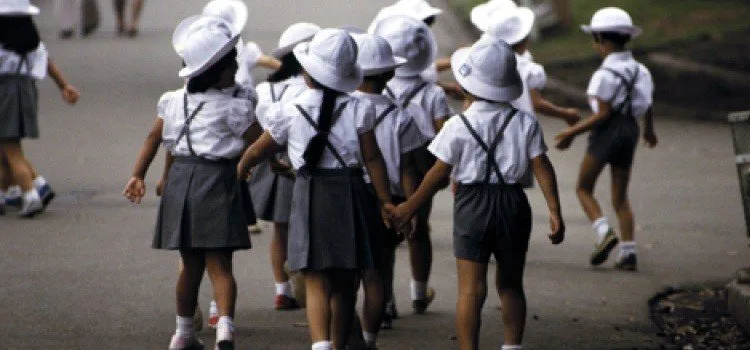
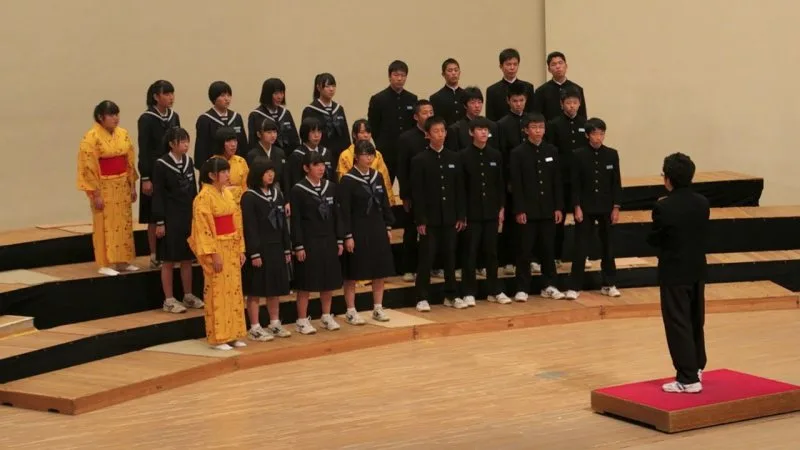
Some traits are common. Dark hair is frequent. School uniforms and office dress codes can flatten the first impression: a street of dark suits, or a class in the same hat and sailor collar, makes the group look more uniform than the faces are. That is clothing and hair, not a single face issued at birth.
Look at a school photo or a choir on stage: same hats, same collars, same dark jackets. From a few meters away the group reads as one texture. Walk closer and the faces split — rounder jaw, longer chin, different eyebrows, a smile that belongs to one person only. Uniforms are a visual shortcut. They are not evidence that the people wearing them were stamped from one mold.
Japan is not a photocopier of one look. Features vary by family and region. People dye their hair, grow it out, wear glasses, gain weight, lose it. From my own experience, I could pick my Japanese friends out of a crowd once I was used to their faces. Spend time with people as people — not as "the Japanese" — and the differences stop being subtle.
The stereotype also smudges a huge map. "Asian" is not one face. The remark usually aims at East Asians — Japanese, Korean, Chinese — and even that trio is not a single mold. Guessing nationality from a still photo is a sloppy game. Recognizing a person you know is a different skill, and it improves with attention, not with a theory about isolation or diet.
Living in Japan is not a magic switch
Studies keep landing on a less convenient point: moving to Japan, or walking past thousands of faces on a commute, does not automatically rewire recognition. Your brain needs actual looking — the kind you give friends, classmates, coworkers — not a blur of strangers in matching clothes.
We grow up practicing the faces around us. If that practice set is narrow, other groups stay blurry. A mixed city helps some people, because more kinds of faces show up in daily life; it does not grant a superpower. You still get better at the faces you bothered to learn. I do not find all Japanese people alike, and that has less to do with a secret Japanese gene than with years of looking at Japanese culture up close.
The same trick happens inside one country. People who grew up in the same town, the same school, the same sports club start noticing details outsiders miss. Familiarity is the skill. The stereotype is what fills the gap when that skill was never trained.


Community
Comments
0 comments
There are no published comments in this language yet.
Send comment