
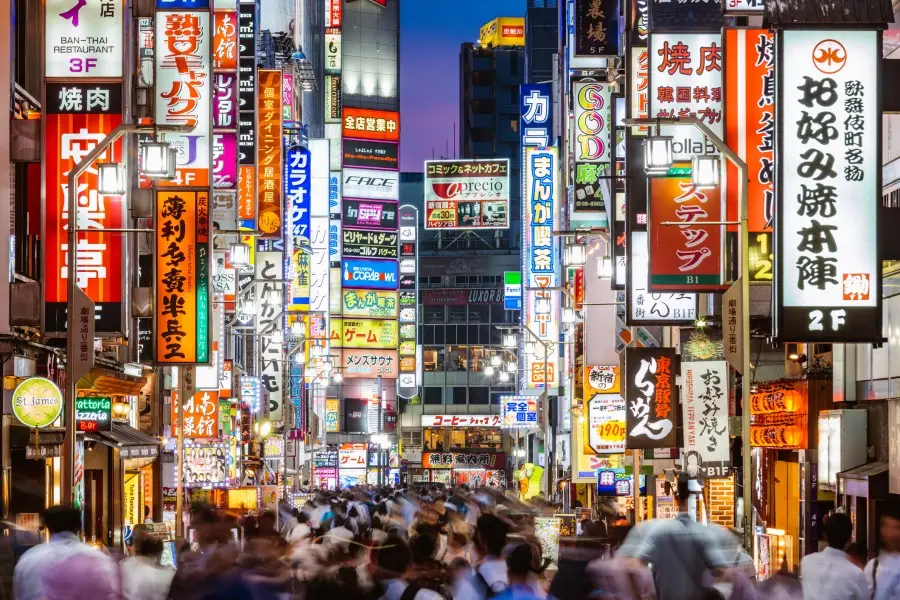
What are the needs of the external market, if Japan is a country with one of the largest economies in the world? To better understand the answer to this question, let’s look at everything behind the economy in Japan.
The Japanese economy gained prominence after World War II. In the 1980s and 90s, Japan became a major economic power in the world, being the third largest in the world, behind only the United States and China.
Table of Contents
Historical Context
In the Edo Period (1603 – 1969), Japan underwent a process of political and economic isolation and greater rigidity regarding internal economic control. Thus, the feudal domains were subject to the imposition of legal codes. During this period, economic development included urbanization, increased transportation of goods, a significant expansion of domestic and initially foreign trade, and a diffusion of commerce, industries, and crafts.
With the population growth, Osaka and Kyoto already had more than 400,000 residents, becoming centers of intense commerce and service production. The basis of the economy was rice. It was common even to use contracts for the sale of rice that had not yet been harvested. This period was also marked by a growing interest in the study of Western science and techniques.
The Meiji Period was marked by several changes in the economy, education, religion, institutions, and many others. Structural changes significantly affect a country’s finances. After Japan’s defeat in World War II, it needed help to recover financially. For this, it relied on the assistance of the United States. They used this to regain independence. The post-war economic development process became known as the Japanese miracle.
In the 1980s, Japan became the second-largest economy in the world until 2010. In that same decade, the rise in real estate stocks caused an overheating of the Japanese economy known as the Japanese financial and real estate bubble.
From 1990 to 1992, the Tokyo Stock Exchange crashed, and real estate peaked in 1991. But from 2001 to 2010, the increase in per capita income surpassed that of Europe and the United States. Currently, a concern regarding the economy is due to the aging population. Because of this, although Japan is a major producer of entertainment in the world of anime and music, the country faces heavy competition from China and South Korea, especially in music.

Japan’s Economy
The Japanese currency is the yen, which is the third most traded currency in the foreign exchange market after the US dollar and the euro. The Gross Domestic Product (GDP) in 2019 was 5.75 trillion dollars. The most popular economic sectors are industry, technology, and finance.
The industrial regions are concentrated in the islands of Honshu, Hokkaido, Shikoku, and Kyushu. Vegetables, rice, sugar, beet sugar, eggs, fish, and fruits are the most relevant agricultural products. The products from Japan that are also very profitable include automobiles, electronics, machinery, chemicals, computers, processed foods, and textiles.
Japan often exports commodities or commodity (goods or products of primary origin with high commercial value) such as semiconductors, transportation equipment, electrical machinery, and vehicle engines.
The countries that contribute to Japan’s external market are the United States, China, South Korea, and Hong Kong. Those that Japan itself typically buys from are usually China, Australia, and Saudi Arabia. It is worth noting that there are certainly more countries, and each place has its interest in specific products; these are just the main ones.
Japan is among the three largest importers of agricultural goods in the world and is the largest importer of fish and derived products. Japan decided not to exploit its forest resources for economic purposes.
Agriculture and fishing were the best-developed resources, but only after years of significant investment and work. Japan built its own manufacturing and processing industries to convert raw materials from the external market.
This economic development strategy required the establishment of a strong economic infrastructure to provide the energy, transportation, communications, and technological knowledge necessary. Deposits of gold, magnesium, and silver help meet industrial demands, but Japan is dependent on external market resources for many of its essential minerals for industry. Examples include iron, copper, bauxite (a natural mixture of aluminum oxides), aluminum, and forest products that need to be imported.

Post-Pandemic Japanese Economy
The pandemic caused by COVID-19 was something that caught many by surprise and negatively affected the global economy. In the first half of 2021, Japan’s exports decreased, and there was an increase in import costs.
According to Uol Economia, the yen is weaker, and the rise in oil prices has increased import costs, affecting Japan’s terms of trade (which is poor in natural resources) and undermining Prime Minister Fumio Kishida’s promise to correct inequalities. The cost of living in Japan is rising due to these factors.
Exports increased by 13% in September 2021 compared to the same period in 2020. The expectation is that with the external market, the country will be able to recover. Due to the economic crisis caused by the pandemic, the entry of automobiles fell by almost half.
As Japan depends on the external market, meaning it secures itself through exports, crises like these are significant because countries lose interest in technological items and prioritize more basic items. The Japanese market is somewhat “poor” in natural products compared to other countries. But since the pandemic is not completely over, it is still unclear what traces it will leave on Japan’s economy and its relations with the external market.

Leave a Reply