Do you know the traditional Japanese clothing called Kimono? In this article, we will see a little about the famous traditional garment Kimono and its parts and accessories, as well as some other similar clothes.
Japan maintains a millennia-old culture; even with westernization, Japanese fashion stands out from the rest of the world. Fortunately, traditional clothing from previous centuries remains in fashion, being worn on various occasions.
Table of Contents
Which country has the kimono as traditional attire?
Although the article makes it clear that the Kimono is traditional Japanese clothing, both Japan and other Asian countries have influenced each other throughout history. Today, it is possible to find these traditional clothes in both countries.
Of course, each country has a traditional attire that differs quite a bit but has similarities. In China, we have the Hanfu, and in Korea, we have the Hanbok.
The traditional Chinese clothing Hanfu has wide and large sleeves like the Kimono, in addition to some extra stylish details, while the Hanbok has thinner sleeves and a distinctive skirt.

Is it Kimono or Quimono?
Is it correct to say Quimono or Kimono? What does it mean? Let’s start the article by answering these two small questions. Quimono is a Brazilianized version of the word Kimono. Both are correct, but I prefer to write it in the original form.
Its meaning is quite simple and means “thing to wear.” In the word Kimono, we have the ideogram for wear [着] and thing [物]. It is a simple word that is currently used to refer to a specific type of traditional Japanese clothing.
Nowadays, it is common to associate the Kimono with clothing used in martial arts like judo, jiu-jitsu, etc. Although they share the same name, they are different garments. In fact, the word was once used to refer to any type of clothing or thing to wear.

What is the Origin of the Kimono?
The Kimono was created under the influence of Chinese clothing “HAN” or “Hanfu” but developed over the centuries, becoming part of traditional attire from the years 794 to the 19th century.
Over time, the Kimono was replaced by Western clothing, and yukata for greater comfort and ease of movement. Today, they are worn more by women and on special occasions. The Kimono has a long history and has undergone various changes over the millennium.
In 1903, the first variation of clothing inspired by the cuts of the traditional kimono emerged. This variation was created by Paul Poiret and became popular throughout Europe. Soon, other variations appeared, one of which was made by Brazilian Nívia Freitas and became popular around 2016.

What are the parts of a Kimono?
Before we get to know the pieces and accessories that make up the Kimono, we need to understand the parts of this large garment.
- Doura [胴裏] – upper lining of the women’s piece;
- Eri [衿] – collar;
- Fuki [袘] – hem guard;
- Sode [袖] – sleeve below the armhole;
- Obi [帯] – a belt used to fold excess fabric;
- Maemigoro [前身頃] – main front part, excluding sleeves;
- Miyatsukuchi [身八つ口] – opening under the sleeve;
- Okumi [衽] – front inside panel on the left and right front edge, excluding the sleeve;
- Sode [袖] – Sleeve;
- Sodeguchi [袖口] – sleeve opening;
- Sodetsuke [袖付] – armholes;
- Susomawashi [裾回し] – lower lining;
- Tamoto [袂] – sleeve bag;
- Tomoeri [共衿] – [collar protector] along the collar;
- Uraeri [裏襟] – inner collar;
- Ushiromigoro [後身頃] – main back part, excluding sleeves;

Different types of Kimono
The Kimonos can vary greatly and change depending on age, season, occasion, and various other factors. There is a whole etiquette behind Kimonos and even a correct way to wear them. Now let’s look at some types of kimono.
Furisode [振袖] are kimonos with long sleeves (70 to 90cm) that sway. It is formal and worn by single women, richly patterned, fastened with a multicolored brocade obi tied in large bows at the back.
The Furisode kimonos can be worn by the bride’s single friends at wedding ceremonies. Young women also tend to wear the Furisode at their coming-of-age ceremony (20 years old) called Seijin Shiki.
Kosode [小袖] is an expression that derives from the custom that when women married, they wore Kimono with short sleeves or cut the sleeves as a symbol of fidelity to their husbands, giving rise to Tomesode [留袖].
Generally, these Tomesode kimonos are worn at wedding ceremonies and are quite formal. They usually have 5 or 3 Kamons (family crests) printed and embroidered on the sleeves, chest, and back.
Read also: Kamon – The crests of Japanese clans

Tomesode are short-sleeved kimonos usually categorized as:
- kurotomesode [黒留袖] – Black and formal;
- irotomesode [色留袖] – Black and less formal;
The parents of the bride or groom usually wear the Kurotomesode, while the relatives and friends of the bride often wear the Irotomesode. Generally, this type of Kimono uses a brocade and gold obi. The sleeves range from 50 cm to 70 cm in length.
Houmongi [訪問着] – A plain one-color Kimono, usually in pastel shades. This type has no kamons (family crests) and is considered less formal than the Irotomesode but can be worn at parties and wedding ceremonies.
Tsukesage [付下げ] – An exquisite Kimono worn by single or married women. It usually has a more discreet decoration and is less formal than the Houmongi, making it suitable for daily wear on different occasions.
Iromuji [色無地] – A one-color Kimono that may have textures but no decoration in another color, primarily worn in Tea Ceremonies. It may have a small decorative embroidery or a Kamon (family crest) on the back.

What are the differences between Kimono and Yukata?
Yukata is one of the items most similar to Kimono and is often confused by people who do not know their differences. One of the main differences is that traditional kimono is made up of several pieces, while yukata is simpler and thinner.
Yukata is a type of more casual and lighter Kimono, usually consisting of just one piece and a belt. It is often worn after bathing in traditional Ryokan and Onsen hotels. The word Yukata literally means bathing clothes.
Yukata [浴衣] is a popular Japanese garment in summer. People usually wear Yukata at Japanese festivals and fireworks festivals (Hanabi Taikai) and other traditional summer events.
To learn more about traditional Japanese summer clothing, we recommend reading:

What are the pieces and accessories of a Kimono?
There are several other accessories and clothing pieces related to Kimono that were created specifically to be worn with it. If you do not use some of the pieces we will mention below, you cannot even say you are wearing a Kimono.
Obi [帯] – Wide ornamental belts that are wrapped around the waist of the Kimono or Yukata. Depending on the garment, these obi can cost more than the kimono itself.
Eri-sugata [衿姿] – Fake collar that can be worn with the kimono to simulate more layers;
Haori [羽織] – Types of jackets that are worn over kimonos on cold days. Happi [法被] is a type of Haori worn by merchants, which is currently often seen as team uniforms at festivals.

Koshihimo [腰紐] – A narrow strip used to assist in dressing, often made of silk or wool. They are used to keep virtually anything in place during the dressing process and can be used in various ways.
Nagajuban [長襦袢] – A kimono-shaped robe worn by men and women under the Kimono. Since they are made of silk, they are delicate and difficult to clean; the nagajuban helps keep the kimono clean by avoiding contact with the wearer’s skin.
Zori [草履] – Traditional sandals similar to flip-flops. There are formal and informal zori, made from many materials, including fabric, leather, and vinyl, and they can be embellished.
- Geta [下駄] – Wooden sandals worn by men and women with yukata;
- Waraji [草鞋] – Straw sandals worn by monks;
Pieces and accessories of Women’s Kimono
Hiyoku [ひよく] A type of sub-Kimono, historically worn by women under the kimono. Today, they are only worn on formal occasions, such as weddings and other important social events.
Kanzashi [簪] – Hair ornaments worn by women. There are many different styles, including silk flowers, wooden combs, and hairpins.
- Juban [襦袢] and Hadajuban [肌襦袢] – A fine piece of clothing similar to a camisole;
- Susoyoke [裾除け] – An inner skirt, a women’s undergarment;

Pieces and accessories of Men’s Kimono
Hakama [袴] – Traditional Japanese clothing. It is usually worn over the kimono, covering the lower part of the body and resembling wide pants. Hakama are traditionally men’s clothing.
Originally, it was worn only by samurai men to protect their legs while riding horses. On foot, the Hakama hides the legs, making it harder to predict movement, thus providing an advantage in combat.
Nowadays, Hakama are worn only in extremely formal situations, such as tea ceremonies, weddings, and funerals. Attendants at Shinto temples and practitioners of certain Japanese martial arts, such as aikido, kenjutsu, kendo, and kyudo also wear Hakama.
- Fundoshi [褌] – Traditional Japanese undergarment [thong] for adult males, made from cotton;
- Netsuke [根付 ou 根付け] – Consists of a worn ornament suspended on the obi;
- Jittoku [十徳] A type of haori worn only by men;
- Jinbaori [陣羽織] – Made specifically for a samurai to wear;
These were some curiosities about the kimono and its accessories. If you liked the article, don’t forget to share and leave your comments. Thank you very much and see you next time!

The Western Kimono
Strangely, whenever we search for Kimono on Western clothing websites, we come across pieces that have absolutely no relation to traditional Japanese Kimono. We only find some short and even low-cut blouses, completely the opposite of a kimono.
I am not sure, but this is an invention of the West. In 1903, French designer Paul Poiret created a version of a short kimono jacket, which generated quite a controversy but became popular in Europe.
A Brazilian designer named Nívia Freitas also created her version of a kimono as a dress in 2016, which also became a trend. When researching Kimono, we also come across a lot of martial arts uniforms, which in Japan have various names.
It seems that in Brazil, any overlay blouse with a belt ends up getting nicknamed Kimono. Here, even Yukata are sold in stores under the name Kimono, but don’t be fooled.

What occasions to wear a Kimono?
Kimono [着物 Quimono] is a traditional Japanese garment made of silk clothing, belts, and various accessories. As it is a traditional, expensive, and complex garment, it is not something commonly worn every day.
Despite all the difficulties and different types of Kimonos for each occasion, they are very dear to the Japanese. Below we will see some of the main situations or occasions where one should wear a Kimono:
Kimono with Hakama skirt at graduation ceremony
A great opportunity to wear the kimono is during university and college graduation ceremonies. For women, it is one of the only opportunities to wear the Hakama over the Kimono (a type of skirt worn by samurai).

The wedding kimono
Western-style weddings are very popular in Japan, but some prefer to wear kimonos at traditional Shinto weddings. Those who marry in the Western style also often wear the wedding Kimono during the wedding party.
At Shinto weddings, the groom usually wears a traditional dark-colored outfit with five family crests, known as kurotomesode. The groom also wears a hakama.
Wedding guests also often wear traditional Japanese clothing. Single and young women tend to wear brighter colors, while older guests usually wear darker colors.

Kimono worn at Funerals
At funerals, it is customary to wear a black Kimono; unfortunately, this custom has been replaced by suits that are cheaper.
Wearing Kimono in stores
Employees of stores that sell traditional items, such as wagashi, often wear kimono. Cleaning the street in front of the store while wearing a Kimono is a tradition. There are many other types of businesses that tend to choose traditional clothing as their uniform.
Restaurants are some of the businesses with an implicit dress code. The easiest way to see Japanese people wearing their traditional clothing in a modern and technological city is by visiting such traditional stores and restaurants.
Read also: 18 Wagashi – Japanese desserts
Kimono in the art of Kyudo
Kyudo is an art of archery in which it is common to wear Kimono along with Hakama. It is quite different from the Kimono worn in Japanese martial arts, especially since Kyudo often involves the participation of women.
Read also: The 10 Japanese Martial Arts + List

Wearing Kimono at Festivals and Hanami
Japanese festivals often involve performances or parades of people in yukata or Kimono. In many cases, people also attend festivals in traditional Japanese clothing.
However, it is much more common to go to a matsuri in yukata (a type of summer kimono, cheaper). Besides festivals, during the months when cherry blossoms bloom, Japanese people often wear a Kimono or Yukata to see the cherry blossoms bloom.
See also: Hanami Guide – Appreciating the flowers in Japan

Other situations where Kimono is worn
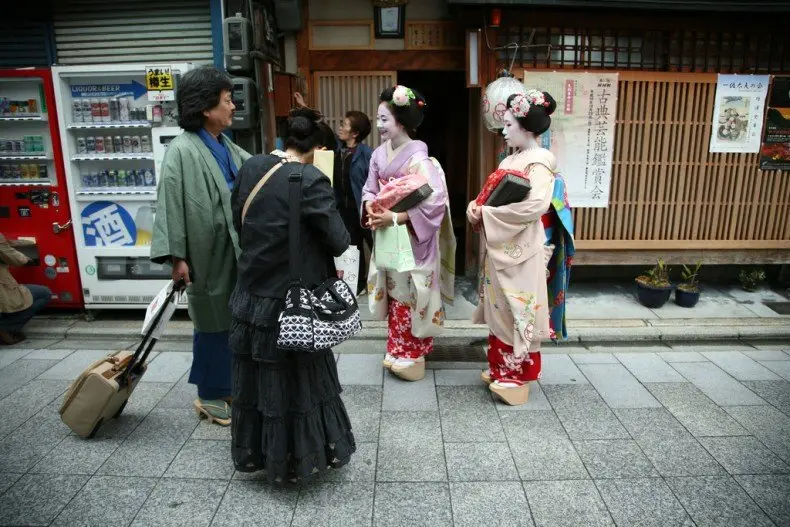
Those who participate in the tea ceremony wear a Kimono. Geisha and Maiko, in addition to traditional clothing, often wear additional layers, such as a shiny inner layer known as hiyoku.
Traditional Japanese inns are a great opportunity for you to wear a Yukata. It is common to wear Kimono for training and events in traditional Japanese arts, such as Ikebana, musical performances, or traditional fights.
See also: Ikebana – The Japanese art of floral arrangements
These are some of the occasions when Japanese people wear this traditional clothing. There are many others, as well as many details that were not mentioned for each occasion. What did you think of the article? Leave your comments and share with your friends.
Where to Buy a Kimono?
To acquire the traditional Japanese clothing, it may be necessary to import from Japanese websites, but there are alternatives such as having it made or buying cheap imitations inspired by famous stores like Amazon.
We also recommend reading: Amazon – The largest online store in Japan and the world
Perhaps your case is just a Kimono for practicing martial arts. If that is the case, the options below will help you:
https://br.pinterest.com/pin/402720391663253876/Videos about Kimono
Below we will leave some videos related to traditional Japanese clothing:


Leave a Reply