
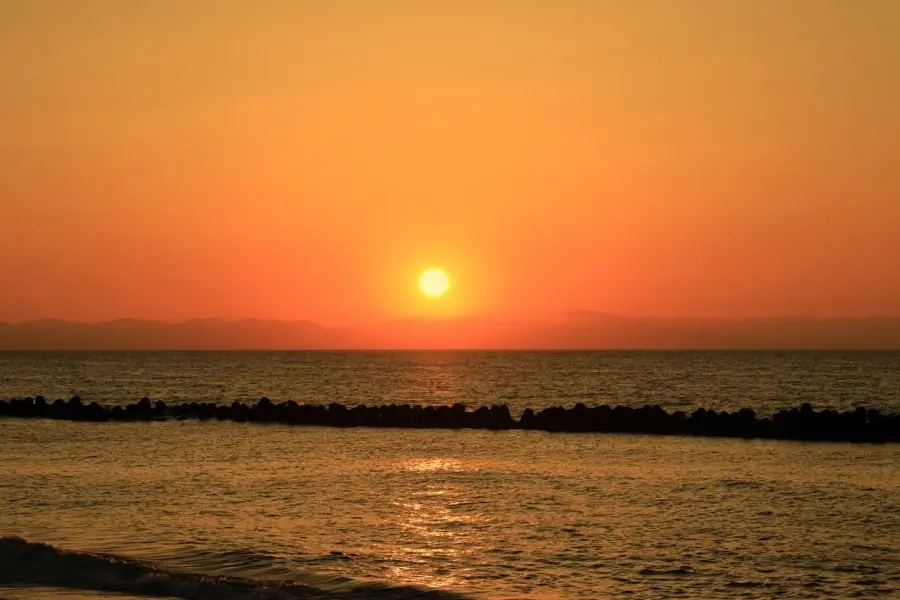
Where did the term “Land of the Rising Sun” come from? In ancient times, China developed a large part of the brands and symbols of advanced civilization in various areas, such as writing, city architecture, and bronze manufacturing — all of this 2,000 years before Japan.
As a result of this dominance, China had a huge influence on Asian culture, sharing its philosophies, political structures, architecture, religion, clothing styles, and written language.
With such powerful influence, when Japan was described at the beginning of its development, it was done from a Chinese perspective.
Thus, when the Chinese looked to the east, towards Japan’s location, they were looking in the direction of the dawn. That is how they referred to the country as the land of the rising sun. But other stories are also reported about the origin of this title.
We recommend reading:
- The 5 main islands of Japan All History
- Coins of Japan – Getting to know the Yen and its history
- Anonymous Japanese – Does Japan prefer anonymity?

Japanese History of the Land of the Rising Sun
At the moment the first Japanese ambassador was sent to the eastern Chinese capital of the Han dynasty in 57 AD, Japan was called “Wa” (和), a name that also designated the Japanese people.
According to contemporary Chinese accounts, these early Japanese “fed on raw vegetables, rice, and fish. They had vassal-master relationships, collected taxes, provincial granaries, and markets. They also had violent succession struggles.”
In the first century AD, a clan, the Yamato, began to dominate its neighbors, and by the 5th century AD, it became synonymous with leadership for Japan. As a single central government emerged, Japan increasingly followed Chinese culture, including its methods of administration.
Around 600 AD, the Regent Prince of Japan, Shotoku (574-622 AD), who was a great fan of Chinese culture, introduced a wide variety of influences from China to Japan. He adopted the models of Confucius regarding classes and etiquette.

Choosing the term Land of the Rising Sun
Shotoku also adopted the Chinese calendar, developed a similar road system, built numerous Buddhist temples, a similar judicial system, and sent Japanese students to China to study Buddhism and Confucianism, establishing diplomatic relations with that country.
Furthermore, Shotoku is widely credited in Japan for creating the name Nippon (“Origin of the Sun”) for the country. Reports say that the Prince, in the year 607 AD, at the time of the first embassy of the Sui dynasty, sent a letter to the Chinese emperor, Yangdi, which said: “from the Son of Heaven, in the land where the sun rises to the Son of Heaven in the land where the sun sets.”
Also read: How do you say Japan in Japanese? Nihon or Nippon?
Apparently, the Chinese felt offended that Shotoku tried to name himself as “Son of Heaven” on the same level as the Chinese emperor, who was also named that way. However, the part that says “in the land where the sun rises” also became marked as an identification of Japan.

Regardless of this, in 645 AD, according to Japanese history, a coup led to the introduction of the Taika reform. With the intention of further centralizing the government, the reform eliminated private land ownership, placing it under its control. As part of this reform, Nippon, Nihon (both meaning “origin of the sun”) and Dai Nippon (Great Japan) were used in diplomatic documents and chronicles instead of Wa (Wo).
Leave a Reply