
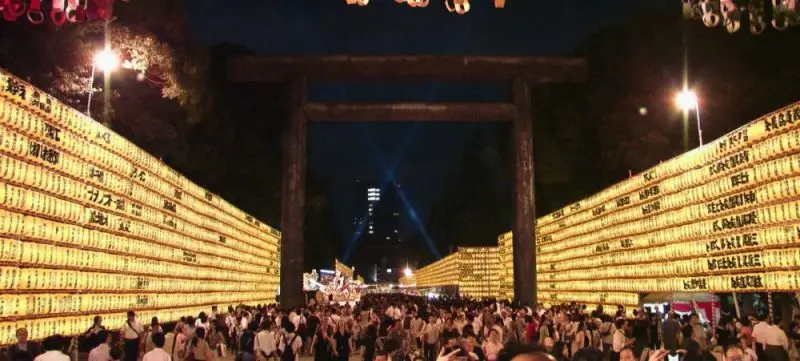
The majority of the Japanese population is Buddhist, making their rituals part of the national tradition. One of the most widespread customs is Obon, known as the day of all souls. In Brazil, the festival usually takes place under the name of Bon Odori, as the festival focuses a lot on dance.
Obon can also be simply called Bon or Urabon, which is derived from Avalambana in Sanskrit (day of all souls). It is a similar event to the Day of the Dead, but with a joyful dance atmosphere and gratitude.
This festival occurs on various dates depending on the region of the country, with the most common being in August (summer season). This variation among three dates occurs from the arrival of the Gregorian calendar at the beginning of the Meiji era.

In the east of Japan, from around July 15, the celebration based on the solar calendar exists. On August 15, it is the most celebrated date in the country and is based on the lunar calendar in the Kanto region. And on the fifteenth day of the seventh month of the lunar calendar, which changes the date annually, the celebration occurs in the northern part of the Kanto region.
Table of Contents
RITUALS OF THE OBON FESTIVAL
The festival was created to honor the ancestors, which is why it is very common for people to take time off work or organize vacations for these three days of celebration. During this period, everyone returns to their hometowns for the festival.
Many preparations are necessary. The graves need to be cleaned, and offerings (food, drink, flowers) are placed for the ancestors on altars. Everything is done with great care and attention, as it is believed that the ancestors come from the world of the dead especially to reunite with the family during this period of fellowship.

There are a series of rituals that are part of Obon. It all starts on the first day, when lanterns are lit inside the houses to help the family bring the ancestors from the grave to the home. On the last day, lanterns are painted with the family crest to guide the ancestors back to the graves. All this is accompanied by a lot of incense in the cemeteries, as well as in Japanese homes. Fire marks the beginning and end of the festival.
During these three days, there are other events. One of them is the ritual of floating lanterns (Tooro Nagashi), which occurs with handmade lanterns, with a candle illuminating their interior. These are placed in a river to be carried out to the ocean and represent the souls of the ancestors.
The Bon Odori Dance
The Bon Odori (typical dance) takes place during the nights accompanied by drums in shrines, temples, and parks. This dance is performed with the intention of symbolizing both the welcoming and the celebration of the living with the dead through dance.
It varies from region to region, each having a different style of dance and music. The way the dance is performed also differs; it is typically done with people in a circle around the yagura (a stage for musicians and singers of Obon music).
They may also spin around the yagura in a clockwise or counterclockwise direction, sometimes facing the yagura and moving away from it, or even dancing in a straight line through the streets of the city. The choreography of the dance is different in each region, as is its meaning.

For example, in a mining region, there may be movements symbolizing digging for ore, carrying, and pushing full ore carts. Each dance has an object used by the participants, such as hats decorated with flowers, towels, or small wooden bells. As the festival takes place in summer, participants wear yukata, lightweight cotton kimonos.
It occurs during the nights accompanied by drums in shrines, temples, and parks. This dance is performed with the intention of symbolizing both the welcoming and the celebration of the living with the dead through dance. It varies from region to region, each having a different style of dance and music.
The way the dance is performed also differs; it is typically done with people in a circle around the yagura (a stage for musicians and singers of Obon music). They may also spin around the yagura in a clockwise or counterclockwise direction, sometimes facing the yagura and moving away from it, or even dancing in a straight line through the streets of the city.
The choreography of the dance is different in each region, as is its meaning. For example, in a mining region, there may be movements symbolizing digging for ore, carrying, and pushing full ore carts. Each dance has an object used by the participants, such as hats decorated with flowers, towels, or small wooden bells. As the festival takes place in summer, participants wear yukata, lightweight cotton kimonos.
Origin OF THE OBON FESTIVAL
Buddhism is a religion and philosophy created from the teachings of Buddha, who lived in northern India. It spread from India to Central Asia and then to China, Korea, and Japan. For this reason, the scriptures and doctrines were mostly developed in Pali and Sanskrit, literary languages linked to ancient India.

This is the reason a Japanese festival derives from an Indian sutra, the Avalambana-sutra (Urabon-kyo in Japanese). It tells the story of a disciple of Buddha who uses his supernatural powers to identify where his deceased mother is. He discovers that she is in the realm of hungry ghosts suffering greatly.
He then asks Buddha how he can free his mother from there, who instructs him to make offerings to the Buddhist monks who had completed their summer retreat on the fifteenth day of the seventh month. He carries out the task and manages to free his mother from hell.
He reflects on his mother’s life and realizes all her selflessness and sacrifices made for him. As he was very happy with his mother’s liberation and grateful for her kindness, he then dances with joy. Thus, Bon Odori is born, where the ancestors and their sacrifices are remembered and celebrated.
Leave a Reply