

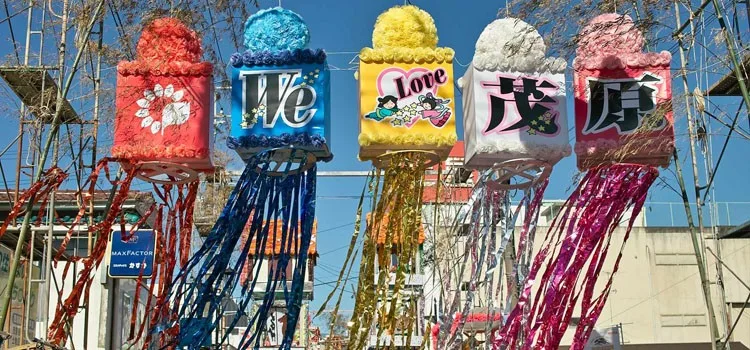
When was the last time you wrote a wish and hung it on a piece of colored paper, hoping the sky would listen? In Japan, this happens every year during the Tanabata Matsuri, also known as the Festival of Stars. This event, which blends tradition, romance, and spirituality, is celebrated by millions of people who connect with the ancient legend of Orihime and Hikoboshi — two lovers separated by the Milky Way.
In addition to its visual appeal with paper and bamboo decorations, the Tanabata Matsuri is one of the most symbolic moments of the Japanese summer. The festival takes place on the seventh day of the seventh month, with variations in dates depending on the region. It is also celebrated in other Asian countries, such as Korea and China, where the tradition has deep roots. And if you have heard of the Obon festival, know that the two often overlap in their practices and spiritual energy.
Contents 8
What is the origin of the Tanabata Festival?
Although it is deeply Japanese today, the Tanabata originates from ancient China. The story began with the Qixi festival, which was incorporated into the Japanese calendar in the year 775 by Empress Koken. At that time, it was celebrated at the Imperial Palace in Kyoto, mainly by the court elite.
Over the centuries, especially during the Edo Period, the celebration became popular and began to blend with the Obon festival, gaining its own elements and a striking visual identity. The highlight of modern festivities occurs in the city of Sendai, in Miyagi Prefecture, where more than 3,000 bamboo poles adorn the central streets in August, attracting thousands of visitors.
What is the legend behind the Tanabata Matsuri?
The heart of the Tanabata Matsuri is an ancient love story — and like any good legend, it is filled with emotion, tragedy, and hope. Orihime (織姫), the Weaver Princess, was known for her ability to weave celestial garments. However, she lived alone and overwhelmed with work.
Her father, the Celestial Lord (天工), moved by her sadness, introduced her to Hikoboshi (彦星), a young star shepherd. The two fell in love, but their love caused them to neglect their duties. As punishment, their father separated them, placing them on opposite sides of the Milky Way (天の川, Amanogawa).
However, a divine concession was made: if they fulfilled their tasks with dedication, they could reunite once a year, on the seventh day of the seventh month. If it rained on that date, Orihime would not be able to cross the celestial river unless the Kasasagi (sacred birds) formed a bridge with their wings.
That is why, when looking at the night sky in July, many Japanese believe that the brightness of the stars Vega and Altair signals the annual reunion of the celestial couple.
Why Vega and Altair?
Vega (Orihime) and Altair (Hikoboshi) are stars that are actually visible in the northern hemisphere sky during the summer. They form a line separated by the Milky Way, visible on clear nights. The ancients saw there the perfect metaphor for a love divided by the stars.

What are the Tanzaku and what is their significance in Tanabata?
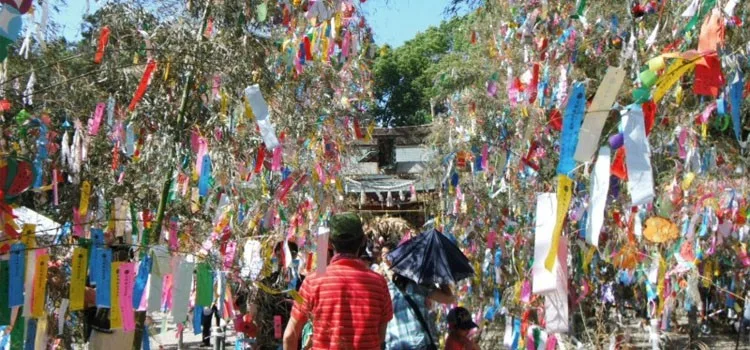
During Tanabata, one of the most striking traditions is to write wishes on colored papers, called Tanzaku (短冊), and hang them on bamboo branches. This practice began around 1818 and is still a ritual that symbolizes hope and spirituality.
Each color of Tanzaku has a meaning:
- White (peace)
- Yellow (money)
- Green (hope)
- Red (passion)
- Pink (love)
- Blue (protection from the heavens)
At the end of the festival, many burn the papers in ceremonial bonfires so that the wishes can reach the heavens and, perhaps, be granted by Orihime and Hikoboshi.
Few people know, but the choice of colors for the Tanzaku comes from the Wu Xing system (five Chinese elements). Red symbolizes fire and passion; green represents wood and growth; blue is water and protection. This connection shows how Tanabata is a bridge between Chinese and Japanese cultures since its roots.
How to find a Tanabata Matsuri in Japan?
If you are in Japan between July and August, the chances of encountering a Tanabata Matsuri are high — but knowing exactly where and when to go can make all the difference in your experience. Each city celebrates in a unique way, with slightly different dates, so it is important to plan ahead. Fortunately, we created a Tanabata Calendar.
The first step is to check which cities have traditional Tanabata festivals. The most famous ones occur in Sendai (Miyagi Prefecture) and Hiratsuka (Kanagawa), attracting millions of visitors. Sendai, for example, celebrates Tanabata in August, following the lunar calendar, while other regions maintain the date of July 7.
A good tip is to use the official tourism website of each city, where you can find updated information about dates, times, and parallel events, such as parades, taiko performances, and fireworks shows.
If you are in Tokyo, you don’t need to go far. Neighborhoods like Asakusa and Shitamachi organize their own versions of the festival with Tanzaku, typical foods, and traditional costumes. For those who prefer something more authentic and less touristy, smaller cities like Mobara (Chiba) or Fussa (Tokyo) offer intimate and charming parties.
Tanabata Matsuri Song
A simple yet powerful song is part of the childhood memories of almost every Japanese: the song of the Tanabata Matsuri. Learned in schools, it depicts the softness of bamboo leaves swaying in the wind and the stars shining in the sky.
笹の葉 さらさら
Sasa no ha sara-sara
The bamboo leaves murmur softly
軒端に ゆれる
Nokiba ni yureru
Swaying at the edge of the roof
お星さま キラキラ
Ohoshi-sama kira-kira
The little stars shine, shine
金銀 砂ご
Kin gin sunago
Like gold and silver dust
五色の たんざく
Goshiki no tanzaku
Strips of paper in five colors
私が 書いた
Watashi ga kaita
Were written by me
お星さま キラキラ
Ohoshi-sama kira-kira
The little stars shine, shine
空から 見てる
Sora kara miteru
Watching from the sky
Tanabata Matsuri outside Japan
The beauty and symbolism of the Tanabata have crossed borders. In countries with large Japanese communities, such as Brazil, the United States, and Peru, the festival has gained adapted versions.
In Brazil, for example, the first celebration took place in the city of Assaí in 1978, and soon after it began to be celebrated annually in the Liberdade neighborhood in São Paulo. Today, cities like Ribeirão Preto, Araraquara, and others in the ABC region also organize their own parties, with music, gastronomy, and cultural performances.
In common with Japan, these celebrations maintain the Tanzaku, traditional dances, and the spirit of connection between the heavens and people.
A wish hung among the stars
The Tanabata Matsuri is more than a festival: it is a living reminder that even the most improbable distances can be overcome by love and persistence. By hanging a Tanzaku, you participate in an ancient tradition that continues to move generations.
If you have the chance to experience this festival, whether in Japan or another country, don’t hesitate. Write your wish sincerely. After all, you never know when the stars will be paying attention.



Community
Comments
0 comments
There are no published comments in this language yet.
Send comment