
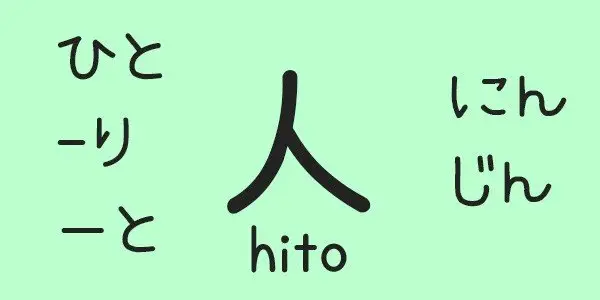
The kanji 人 is the basic Japanese character for “person,” but its reading changes with the context. On its own it is usually read hito, while in compounds it often shifts to jin or nin. Once you understand that pattern, words like Nihonjin (Japanese person), hitori (one person), and futari (two people) stop looking random.
This is also one of the first kanji beginners meet, so it is worth learning beyond the dictionary gloss. 人 appears in everyday pronouns, counters, nationality words, and common compounds that show up early in real Japanese.
Contents 6
What 人 means when read as hito
When 人 appears alone, the most common reading is hito (ひと). In plain conversation it usually means a person, someone, or people in a broad human sense depending on the sentence. You will hear it in expressions such as ano hito (that person), kono hito (this person), and ii hito (a good person).
Japanese also uses 人 in flexible ways that English splits into several words. Depending on context, it may point to a single person, people in general, or a human being as opposed to an animal or object. That is why memorizing only “person” is not enough; it is better to watch how the word behaves in phrases.
If you are still getting used to native and Sino-Japanese readings, this guide to how to recognize the correct kanji reading helps explain why one character can sound different from one word to another.
Main readings of 人
The three readings you need first are hito, jin, and nin. A simple way to think about them is this:
- hito: often used when the kanji stands alone or stays close to a native Japanese word.
- jin: common in words about identity, nationality, or type of person, such as Nihonjin (Japanese person) and gaikokujin (foreigner).
- nin: common when 人 works as a counter for people, especially from three upward, as in sannin and rokunin.
There are useful exceptions, so it is safer to learn the reading together with the whole word. For example, koibito (lover) keeps the native flavor, while honnin (the person in question) and ningen (human being) use compound readings.
How 人 works when counting people
As a counter, 人 does not behave in a perfectly regular way. The first two numbers are the ones every learner should memorize early:
- 一人 - hitori - one person
- 二人 - futari - two people
After that, the pattern becomes more predictable: sannin, yonin, gonin, rokunin, and so on. If counting still feels slippery, this article on Japanese counters and counting patterns gives a broader overview.
Common words built with 人
Once you move past the standalone reading, 人 starts appearing in some of the most useful beginner vocabulary in Japanese:
- 日本人 (Nihonjin) - Japanese person
- 外国人 (gaikokujin) - foreigner
- 人間 (ningen) - human being, humankind
- 本人 (honnin) - the person themselves, the person in question
- 恋人 (koibito) - lover, romantic partner
- 大人 (otona) - adult
That last example is especially useful because it shows why you cannot force one reading onto every word. Even though 人 often becomes jin or nin in compounds, otona is learned as its own word and should be memorized that way.
Plural and nuance: hito is not always just one person
Japanese does not mark plural the same way English does, so 人 can stay broad and flexible. In some contexts it clearly means one person, and in others it leans toward people in general. You will also find 人々 (hitobito) when the idea of “people” needs to be made more explicit.
That is why natural Japanese depends less on mechanical word-for-word translation and more on the phrase around the kanji. When you see 人, ask whether the sentence is pointing to a person, a group of people, a nationality, or a counting pattern. The answer usually tells you which reading makes sense.
A practical way to remember 人
Instead of trying to memorize every reading in isolation, keep a few anchor words in mind: hito, hitori, futari, Nihonjin, and ningen. Those five examples cover the most common patterns you will meet early on and make the character feel much more familiar in real sentences.
Once those forms are comfortable, 人 stops being “that kanji for person” and starts acting like a building block you can recognize across everyday Japanese.




Community
Comments
0 comments
There are no published comments in this language yet.
Send comment