
Puyo Puyo is often called Japanese Tetris, and the comparison is useful for about ten seconds. Both games drop pieces into a narrow field, ask players to make quick decisions, and become far more tense in a versus match. Their central rules are different, though: Tetris is about completing lines, while Puyo Puyo is about linking colors and setting up a reaction that keeps going after the first clear.
That difference changes every decision on the board. In Tetris, a clean line can be the immediate goal. In Puyo Puyo, an early clear may be a good escape, but it can also destroy the shape needed for a larger chain. The important question is often not “what can disappear now?” but “what will fall after this color disappears?”
Contents 7
How Puyo Puyo works
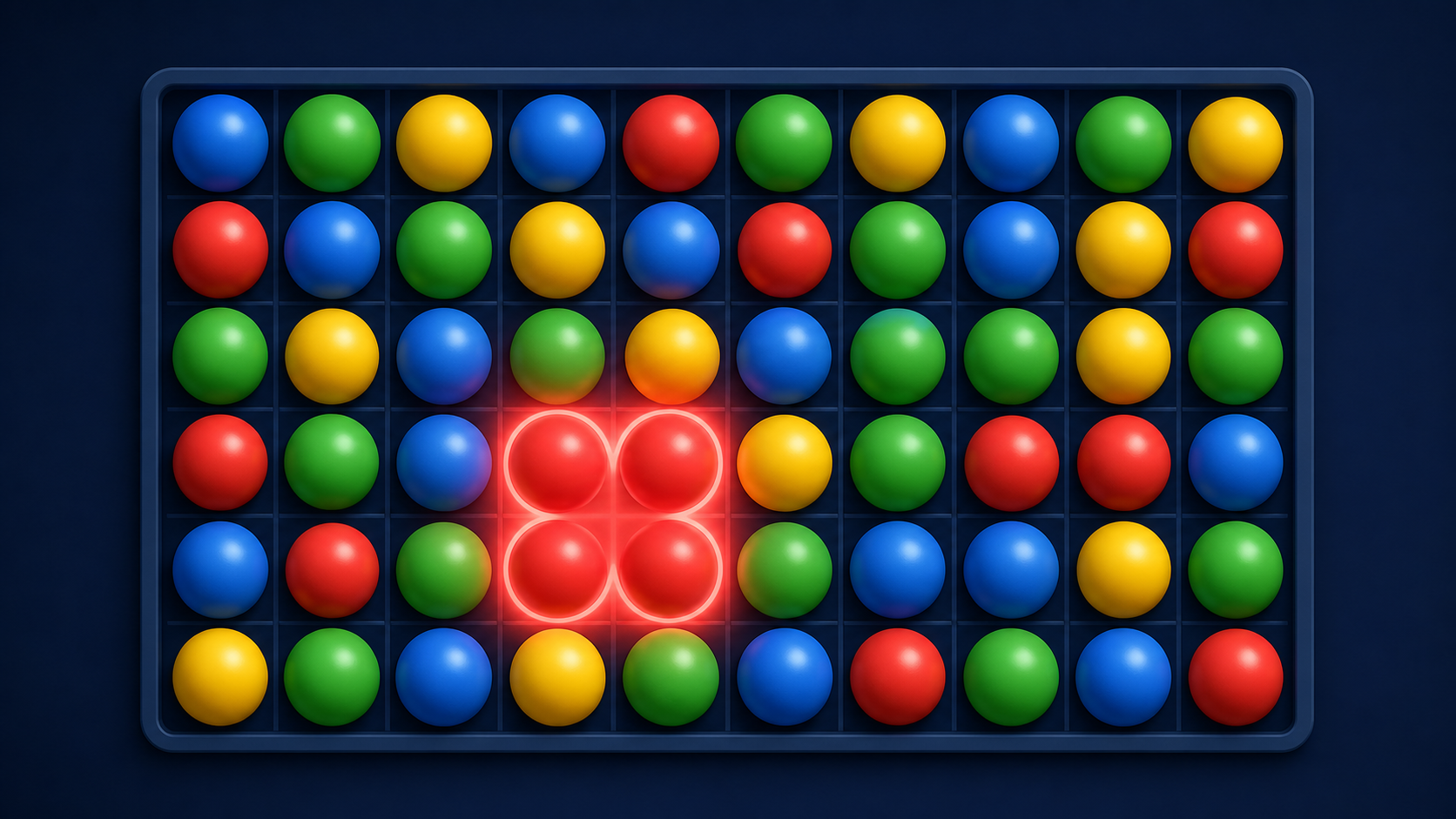
Puyos are round, colored pieces that usually fall in pairs. Connect four or more of the same color and that group pops. Connections count horizontally and vertically, not diagonally, so a tempting diagonal touch does not complete a group. The group also does not need to form a straight line; a compact cluster of four works as long as the colors are connected.
Once a group disappears, Puyos above it drop into the empty space. If that drop creates another group of four, it pops too. That follow-up is a chain, called rensa in Japanese. A chain can begin with a small clear and continue through shapes that were prepared several moves earlier.
Why Puyo Puyo is not Tetris
Tetris rewards line clears made with falling tetrominoes. Puyo Puyo rewards connected color groups and the chain reactions created by gravity. The games can share a screen in the official Puyo Puyo Tetris crossover, but each side still follows its own puzzle logic.
This is why the comparison can mislead beginners. A board with gaps is usually a problem in Tetris, while Puyo Puyo players sometimes leave deliberate spaces so a later clear can drop the right color into place. The board may look unfinished to someone watching, yet the next few drops can already be planned.
What makes a chain work
A reliable chain needs a first group, a trigger, and room for pieces to fall. Imagine a group of red Puyos that will pop first. Above or beside it, another color is one piece away from a group of four. When the red group vanishes, gravity drops that waiting color into place and starts the next link.
Beginners often build visible groups of three without deciding where the fourth piece will land. A better habit is to identify the first color that will pop, then follow the spaces it opens. Does it release a support? Does it create a vertical lane? Does it drop a pair onto a nearly complete group? Reading those consequences is more useful than chasing a large shape with no trigger.
Attacks, nuisance Puyos, and counterplay
In competitive rules, a chain sends nuisance Puyos to the opponent. These obstacles can clog useful spaces and force a rushed clear. Longer chains normally send more pressure, which gives players a reason to build rather than pop every group as soon as it appears.
Attack is not the whole story. A responding chain can offset part of the incoming nuisance Puyos, and a small chain can matter if it fires before the opponent finishes a larger one. Exact timing and scoring vary by game and mode, but the basic exchange stays recognizable: one player creates pressure, the other chooses whether to defend, counter, or keep building.
Build a base without locking yourself in
Strong boards are flexible rather than perfect-looking. Leave room near the top for incoming pairs, avoid sealing off the color that must act as a trigger, and keep enough open routes for a future drop. A rigid setup can collapse when the next pair brings an inconvenient color.
It also helps to separate two jobs on the board. The lower area can hold the beginning of a chain, while the upper area stays usable for adjustments. When everything is packed tightly from the start, one awkward pair can block both the trigger and the escape route. Good play is often about preserving options for one more turn.
When clearing early is the right choice
Saving every Puyo for a huge chain is not always smart. If the field is rising, a small clear can restore space before the board becomes unplayable. If an opponent is about to send pressure, a quick response may cancel enough of it to keep the match alive. The decision depends on the board in front of you, not on an imaginary perfect chain.
That balance gives Puyo Puyo its personality. Fast hands help, but they do not replace board reading. A player who sees a modest two- or three-step reaction at the right moment can interrupt a stronger-looking setup and regain control of the round.
Where the series came from
Puyo Puyo began as a spin-off from Madō Monogatari, then became a puzzle series with its own characters, competitive vocabulary, and long history. SEGA now presents Puyo Puyo alongside Tetris in crossover games with several battle modes, making the contrast between the two systems easy to see in one package.
The basic rule remains approachable: match four colors and watch them pop. Improvement comes from seeing the board one reaction ahead, then two. Once that habit starts, Puyo Puyo stops feeling like a color-matching diversion and becomes a game about timing, space, and the chain hidden inside a crowded field.



Community
Comments
0 comments
There are no published comments in this language yet.
Send comment