
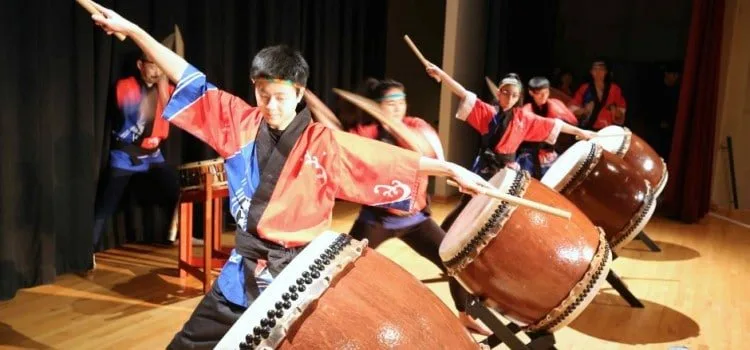
Taiko drums (太鼓) are icons of Japanese culture, known not only for their sound but for the physical presence they bring to a stage or festival square. In Japanese, taiko can mean almost any drum. Outside Japan, the word usually points to traditional Japanese drums — wadaiko (和太鼓) — and to the ensemble style that made them famous worldwide.
The characters 太 (tai, “great” or “thick”) and 鼓 (ko, “drum”) already hint at scale, but the story is wider than size alone: shrine ritual, battlefield signals, theater, village festivals, and, after 1951, the modern group performance known as kumi-daiko.
Contents 8
Origin and history of taiko
Historical accounts suggest Japanese drumming was shaped by Chinese and Korean influences from roughly the sixth century onward. Archaeological finds from the Kofun period — including haniwa figures of drummers — place barrel-shaped drums on the archipelago early. Mythology offers another origin: the goddess Ame-no-Uzume is said to have danced on an emptied sake barrel to lure Amaterasu, the sun goddess, out of her cave and restore light to the world.
In feudal Japan, drums helped motivate troops, set a marching pace, and pass orders. They also entered classical and popular theater. In Kabuki and Noh, specific rhythmic patterns shape atmosphere and scene changes. At the same time, taiko remained part of shrine and temple life, local matsuri, and dances such as those around Obon.
Kumi-daiko: ensemble taiko
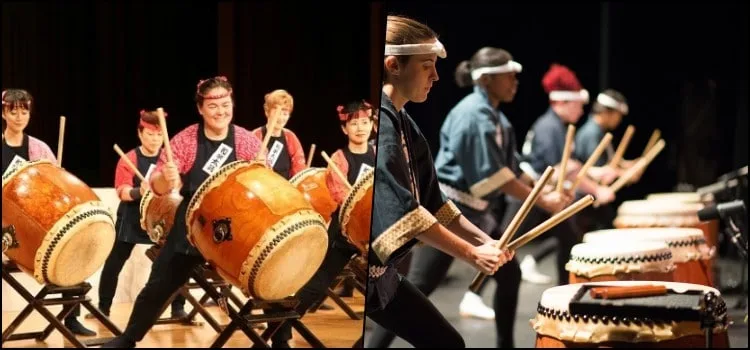
Kumi-daiko (組太鼓), literally a “set of drums,” is the group performance style that emerged in 1951 with Daihachi Oguchi. A jazz drummer by training, he rearranged older festival material so several players could share interlocking parts on drums of different sizes — closer to a kit’s division of roles than to a single ceremonial hit.
His ensemble, Osuwa Daiko, helped set the modern template. Later groups such as Ondekoza and Kodo took the format on tour and refined stage craft, training, and repertoire. In a typical set you hear the steady pulse of a large ō-daiko, the mid-range drive of nagadō-daiko, and the tight timekeeping of shime-daiko, sometimes joined by vocals, shinobue flute, or other colors.
Counts of active groups vary by source — estimates for Japan range from several hundred organized ensembles to several thousand community groups when amateurs are included — and the scene has also grown in the Americas, Europe, and elsewhere. What matters more than a single number is how local: school clubs, professional companies, and neighborhood practice rooms all keep the form alive.
Four principles often taught in taiko practice
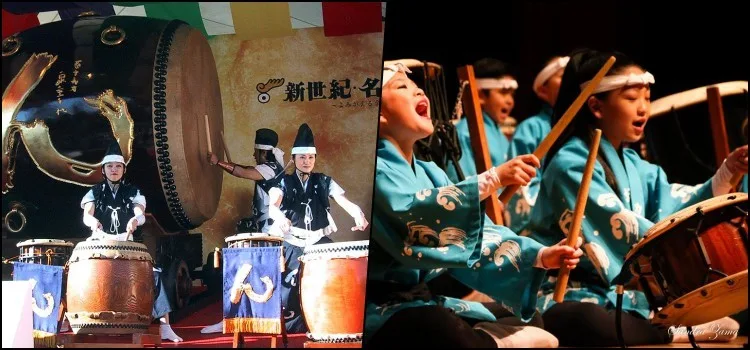
Many schools treat taiko as more than hand technique. Four ideas appear again and again in dojo language:
- Attitude — humility, attention to the group, and respect for the instrument and the space.
- Ki (気) — the sense of energy running through body, breath, and strike, not only the surface sound.
- Kata (型) — form: stance, posture, and the visible shape of each movement.
- Technique — control of rhythm, dynamics, stick grip, and the patterns that hold an ensemble together.
Those ideas explain why rehearsals can feel almost athletic: balance, intention, and timing sit beside the notes themselves.
Parts of a taiko
Knowing the pieces of the instrument makes the sound less mysterious. Construction varies by maker and model, but most wadaiko share a few named parts:
- Dō (body) — traditionally carved from a single log of keyaki (Japanese zelkova) or assembled from staves; some modern shells use laminated wood or even fiberglass for durability and weight.
- Kawa (skin) — usually cowhide or bull hide, stretched over the shell; tension sets pitch and sustain.
- Byō (tacks) — on many classic barrels, metal tacks fix the skin and give the familiar studded look of byō-uchi construction.
- Oke (staved frame) — on cylindrical okedō-type drums, wooden strips and rope systems let players retension the heads.
- Bachi (sticks) — wooden beaters in different lengths and thicknesses, matched to drum size and style.
Makers may spend years drying wood and hide before a drum is ready. That slow craft is part of why large ō-daiko feel like architecture as much as instruments.
Main types of taiko drums
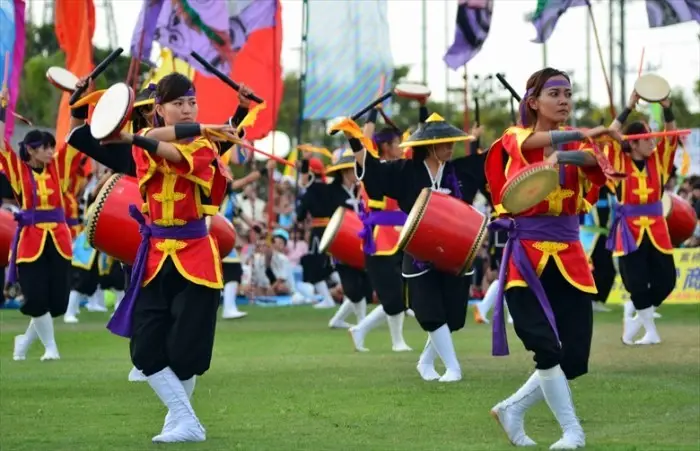
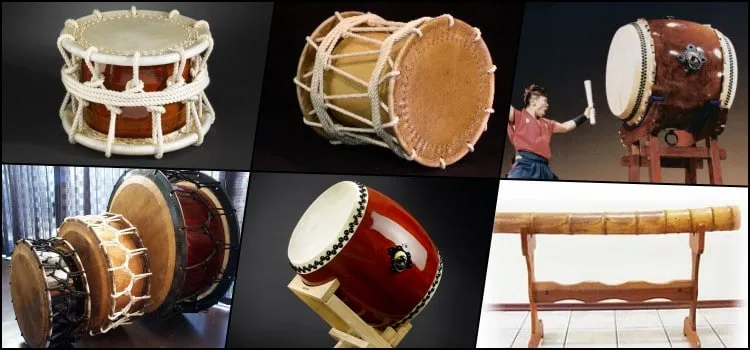
The family is wider than one barrel on a stand. Among the shapes you will meet most often:
- Shime-daiko — small, high, and tunable with rope or bolts; often locks the tempo for the group.
- Ō-daiko — the largest drum in a given setup, with deep resonance that can sit under the whole arrangement.
- Okedō-daiko — tubular, rope-tensioned body; flexible on stage and sometimes worn with a strap.
- Nagadō-daiko — the classic elongated barrel with tacked heads; the workhorse of many ensembles (sizes often described as ko-, chū-, and ō-daiko by diameter).
- Hira-daiko — flatter profile (head wider relative to depth), with a broad, resonant voice.
You will also hear terms for how a drum is built or staged: byō-uchi drums have heads nailed with tacks; naname describes a diagonal stand rather than a separate drum model. For a wider map of Japanese instruments, see the guide to traditional Japanese musical instruments.
Details worth knowing
- Groups such as Kodo and Ondekoza helped export modern ensemble taiko; some staging choices — including traditional work clothes or fundoshi in certain eras of performance — became part of their visual identity.
- Jiuchi (地打ち) is the underlying “ground” rhythm, often on shime-daiko, that supports the main patterns.
- Bachi are the sticks; grip and length change with the drum and the school.
- Arcade and console fans meet the instrument through Taiko no Tatsujin, which turns don (center) and ka/katsu (rim) hits into a rhythm game vocabulary millions already recognize.
Taiko no Tatsujin: the game that carried the sound
Taiko no Tatsujin, from Bandai Namco, debuted in 2001 and became a long-running rhythm series. Players strike a controller or arcade drum following notes for center hits (don) and rim hits (katsu), across pop, anime, and traditional-flavored tracks.
Extra songs usually come from official DLC on consoles, rotating arcade catalogs, or community tools on platforms where custom charts are allowed. The game does not replace a real dojo, but it spreads the basic feel of split center/rim timing far beyond festival grounds.
Osu! and other digital doorways
Osu! is a free PC rhythm game with a Taiko mode that borrows the same don/katsu idea inside a community beatmap culture. Players download maps, build their own, and share packs online. It is a practical way to train reading and stamina if a physical drum is not nearby — still a game mode, not a substitute for kata and ensemble listening.
Between shrine yards, theater pits, professional stages, and game cabinets, taiko keeps changing rooms without dropping the core craft: wood, hide, sticks, and people hitting together on time.





Community
Comments
0 comments
There are no published comments in this language yet.
Send comment