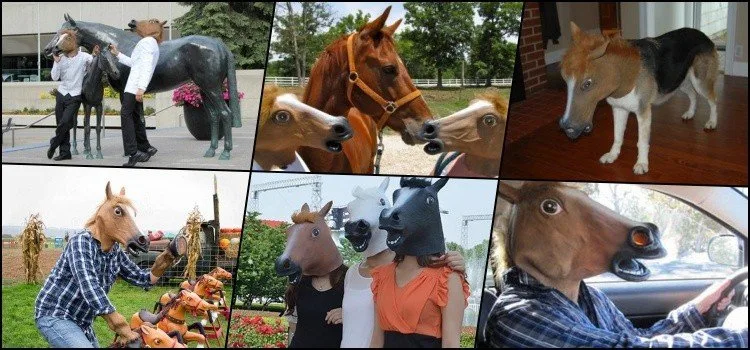
You've probably already seen it on a feed: someone in a supermarket aisle, a stadium, or a random street clip with a full horse head where a human face should be. The latex is too shiny, the eyes too round, and the whole thing is funnier than it has any right to be. You want a photo. That is the entire trick.
That vinyl-and-latex gag is the horse head mask. A Seattle novelty shop sold it to scare people at Halloween. It failed at scary and won at something stranger: a face you can wear when you do not want to look like a person.
Contents4
Where the horse head mask came from
The original was manufactured by Seattle novelty dealer Archie McPhee and sold as a Halloween costume from around 2002–2003. The product name is Horse Head Mask: brown latex, a faux-fur mane, and full head coverage. McPhee's catalog line is that a person wearing one "looks downright disturbing." Other factories copied the design almost immediately.
It was not invented as a meme. It was invented to look like a horse and slightly ruin a living room.
How a Halloween gag went viral
Nobody can point to a single day when the mask stopped being a costume. What exists is a stack of accelerants.
In 2005, Lonely Planet's Guide to Experimental Travel included an experiment called Horse Head Adventure: one person in the group wears the mask while everyone else tours a city, just to watch the reactions. Canadian comedian Tom Green later wore one on his internet show Tom Green's House Tonight, screaming and shaking his head.
The bigger jump came from Japan. On Nico Nico Douga, people who wanted to stay faceless often put something over their heads. The horse sat next to scream masks and Darth Vader helmets as one of the site's signature looks. By January 2008 a performer known as Wotaken (ヲタケン) had been mirrored onto YouTube as "Dancing Japanese Man Wearing a Horse Mask Cooks Wild Mushrooms": dancing to the Final Fantasy track "Dancing Mad," picking and cooking mushrooms, wearing little besides the mask. The clip passed two million views, landed on English blogs, and was later taken down for breaking YouTube's rules. Versions of Wotaken in the mask were already on Nico Nico in 2007.
Copycats followed. In 2010 Google Street View caught a man in Aberdeen, Scotland — quickly nicknamed Horse Boy — who put the mask on when he saw the camera car. During Hurricane Sandy in 2012, a shirtless jogger in a horse head ran through a live news shot in Washington, D.C.
On July 8, 2014, Barack Obama shook hands with a bystander in a horse head mask on a downtown Denver street. Photos from that walk went national the next morning.
That Denver handshake is the moment a Halloween leftover walked into newspapers that had never heard of Nico Nico.
Japan, Nico Nico, and anime
The McPhee mask is American. The culture that treated it as a face, not leftover Halloween plastic, is Japanese internet humor: absurd, a little creepy, and happy to hide the person talking.
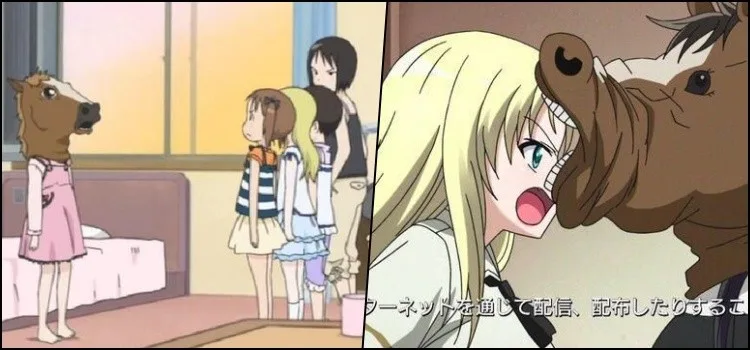
Anime had already been playing with the same silhouette. In 2003, Full Metal Panic? Fumoffu introduced Pony-man (ぽに男), a horse-headed pest who chased schoolgirls with a hairbrush and tied their hair into ponytails. He looks uncomfortably close to someone who simply put the novelty mask on. Because the real masks were already in shops, that gag kept coming back.
Later the latex head walks into other shows as a prop. In Boku wa Tomodachi ga Sukunai Next (Haganai Next, 2013), Yozora shows up in a swimsuit wearing one. Slice-of-life series such as Ichigo Mashimaro (Strawberry Marshmallow) drop the same face into an ordinary bedroom. The joke is location: the mask does not belong next to a bedspread.
Nico Nico users did not need a plot. They needed a face that was not theirs. The horse did that job the way a Guy Fawkes mask did on English-speaking boards, except the horse never asked to be a political symbol. It just looked wrong enough to be funny.
There is a cousin that is not the mask at all. The 2016 otome game Uma no Prince-sama (My Horse Prince) follows a girl who ends up with a horse that has a handsome human face. It parodies Uta no Prince-sama; it is not a spin-off of the latex gag. It does sit in the same Japanese appetite for a horse that should not have that face. If you want the format itself, start with what a visual novel is.
Traditional Japanese masks — Noh, kitsune, oni — carry theater and ritual. The horse head carries none of that. That is why it feels so loud in a Japanese video: a foreign Halloween toy used as a blank identity.
Buying a horse head mask
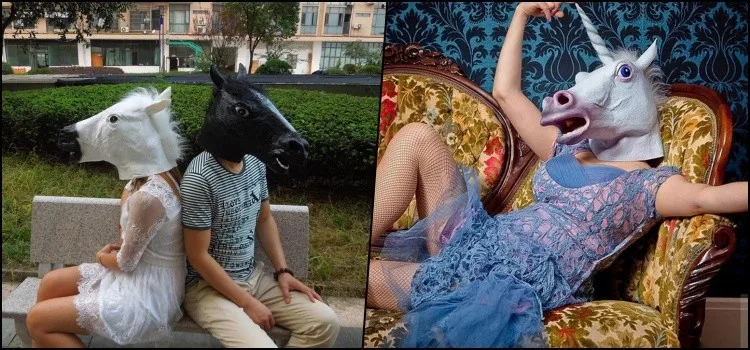
Archie McPhee still sells the original as a novelty, usually around twenty dollars, and tells buyers to skip undersized copies. Unicorn and zebra heads appeared as soon as the photos spread. Street prices on random marketplaces change too fast to treat as a catalog.
The best use is still the dumbest one: walk outside with it on. People ask for photos. People also ask, half-joking, what species you think you are. I bought one myself. If you have the nerve to wear it past the front door, the mask does the rest of the talking.
The horse head mask never needed a secret code in the mane. A cheap latex horse, worn where a human face was expected, is still one of the fastest ways to make a crowd stop and take a picture.
Kevin Henrique has written about the Japanese language, culture, anime, games, and travel since founding Suki Desu in 2014. He first visited Japan in 2016.
Community
Comments
0 comments
There are no published comments in this language yet.


 Nico Nico users did not need a plot. They needed a face that was not theirs. The horse did that job the way a Guy Fawkes mask did on English-speaking boards, except the horse never asked to be a political symbol. It just looked wrong enough to be funny.
There is a cousin that is not the mask at all. The 2016 otome game Uma no Prince-sama (My Horse Prince) follows a girl who ends up with a horse that has a handsome human face. It parodies Uta no Prince-sama; it is not a spin-off of the latex gag. It does sit in the same Japanese appetite for a horse that should not have that face. If you want the format itself, start with what a visual novel is.
Traditional Japanese masks — Noh, kitsune, oni — carry theater and ritual. The horse head carries none of that. That is why it feels so loud in a Japanese video: a foreign Halloween toy used as a blank identity.
Nico Nico users did not need a plot. They needed a face that was not theirs. The horse did that job the way a Guy Fawkes mask did on English-speaking boards, except the horse never asked to be a political symbol. It just looked wrong enough to be funny.
There is a cousin that is not the mask at all. The 2016 otome game Uma no Prince-sama (My Horse Prince) follows a girl who ends up with a horse that has a handsome human face. It parodies Uta no Prince-sama; it is not a spin-off of the latex gag. It does sit in the same Japanese appetite for a horse that should not have that face. If you want the format itself, start with what a visual novel is.
Traditional Japanese masks — Noh, kitsune, oni — carry theater and ritual. The horse head carries none of that. That is why it feels so loud in a Japanese video: a foreign Halloween toy used as a blank identity.
 The best use is still the dumbest one: walk outside with it on. People ask for photos. People also ask, half-joking, what species you think you are. I bought one myself. If you have the nerve to wear it past the front door, the mask does the rest of the talking.
The horse head mask never needed a secret code in the mane. A cheap latex horse, worn where a human face was expected, is still one of the fastest ways to make a crowd stop and take a picture.
The best use is still the dumbest one: walk outside with it on. People ask for photos. People also ask, half-joking, what species you think you are. I bought one myself. If you have the nerve to wear it past the front door, the mask does the rest of the talking.
The horse head mask never needed a secret code in the mane. A cheap latex horse, worn where a human face was expected, is still one of the fastest ways to make a crowd stop and take a picture.



Community
Comments
0 comments
There are no published comments in this language yet.
Send comment