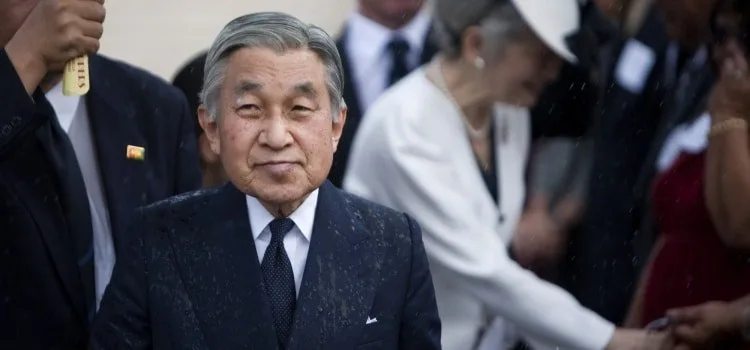
Akihito, also known as 天皇陛下明仁 (His Majesty, Emperor Akihito) is the 125th Emperor of Japan, holder of the Chrysanthemum Throne after succeeding his father, Emperor Shōwa (Hirohito, when he was alive).
Akihito has reigned over the country since January 1989, following his father's death, and his era is known as the Heisei Era (平成時代) and, indeed, this will be Akihito's posthumous name, according to the tradition of the Japanese monarchy.
When Akihito dies, he will be renamed and known as Emperor Heisei. However, according to an announcement from the Japanese government made in December 2017, Akihito will abdicate the throne in April 2019.
Contents3
Previous Life as Prince
Akihito was born in the Imperial Palace of Tokyo in the City of Tokyo on December 23, 1933. Named Prince Tsugu (継宮 tsugu-no-miya) as a child, he was raised and educated by his private tutors and later attended the primary and secondary departments of Gakushūin (noble family school) from 1940 to 1952.
Unlike his predecessors in the imperial family, Akihito did not receive a commission as an army officer, at the request of his father, Hirohito. Thus, Akihito was the crown prince of the Chrysanthemum Throne from birth.
His formal investiture as Crown Prince (立太子礼 rittaishi-no-rei) was held at the Imperial Palace of Tokyo on November 10, 1952.
In August 1957, he met Michiko Shōda on a tennis court in Karuizawa near Nagano. Eventually, the Imperial House Council formally approved the Crown Prince's engagement to Michiko Shōda in 1958.
It was the first time a commoner would marry a member of the Imperial Family. The engagement ceremony took place on January 14, 1959, and the wedding on April 10, 1959.
Emperor Akihito and Empress Michiko have three children: sons Naruhito, Crown Prince of Japan and Fumihito, Prince Akishino, and daughter Sayako, Princess Nori.
Official Functions of the Emperor
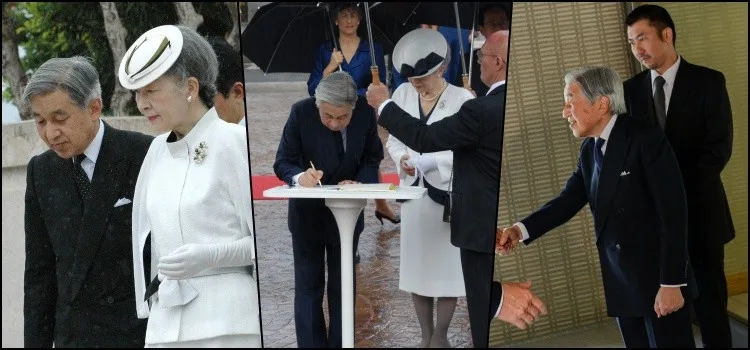
Despite the pressure, Akihito made several statements of remorse to Asian countries. For the suffering caused by the Japanese occupation, he expressed remorse to China made in April 1989.
He offered prayers and flowers at various memorials, honoring Japanese who died, American soldiers, Korean workers, and local islanders. Thus was the first trip of a Japanese monarch to a World War II battlefield abroad.
In 2016, NHK reported that the Emperor intended to abdicate in favor of Crown Prince Naruhito. The reason would be his age and health. An abdication within the Imperial Family had not occurred since 1817.
Subsequently, the Emperor gave a televised speech, where he emphasized his advanced age and deteriorating health; this was interpreted as an implication of his intention to abdicate.
In 2017, the law that would allow Emperor Akihito to abdicate was issued by the Japanese government cabinet. Months later, the National Diet approved the law allowing Akihito to abdicate. Thus, the government will organize the process of handing over the position to Crown Prince Naruhito.
Kevin Henrique has written about the Japanese language, culture, anime, games, and travel since founding Suki Desu in 2014. He first visited Japan in 2016.
Community
Comments
0 comments
There are no published comments in this language yet.

 Unlike his predecessors in the imperial family, Akihito did not receive a commission as an army officer, at the request of his father, Hirohito. Thus, Akihito was the crown prince of the Chrysanthemum Throne from birth.
His formal investiture as Crown Prince (立太子礼 rittaishi-no-rei) was held at the Imperial Palace of Tokyo on November 10, 1952.
In August 1957, he met Michiko Shōda on a tennis court in Karuizawa near Nagano. Eventually, the Imperial House Council formally approved the Crown Prince's engagement to Michiko Shōda in 1958.
It was the first time a commoner would marry a member of the Imperial Family. The engagement ceremony took place on January 14, 1959, and the wedding on April 10, 1959.
Emperor Akihito and Empress Michiko have three children: sons Naruhito, Crown Prince of Japan and Fumihito, Prince Akishino, and daughter Sayako, Princess Nori.
Unlike his predecessors in the imperial family, Akihito did not receive a commission as an army officer, at the request of his father, Hirohito. Thus, Akihito was the crown prince of the Chrysanthemum Throne from birth.
His formal investiture as Crown Prince (立太子礼 rittaishi-no-rei) was held at the Imperial Palace of Tokyo on November 10, 1952.
In August 1957, he met Michiko Shōda on a tennis court in Karuizawa near Nagano. Eventually, the Imperial House Council formally approved the Crown Prince's engagement to Michiko Shōda in 1958.
It was the first time a commoner would marry a member of the Imperial Family. The engagement ceremony took place on January 14, 1959, and the wedding on April 10, 1959.
Emperor Akihito and Empress Michiko have three children: sons Naruhito, Crown Prince of Japan and Fumihito, Prince Akishino, and daughter Sayako, Princess Nori.




Community
Comments
0 comments
There are no published comments in this language yet.
Send comment