
Japan has a unique way of transforming even the most intimate desires into something that borders on art. The country is known for technology and ancient tradition, but Japanese culture is also a master at taking common fetishes and elevating them, giving them names, aesthetics, and even their own rituals. While in much of the world certain fantasies remain a matter of improvisation, in Japan they become almost a genre, with rules, codes, and global influence.
And the most curious part? Many of these typically Japanese obsessions haven't been confined to the archipelago. Thanks to anime, manga, erotic films, and of course, the internet, these fetishes have crossed oceans and are now known (and practiced) worldwide. Some are bizarre, others unexpectedly common, but all say a lot about how Japan perceives pleasure, fantasy, and the boundaries between the sensual and the surreal.
Contents 10
Shibari (Kinbaku): The art of tying
Here's a Japanese practice that has become a living art! Shibari (or kinbaku) traces back to hojōjutsu, the art of restraining prisoners in feudal Japan. What began as a method of control has turned into something almost poetic.
Today it is an intimate dance between ropes and body. More than restraint, each knot and each crossing draws patterns that turn the skin into a canvas. The ropes follow curves, accentuate shapes... and of course, touch those hot spots that only the right tension reveals.
Beyond the visual, there's the physicality: pressure that alternates between discomfort and pleasure, the surrender that comes with vulnerability, and, above all, the intense connection that forms between the one who ties and the one who is tied. It's no wonder it has become a global craze: workshops are popping up everywhere, showing that shibari is both a fetish and an artistic expression. Who would have thought that ropes could carry so much history and emotion?

Tentacle Erotica
If you've ever explored adult anime or manga, you've probably come across scenes of tentacled creatures in... intense situations. This is tentacle erotica, a typically Japanese fusion of science fiction, fantasy, and eroticism, almost always taken to surreal extremes. Yes, it was born in Japan, but today it has global variations.
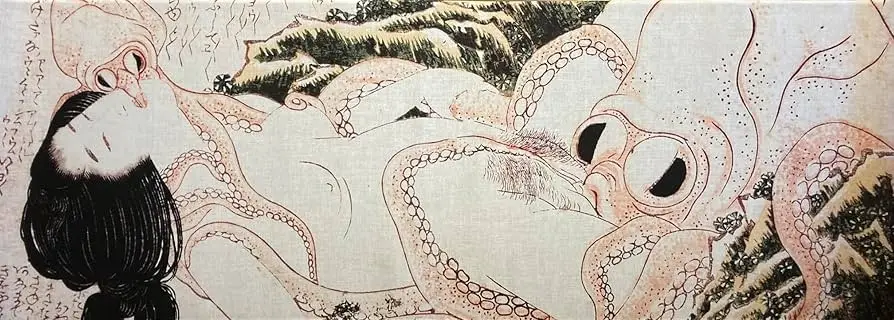
What is the origin? The genre goes back to the shunga prints of the Edo period: the earliest examples are 18th-century works by masters like Kitao Shigemasa and Katsukawa Shunshō, and the most famous is "The Dream of the Fisherman's Wife," the 1814 print in which Hokusai depicts a diver entwined with a pair of octopuses. Over time, the idea migrated to modern hentai, where it also served as a way around the ban on showing genitals: the mangaka Toshio Maeda has said he used a tentacled creature as a pretext, since a tentacle could be described as part of the monster rather than as a penis. Today, it represents more than a fetish: it is a portal where the human body and the impossible collide, without the brakes of reality.
Omorashi: Pleasure at the edge of control
Omorashi may seem strange to those who have never heard of it, but in Japan it is a well-established fetish and even categorized into subgenres. In short, it relates to the pleasure of holding in urine until the limit and, in many cases, of wetting oneself. The thrill comes from psychological tension: vulnerability, anticipation, and relief.
There are variations like "omutsu omorashi," which involves the use of adult diapers, or "omorashi yagai," where the situation occurs in public or outdoors, adding a dose of adrenaline and consensual embarrassment. Although this fetish is rarely discussed in the West, in Japan it appears in manga, videos, and specialized forums, showing that desire can arise from the most unusual places.
Wakamezake and Nyotaimori
The Japanese also know how to unite two of humanity's great passions: food and eroticism. Wakamezake is one of the clearest examples. Imagine a woman lying on her back with her legs pressed together, forming a cup between her thighs. Sake is poured down her chest and gathered in that hollow, and her partner drinks it from there. The name alludes to the pubic hair drifting in the liquid, which resembles wakame seaweed floating in the sea. The scene mixes sensuality, provocation, and a lot of symbolism.
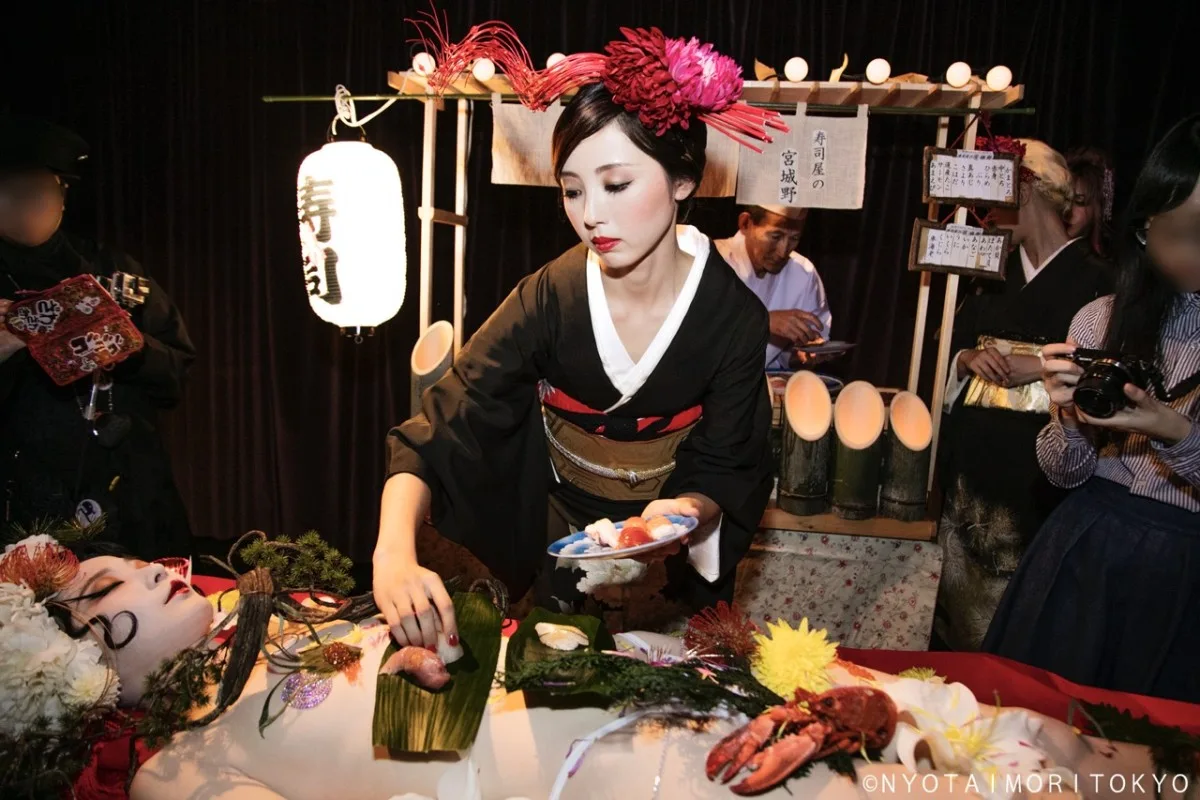
Another famous example is nyotaimori, the so-called "human sushi." In this practice, pieces of sushi or sashimi are served on the naked body of a woman, or of a man in the case of nantaimori. The custom is usually traced to the hot spring resorts of Ishikawa Prefecture, where it was used in the 1960s to attract male customers on company trips; as family travel grew in the 1980s, catering companies and sex establishments picked it up as an exotic attraction. Traditionally, the sushi rests on sanitized leaves, and guests are expected to keep the strictest decorum.
Zentai: The rediscovery of the faceless body
The fetish for zentai, those skin-tight suits that cover from head to toe, creates an experience where identity and appearance disappear. No face, no expressions, no obvious distinctions of gender or physical characteristics. Just the touch of lycra or spandex enveloping the skin.
For many people, zentai represents anonymity, submission, or, on the contrary, absolute freedom to explore the body without judgment. At fetish conventions and gatherings in Japan, and in other countries as well, enthusiasts parade in zentai, exchange experiences, and show that eroticism can arise precisely from what is hidden.
Burusera: The allure of used uniforms
The fetish for used underwear and school uniforms, known as burusera, is one of the most curious and controversial to have originated in Japan. The word combines burumā, the old gym bloomers, and sērā-fuku, the sailor-style school uniform. In the 1990s, it was not difficult to find specialized stores selling panties, socks, and other items supposedly worn by students. These clothes carried not only the scent but an entire world of youth, innocence, and transgression, which fueled the desire of those who bought them.
Stricter laws soon targeted burusera, especially to curb the exploitation of minors. In 1994, a shop manager in Tokyo was arrested for making an underage girl sell her underwear, and from 2004 prefectures began regulating the sale of used garments and other items from people under 18. The fetish never disappeared; it just became more discreet, appearing on websites, in private clubs, or in products that mimic the schoolgirl look without any direct connection to real students.

Oculolinctus: the myth of licking eyes
The fetish for licking eyes, known as oculolinctus, went viral in 2013, when English-language media reported a supposed trend among Japanese teenagers, referred to in Japan as gankyū name purei, or "eyeball-licking play." Several of those articles were later corrected or retracted, and the story is now widely regarded as a hoax that started with a Japanese tabloid. The concept became famous anyway and sparked debates about the limits of erotic curiosity. The eyes are among the most sensitive parts of the human body, and licking them carries real risks: conjunctivitis, herpes, corneal abrasions, and, in severe cases, damage that threatens vision.
In a culture where even the smallest body details become an obsession, it is not so surprising that such a concept occupies the sexual imagination. The practice itself remains rare; it is the term that became famous and is now synonymous with extreme fetish.
Wetlook: The sensuality of wet clothes
Water has a hypnotic power when used in the right context, and the wetlook fetish explores exactly that. Imagine white clothes soaked, streams of water running down the body, or a simple scene of someone unexpectedly wet. The sight of wet fabric clinging to the skin and the play of light on the body create an irresistible combination.
This fetish appears frequently in photo sessions, sensual clips, and Japanese adult films. The appeal goes beyond the visual: water awakens physical sensations like cold, heat, shivers, and vulnerability, making the moment even more stimulating. That makes it a visual and tactile fetish at once, turning something simple like water into fuel for desire.
Lolicon and Bakunyū
Not all fetishes that come from Japan are accepted unanimously. Lolicon, for example, is the attraction to characters that appear very young, usually pre-adolescents. In otaku culture it is generally treated as distinct from attraction to real girls, but the theme generates heated debates about ethics, censorship, and artistic freedom. Japanese law targets real material: the 1999 child pornography law and its 2014 amendment criminalized production, distribution, and possession of images of real children, while fictional depictions remain outside the definition.
On the other hand, bakunyū, literally "giant breasts," explores the exaggeration in the drawing and representation of the female body, something very common in hentai and Japanese pornography. They are examples of how Japanese fetishes can both entertain and raise questions about cultural and social limits.

The little otaku fetishes
If there's one thing Japan does like no other, it's turning details into objects of desire. Otaku culture has its own expressions: "megane-fechi" (attraction to people with glasses), "oshiri-fechi" (fetish for buttocks), "ashi-fechi" (fetish for feet), and so on. The suffix "-fechi," borrowed from the English word, has become a fun and direct way to acknowledge small obsessions that make the heart race.
These fetishes are so popular that they appear in anime, manga, and even collectible products. Characters with glasses gain dedicated fans, artists draw feet or hands with intentional exaggeration, and details considered trivial become the main focus of fantasy. It's a perfect portrait of how attentive Japanese pop culture is to what many would not even notice.
The examples show how wide the spectrum is: from a recognized art form like shibari to niche subcultures and terms that live mostly in headlines and fantasies. For anyone interested in Japan, they are more than a collection of curiosities. What is actually practiced is often a different question from what the images promise.






Community
Comments
0 comments
There are no published comments in this language yet.
Send comment