
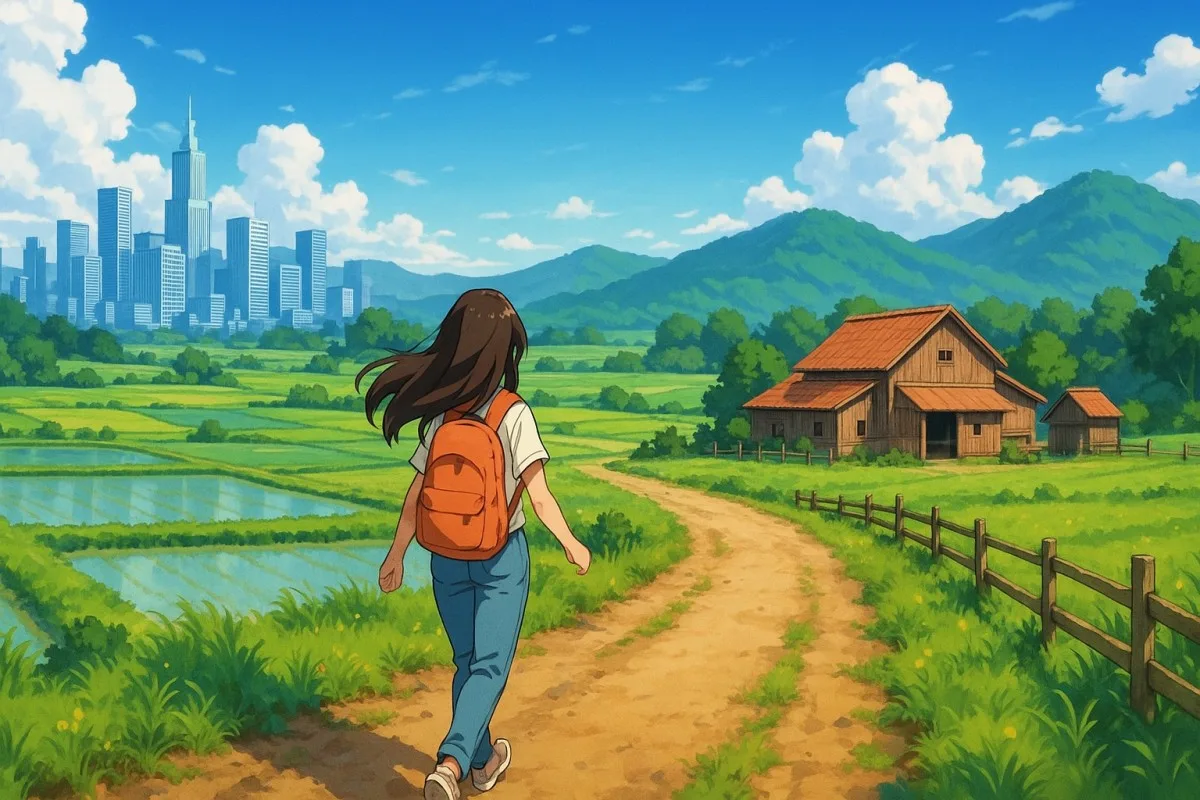
Kwichon – translated as return to the countryside, summarizes the movement of people leaving cities like Seoul, exhausted from high rents, work pressure, and urban loneliness, to try a life in villages, surrounded by nature, community, and a more human pace.
If you enjoy Japanese and Korean culture, you have already seen this idea in dramas and animes: someone leaving the office in the capital to start anew in a village with mountains in the background. The difference is that, in real life, Kwichon involves numbers, public policies, difficult financial decisions… and not just beautiful sunsets.
In this article, we will see what Kwichon is, why it has grown, what hidden struggles exist, and what all of this has to do with how you think about your own urban life.
Table of Contents
What is Kwichon – return to the countryside, in South Korea?
In Korean, Kwichon (귀촌) means “return to the village.” It is used to talk about those who leave the city and start living in rural areas, even if they do not work directly in agriculture. When the change involves actually becoming a farmer, another term appears: Gwinong (귀농), the “return to agriculture.”
Today, in practice, many people use Kwichon as a general label for any city-to-country change.
Imagine someone who worked in Seoul, in a suit, on a crowded subway, and suddenly starts living in a single-story house, with little commerce nearby and a garden in the backyard. This person can:
- continue in the same job, but 100% remote;
- mix online freelancing with a small local café;
- or, indeed, dive headfirst into agriculture.
All of this falls under the umbrella of Kwichon. It is not a unique program, nor an organized movement. It is the sum of thousands of individual decisions, pressured by the same context: expensive, exhausting cities and a growing feeling that “you can’t live like this forever.”

Why do so many people want to leave the city and go to the countryside?
Kwichon did not arise from a “nature-loving” trend. It came from very concrete problems.
The first is the cost of living in the largest cities in Korea. Seoul regularly appears among the most expensive real estate markets in the world. Buying a decent apartment has become almost unattainable for many young people, even with education and stable jobs. The comparison is inevitable: with the price of a cubicle in the capital, sometimes you can have a larger house with land in a small town.
At the same time, there is the weight of the work culture. The expression “Hell Joseon” has become a symbol of the feeling of suffocation: long hours, rigid hierarchy, brutal competition, little sleep, and little free time. It is no wonder that part of the youth is starting to look at rural villages as an alternative for emotional survival.
It is worth mentioning that South Korea has one of the highest suicide rates in the world, much higher than Japan, which had that fame in the 90s. This fact shows how stressful the work culture can be in Korea.
After the pandemic, this accelerated. Remote work opened a gap: if everything happens on the screen, why stay tied to the capital? This mindset helped transform the “dream of going to the countryside” into a concrete plan for many people.
There is also a silent but strong reason: purpose. The impression of living only to pay bills, without building something meaningful, pushes many people to seek another narrative of life. Kwichon, at this moment, appears as a symbol of a new beginning – less consumption, more time, more contact with simple things.

Who is doing Kwichon today?
For a long time, when someone talked about Kwichon, the image was almost automatic: a couple in their 50s or 60s, selling their apartment in Seoul to buy a house with land, planting fruits or vegetables to supplement their income. This profile remains strong, but it is no longer alone.
In recent years, another face has begun to appear: young adults who do not want to wait for retirement to change their lives. Travel articles and trend pieces in Korea show that “rural life” has become a lifestyle desired by part of the younger generation, especially as an escape from the cost of housing and the mental pressure of the capital.
Many of these young people do not come with the idea of “becoming traditional farmers.” They open cafés, small inns, workshops, community spaces, create digital content with rural settings, or work as digital nomads, using the countryside as a base.
There are also the “experimenters”: people who spend weekends, vacations, or a few months in villages to test the routine. A recent article about the “Don’t Worry Village,” for example, shows a group of young people who left Seoul to create a rural community focused on coexistence and mutual support, still exploring models for stable income.
In other words: Kwichon has become a stage where retirees, families with young children, young entrepreneurs, artists, freelancers, and people in transition coexist. Not everyone stays forever, but the flow is already changing the landscape of many villages.

What are the real challenges of life in the countryside?
This is where the part that almost never appears in dramas comes in.
Work and money do not become a problem “just because the place is beautiful”
Those who move to live off the land quickly discover that agriculture requires investment, technical knowledge, and time. It is not just about planting and waiting to sell at the market. The first years often have low and unstable income, and not everyone can endure this adaptation period.
Even for those who maintain a remote job, practical obstacles arise: rural internet with instability, weather affecting energy, difficulty separating personal and professional life when everything happens in the same house. The fantasy of working all day looking at the rice field exists… but not every day.
Moreover, Korea remains very centralized around Seoul. Between 2015 and 2021, about 78% of internal migration of young people was from other regions to the metropolitan area of the capital. In other words: while some are leaving the city, the main tide is still going in the opposite direction. This means fewer skilled jobs and opportunities in the countryside, complicating life for those trying to stay there.
Community, loneliness, and cultural shock
Another strong challenge is social. The person who leaves the city brings with them friends, family, leisure habits, cultural references. In the village, all of this changes.
Right at the beginning, many people feel loneliness. Relationships in small communities are deep but take time. The residents have known each other for decades, share common stories, and have unspoken rules. Newcomers need to learn the local rhythm, participate in community parties, help with events, listen to gossip, and be seen not just as visitors, but as someone who intends to stay.
There are also differences in values. Ideas of sustainability, minimalism, or digital entrepreneurship may sound strange to some of the older population. Likewise, those coming from the city may find the directness, strong social control, or intense curiosity of neighbors to be unusual.
And we cannot forget the basics: more distant hospitals, limited schools, less public transportation, fewer leisure options. For some people, this is peace. For others, it is claustrophobia.

What does Kwichon have to do with Japan – and with you?
If you follow Japan, you may have recalled two very similar terms: U-turn and I-turn. In the Japanese context, U-turn is when someone returns from the big city to their hometown; I-turn is when a person, born in a big city, moves to a rural area where they have never lived before.
Like Korea, Japan faces aging villages, empty houses, and a constant effort for rural revitalization. There are specific job fairs for those wanting to make a U-turn or I-turn, tourism projects to introduce villages to residents of Tokyo, and policies to encourage internal migration.
In Korea, something similar happens within a larger agenda of decentralization and balanced development: OECD reports analyze how the government tries to strengthen regions outside the capital, including efforts related to migration and rural revitalization.
All of this raises an important question for any fan of Japanese or Korean culture who looks at these movements with shining eyes: what exactly attracts you to this idea of “return to the countryside”?
Is it the scenery? The silence? The possibility of a smaller community? Or the chance to live in a way that makes more sense than your current routine?
What can Kwichon teach you about your own life?
It doesn’t matter if you live in São Paulo, Lisbon, Mexico City, or any other metropolis: Kwichon works almost like a mirror. It shows what happens when part of society decides that the standard model of success no longer works.
If we translate this to the individual level, we can draw some very practical lessons:
- Test the life you idealize. Before dreaming of leaving everything behind, try spending a longer time in a small town or rural area. Living for a few weeks is very different from spending a tourist weekend.
- Do the math with brutal honesty. How much do you need to earn to live outside the capital? Where would that income come from? How long could you endure an adaptation phase with lower money?
- Think about community as much as about scenery. The view from the window matters, but it doesn’t hold anyone alone. Ask yourself: who will you talk to, work with, cooperate with, share problems and victories?
- Don’t copy anyone’s story. The success stories of Kwichon and U-turn/I-turn are inspiring, but each person has a different financial, emotional, and family context. Use these stories as references, not as recipes.
In the end, Kwichon – return to the countryside – is not an automatic invitation for you to move to a Korean village tomorrow. It is an uncomfortable reminder: the way you live today was chosen or simply inherited?
If this question bothers you, great. That means you are alive, thinking, questioning. From there, you don’t need to change continents or plant rice to make a “personal Kwichon.” Perhaps your beginning lies in something much smaller: slowing down a bit, reorganizing work, getting closer to a real community, or even planning, calmly and realistically, a future away from urban life as it is today.
And then, being very honest with yourself: what would your ideal scenario outside the big city look like – and what would be the first (even small) step you would have the courage to take in that direction?
Leave a Reply