

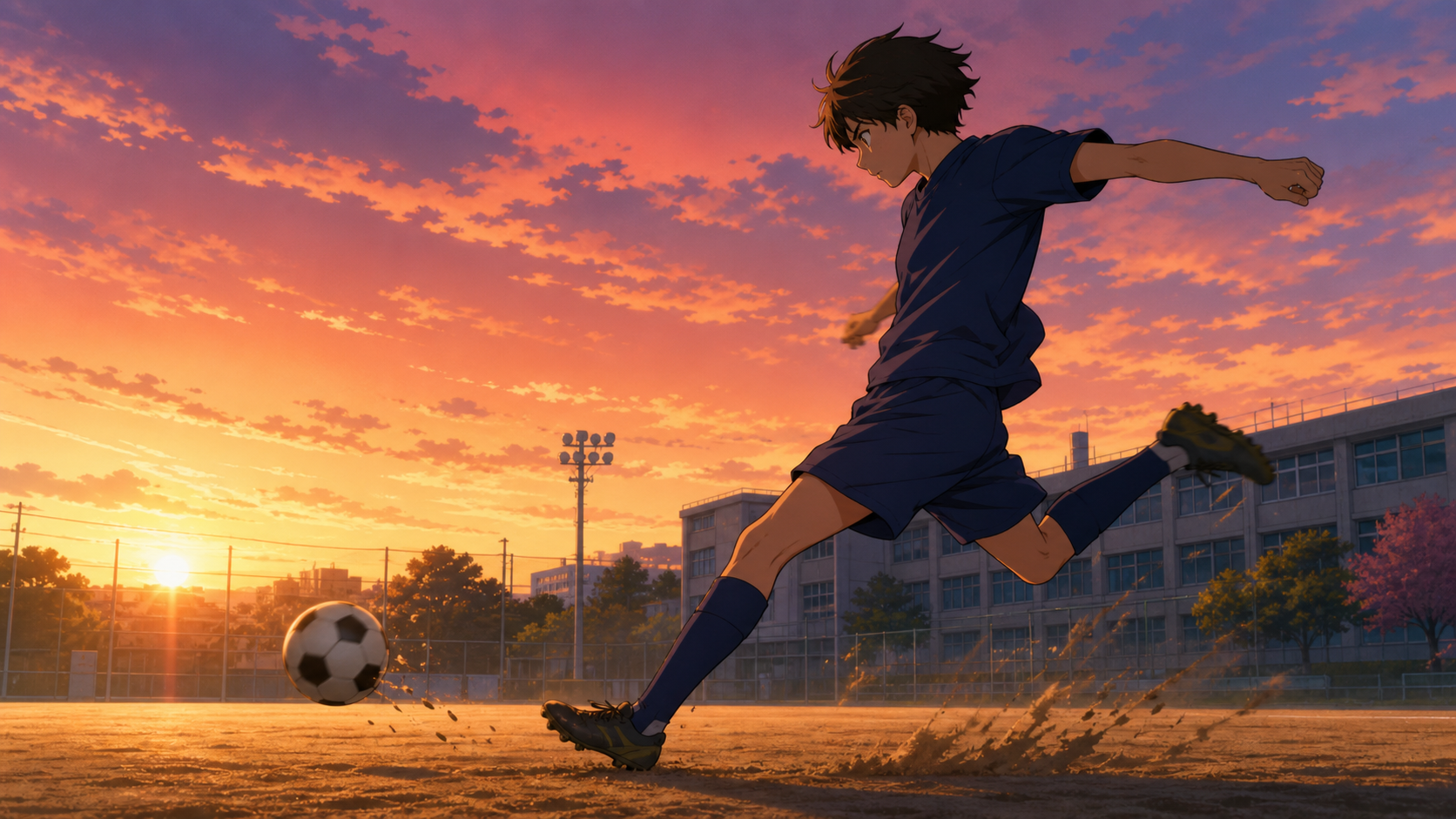
A few decades ago, football was not very popular among the Japanese. The 2002 World Cup, the first held in Asia and co-hosted by Japan and South Korea, helped change that. Football now sits among the country's most popular sports, with a professional league and a national team that expects to compete.
Much of the interest also comes from numerous works, both manga and anime, that portray football. Captain Tsubasa arrived in 1981 with a boy who dreamed of winning the World Cup, and its success inspired a generation of players and a long line of football stories. Players such as Hidetoshi Nakata, Zinedine Zidane and Fernando Torres have cited the series as an influence.
In Japanese, football is sakkā, a word derived from the English "soccer". Localized titles also matter. In Brazil, Captain Tsubasa aired as Super Campeões, and Inazuma Eleven became Super Onze. Many readers met the genre through those dubs, which explains why some character names change from one version to another.
Contents 8
Captain Tsubasa (1983): the series that defined the genre
The anime tells the story of Tsubasa Ozora, a boy who is passionate about football. After moving to a new city, he finds new friends and a world of competitions in the sport.
His main dream is to represent Japan at the FIFA World Cup. So he trains hard and overcomes many challenges on his journey, always striving to improve his strength and skills.
The series is somewhat fantastical in the way it depicts football. But it also deals with relationships between friends, rivals, training, competitions, and the progress of the games.
Tsubasa leaves Japan to play in Brazil and later in Europe, a path that mirrors the careers of several real players. The original 1983 anime ran for 128 episodes, and a 2018 remake introduced the story to a new audience. In Brazil, the series is still known as Super Campeões.

Giant Killing (2010): football from the bench
This anime tells the story of Tatsumi Takeshi, a famous former player who now becomes a football coach. His goal is to pull East Tokyo United out of the bottom of the table.
The story follows Tatsumi and the players, fans, management and administration of the club, showing how a football club works away from the pitch. Matches are built around tactical decisions and the mood of the squad. It is the adult counterpoint to Captain Tsubasa.
The anime adaptation aired in 2010, based on the manga by Masaya Tsunamoto and Tsujitomo, which has been serialized since 2007.
Inazuma Eleven (2008): football as a video game
Inazuma Eleven began as a game series from Level-5 and grew into one of the most recognizable football franchises in Japan. In this anime, we meet Mamoru Endou (in Brazil Satoru Endou), a young and talented goalkeeper of a school team. Even with so much talent, his school does not have a competitive football team. But everything changes when a new and skilled student moves to Endou's school.
Then the goalkeeper goes in search of new players to boost the team. The matches are very fantastical, with players full of powers and various skills, a lot of action, and stadiums that become true battle arenas. The stakes rise from school tournaments to national and international competitions.
The first anime series ran from 2008 to 2011 and helped bring the franchise to a younger audience. If you want football treated as a spectacle, this is one of the most energetic entries in the genre.

Area no Kishi (2012): brotherhood and a second chance
Kakeru Aizawa is the younger brother of the number 10 of Japan's U-15 national team. Kakeru is somewhat skeptical about being a player, so much so that he is only an assistant for his brother's school team.
A serious accident changes everything. Suguru dies, and his heart is transplanted into Kakeru. The operation gives Kakeru a physical second chance, and he decides to pursue the dream his brother could not finish. The story follows him from a supporting role to a place on the pitch.
The anime aired in 2012, with 37 episodes. It is based on the manga written by Hiroaki Igano and illustrated by Kaya Tsukiyama.
Days (2016): the player who refuses to quit
The series shows the development of Tsukushi Tsukamoto, a shy and awkward teenager who is not very skilled at football. One day, after some events, he proves to be very hardworking and dedicated, despite his lack of skill in the sport.
His friend Jin, considered a genius in football, sees Tsukushi's dedication and invites him to join the team. Tsukushi, despite being fragile, weak, and awkward, shows great willingness, which helps the team work together, even if it seems difficult.
The manga ran from 2013 to 2021 and won the Kodansha Manga Award for shōnen in 2016. MAPPA produced the 24-episode anime in 2016.

Blue Lock (2022): the striker as a competitor
Blue Lock starts with a different premise. After Japan's disappointing performance at the 2018 World Cup, the Japan Football Union creates a training program for 300 young forwards. The goal is to produce one striker with the ego and scoring instinct to lead the national team.
Yoichi Isagi, a high school player without a clear position, enters the program and discovers that survival depends on reading the field faster than everyone else. The series treats teamwork as a contest for survival, with competition inside the squad. Every pass and every shot becomes a test of who deserves to stay.
The manga began in 2018 and the anime arrived in 2022. Blue Lock has become one of the most popular football anime of the decade, and its focus on individual psychology gives the genre a new tone.
Ao Ashi (2022): the tactical side of the game
Ao Ashi follows Ashito Aoi, a talented but difficult player from a small town. A youth coach spots him and invites him to try out for the Tokyo Esperion academy, where he has to learn how to play within a system.
The series is built around positioning, awareness and decision-making. Ashito's growth comes from understanding space and reading the game, and his progress is measured by the quality of his decisions. For viewers who want to see how a young player learns to read a match, Ao Ashi is the most detailed football anime of the modern era.
The anime aired in 2022, and the manga finished in 2025 after ten years of serialization. It is a good companion to Blue Lock: one series treats football as a mental duel, the other as a puzzle of space and movement.
Other football anime worth watching
These series fill in the rest of the genre, from childhood football to high school dramas.
- Whistle! (2002) follows Sho Kazamatsuri, a small midfielder who transfers schools to chase a place on a stronger team.
- Ginga e Kickoff!! (2012) is about a boy rebuilding a disbanded youth team.
- Aoki Densetsu Shoot! (1993) follows three friends who reunite in high school to play with their idol.
- Hungry Heart: Wild Striker (2002) centers on Kyosuke Kano, a player who steps out of the shadow of his professional brother.
- Ganbare, Kickers! (1986) follows Kakeru Daichi, a new striker who joins a losing elementary school team.
- Keppeki Danshi! Aoyama-kun (2017) is a comedy about a brilliant player who is obsessed with cleanliness.
- Farewell, My Dear Cramer (2021) follows Nozomi Onda and her high school teammates as they chase a national title.
Four decades separate Captain Tsubasa's 1983 anime from Blue Lock, and the genre has moved from heroic shots to psychological pressure and tactical detail. The starting point stays the same: a player who wants a place on the team. Begin with the era that matches your taste, then move forward or back through the list.
That arc of improvement also runs through other inspirational anime, with football adding a scoreboard and a season to share.



Community
Comments
0 comments
There are no published comments in this language yet.
Send comment