
Japanese is often introduced through the neat, polished version you hear in textbooks, news broadcasts, and language apps. Once you travel outside Tokyo, listen to local comedians, or spend time with families from different regions, that image cracks open very quickly. Japan has a dense patchwork of regional speech varieties known as hōgen (方言), and they can differ in rhythm, vocabulary, grammar, and emotional tone.
That does not mean every region speaks a completely separate language, nor does it mean every dialect is just a funny accent. The interesting part is somewhere in between: some varieties are close enough that you mainly notice the melody and a few expressions, while others feel distant enough that even native speakers from other prefectures need a moment to catch up.
Contents 13
What hōgen means in practice
In everyday Japanese, hōgen is the word people use for regional dialects. It covers the familiar speech habits tied to place: how someone from Osaka jokes, how someone from Fukuoka shortens a sentence, or how northern speech can sound softer or harder to outsiders depending on the area. Geography mattered a lot here. Mountains, islands, old domain borders, and long stretches of local life allowed speech to evolve in parallel instead of staying perfectly uniform.
That is why dialects are not just collections of slang words. They carry local history. A dialect can preserve old grammar, keep a different pitch pattern, or hold onto expressions that instantly reveal where a speaker grew up. For many Japanese people, dialect is part of identity in the same way food, festivals, and hometown habits are.
Main groups of Japanese dialects
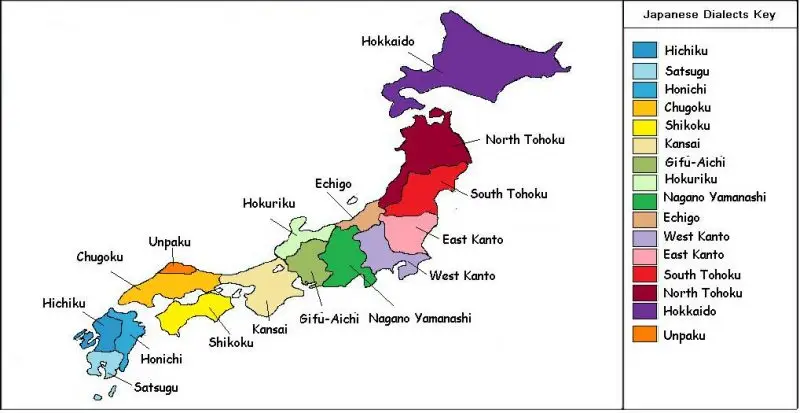
Linguists use finer classifications, but for a reader trying to make sense of the landscape, a broad split helps first. One widely used overview starts with eastern and western groupings, then treats some other varieties as especially distinct.
Eastern Japanese
This side includes the Tokyo area, much of Tōhoku, and Hokkaido. Because standard Japanese is based on Tokyo speech, eastern dialects can feel more familiar to learners at first glance. Even so, that familiarity has limits. Tōhoku speech, for example, is famous for pronunciations and local wording that can sound opaque to outsiders, while Hokkaido has its own expressions shaped by migration from other parts of Japan.
Western Japanese
Western varieties include the speech of Kansai, Chūgoku, Shikoku, and nearby areas. This is where many learners first notice obvious differences from textbook Japanese. Sentence endings shift, negatives can shorten, and the overall cadence often feels more animated. Kansai speech in particular is so culturally visible that many people abroad recognize it before they understand what makes it different.
Kyushu and other distant varieties
Kyushu dialects are often discussed as their own large cluster because several of them move quite far from standard Japanese in both sound and grammar. On top of that, NINJAL and other linguistic research also point out that some speech forms often lumped together with “dialects” in casual conversation are much more distant. Hachijō and the Ryukyuan languages are important examples: they belong to the Japonic family, but they are not simply Tokyo Japanese with a few local quirks.
Famous dialects readers usually notice first
You do not need to memorize dozens of prefectural labels to start hearing the pattern. A few famous varieties already show how wide the range can be.
Kansai-ben
Kansai-ben is probably the best-known dialect group outside Japan. It is associated with Osaka, Kyoto, Kobe, and neighboring areas, but those cities do not all sound identical. What many learners notice first are endings like ya instead of da, the use of oru where standard Japanese would use iru, and highly recognizable words such as akan. It also carries a strong cultural image because of comedy, television, and the region’s public speaking style.
If you want a closer look at that side of Japanese, our guide to Kansai-ben in Kyoto and Osaka goes deeper into the speech patterns people most often hear there.
Tohoku-ben
Tōhoku dialects have a reputation for being harder for outsiders to understand, especially when spoken quickly by older locals. That reputation is not just a stereotype pulled from nowhere. Some varieties in the region blur sounds that standard Japanese keeps more distinct, and local vocabulary can add another layer of difficulty. At the same time, reducing Tōhoku speech to “hard to understand” misses the point. What makes it interesting is precisely that it preserves a different rhythm and local identity instead of flattening everything toward the capital.
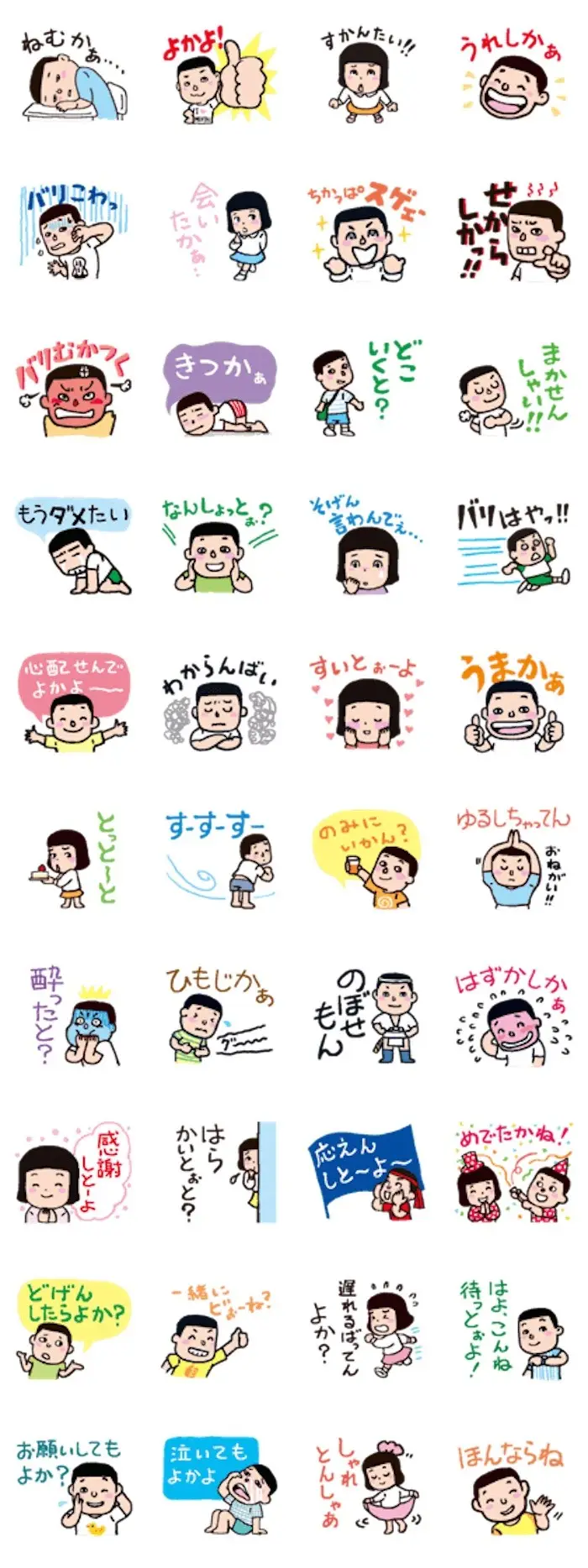
Hakata-ben and Kyushu speech
In Fukuoka and surrounding areas, readers often notice Kyushu speech through Hakata-ben. The sentence flow can feel shorter and more direct, and some endings stand out immediately once you know what to listen for. It is a good example of how a dialect can sound warm, local, and very different without becoming impossible to follow.
We also have a focused article on Hakata-ben in Fukuoka if you want concrete examples from Kyushu.
How dialects differ from standard Japanese
Most differences fall into a few practical categories, and once you know them, dialects stop sounding like random noise.
- Pitch and rhythm: the musical pattern of a sentence can change enough to make familiar words feel new.
- Verb and adjective endings: a standard form may become shorter, older, or simply different in another region.
- Particles and sentence endings: small words at the end of a phrase often reveal where the speaker is from.
- Local vocabulary: common daily words may switch entirely, even when the grammar stays recognizable.
This is why dialect study is useful even for readers who are not trying to speak every variety. It teaches you to hear structure instead of only memorizing isolated words. Once that clicks, you can watch a drama, variety show, or travel interview and notice what is happening instead of assuming “they are speaking too fast.”
Why dialects still matter in modern Japan
Standard Japanese dominates school, national media, and communication across regions, so it is easy to assume dialects are fading into decoration. The reality is more complicated. Some dialects are under pressure, especially in communities shaped by migration, aging populations, or strong pressure toward standardization. At the same time, regional speech remains socially alive. People switch into dialect with family, use it for humor, keep it in music and local media, and treat it as a marker of home.
That is also why the subject matters beyond language trivia. When a dialect weakens, a region does not lose only a few colorful expressions. It can lose old ways of framing experience, local storytelling habits, and distinctions that never fit neatly into standard Japanese. NINJAL explicitly treats many traditional dialects as part of Japan’s endangered linguistic heritage for that reason.
A better way to approach Japanese dialects
If you are learning Japanese, the smartest approach is not to collect dialect phrases like souvenirs. Start with standard Japanese so you have a stable base, then learn to recognize what changes from region to region. Notice whether a speaker is changing endings, shifting pitch, or using a local word you would not hear in Tokyo. That habit gets you further than trying to imitate five dialects at once.
For readers interested mainly in culture, dialects are one of the fastest ways to feel that Japan is not linguistically flat. A joke from Osaka, a rural voice from Tōhoku, or a sentence from Fukuoka can tell you something about place long before a history book does. That is what makes hōgen worth paying attention to: it is living regional character carried in speech.






Community
Comments
0 comments
There are no published comments in this language yet.
Send comment